Comparison of Signals from Gravitational Wave Detectors with Instantaneous Time-Frequency Maps
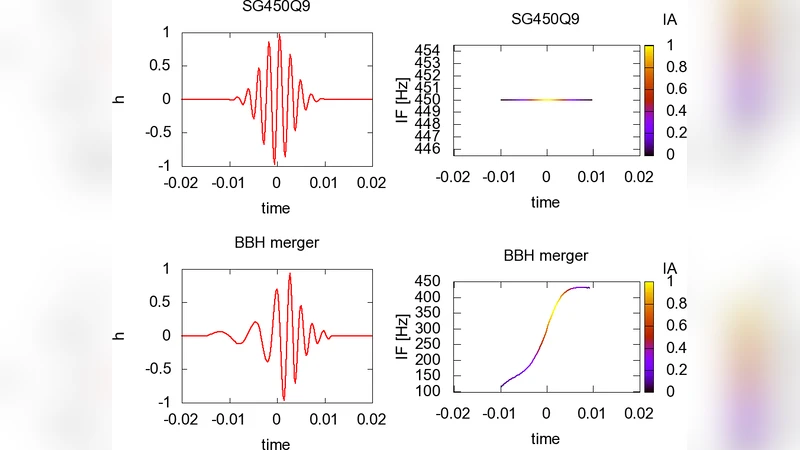
Gravitational wave astronomy relies on the use of multiple detectors, so that coincident detections may distinguish real signals from instrumental artifacts, and also so that relative timing of signals can provide the sky position of sources. We show that the comparison of instantaneous time-frequency and time- amplitude maps provided by the Hilbert-Huang Transform (HHT) can be used effectively for relative signal timing of common signals, to discriminate between the case of identical coincident signals and random noise coincidences, and to provide a classification of signals based on their time-frequency trajectories. The comparison is done with a chi-square goodness-of-fit method which includes contributions from both the instantaneous amplitude and frequency components of the HHT to match two signals in the time domain. This approach naturally allows the analysis of waveforms with strong frequency modulation.
💡 Research Summary
This paper presents a novel methodology for comparing gravitational‑wave (GW) signals recorded by multiple detectors using the Hilbert‑Huang Transform (HHT). The authors exploit the instantaneous frequency (IF) and instantaneous amplitude (IA) maps generated by HHT to construct a χ² goodness‑of‑fit statistic that simultaneously incorporates uncertainties in both IF and IA. The approach serves three main purposes: (1) precise relative timing of coincident GW signals, (2) vetoing of accidental noise coincidences that produce similar but not identical waveforms, and (3) classification of instrumental transients (“glitches”) based on their time‑frequency‑amplitude morphology.
Key technical contributions include:
- Improved Empirical Mode Decomposition (EMD) – The authors address sampling‑induced errors in locating extrema by interpolating around extrema with cubic splines and analytically solving for true extrema positions. This reduces artificial modulation in the extracted Intrinsic Mode Functions (IMFs). They also apply a low‑pass filter at twice the estimated maximum Fourier frequency to ensure the first IMF captures the full signal bandwidth.
- Error Modeling for IF and IA – By injecting a diverse set of simulated waveforms (sine‑Gaussians, binary‑black‑hole (BBH) mergers, white‑noise bursts) into Gaussian noise with signal‑to‑noise ratios (SNR) ranging from 1 to 30, they empirically derive the relationship between the local SNR (IA/σ) and the fractional uncertainties σ_IA and σ_IF. In log‑log space these follow power‑law relations: log₁₀(σ_IA) ≈ –1.12·log₁₀(IA/σ) – 0.52 and log₁₀(σ_IF) ≈ –0.60·log₁₀(IA/σ) – 0.28. The uncertainties are approximately Gaussian, with modest non‑Gaussian tails at high IA/σ.
- χ² Statistic Incorporating Both IF and IA – The reduced χ² is defined as
χ²₁,₂ = (1/2N) Σ_n
Comments & Academic Discussion
Loading comments...
Leave a Comment