Estimating the significance of a signal in a multi-dimensional search
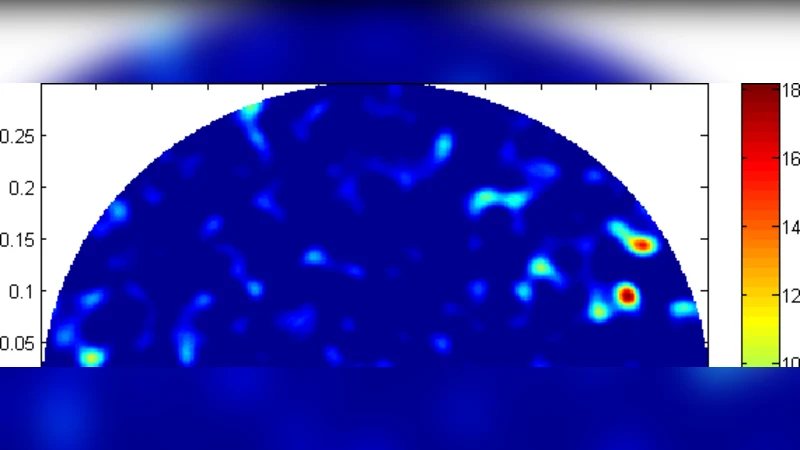
In experiments that are aimed at detecting astrophysical sources such as neutrino telescopes, one usually performs a search over a continuous parameter space (e.g. the angular coordinates of the sky, and possibly time), looking for the most significant deviation from the background hypothesis. Such a procedure inherently involves a “look elsewhere effect”, namely, the possibility for a signal-like fluctuation to appear anywhere within the search range. Correctly estimating the $p$-value of a given observation thus requires repeated simulations of the entire search, a procedure that may be prohibitively expansive in terms of CPU resources. Recent results from the theory of random fields provide powerful tools which may be used to alleviate this difficulty, in a wide range of applications. We review those results and discuss their implementation, with a detailed example applied for neutrino point source analysis in the IceCube experiment.
💡 Research Summary
The paper addresses a fundamental statistical challenge in astrophysical searches, namely the “look‑elsewhere effect” that arises when a signal is sought over a continuous, multi‑dimensional parameter space (e.g., sky coordinates, time). Traditional methods rely on Wilks’ theorem to obtain asymptotic p‑values, but this theorem fails when nuisance parameters (such as source location) exist only under the alternative hypothesis. Consequently, the only reliable way to assess significance has been to perform exhaustive Monte‑Carlo simulations of the entire search, which can require on the order of 10⁷ pseudo‑experiments to reach a 5σ discovery threshold—an impractically large computational burden.
The authors propose a solution based on random‑field theory, specifically the use of the Euler characteristic (EC) of excursion sets. They formulate the test statistic as the profile likelihood ratio q(θ) = –2 log Λ(θ) evaluated at each point θ of the D‑dimensional manifold M (the search space). Under the null hypothesis, q(θ) follows a χ² distribution with one degree of freedom, making q a χ²‑random field. The p‑value of an observed maximum is the probability that the field exceeds a threshold u somewhere on M: p = P
Comments & Academic Discussion
Loading comments...
Leave a Comment