Coarse Graining the Dynamics of Heterogeneous Oscillators in Networks with Spectral Gaps
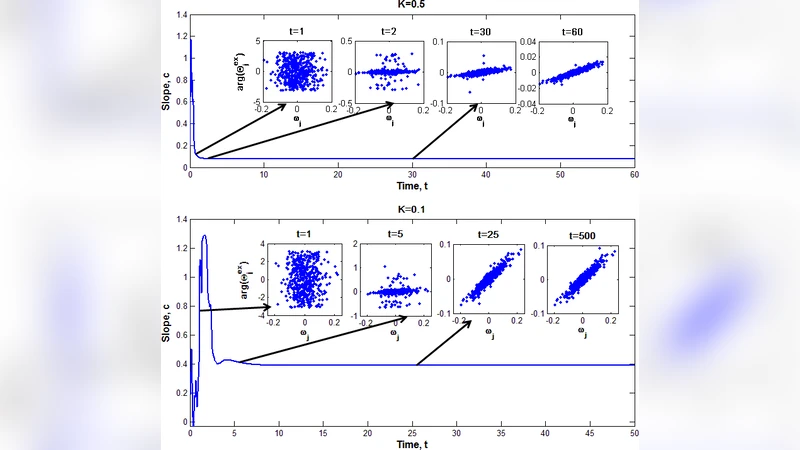
We present a computer-assisted approach to coarse-graining the evolutionary dynamics of a system of nonidentical oscillators coupled through a (fixed) network structure. The existence of a spectral gap for the coupling network graph Laplacian suggests that the graph dynamics may quickly become low-dimensional. Our first choice of coarse variables consists of the components of the oscillator states -their (complex) phase angles- along the leading eigenvectors of this Laplacian. We then use the equation-free framework [1], circumventing the derivation of explicit coarse-grained equations, to perform computational tasks such as coarse projective integration, coarse fixed point and coarse limit cycle computations. In a second step, we explore an approach to incorporating oscillator heterogeneity in the coarse-graining process. The approach is based on the observation of fastdeveloping correlations between oscillator state and oscillator intrinsic properties, and establishes a connection with tools developed in the context of uncertainty quantification.
💡 Research Summary
The paper addresses the challenge of reducing the high‑dimensional dynamics of heterogeneous Kuramoto oscillators coupled through a fixed network that exhibits a spectral gap in its graph Laplacian. The authors first construct a synthetic network composed of ten densely connected communities (500 nodes total) using the Watts‑Strogatz model, and they demonstrate that the normalized Laplacian possesses a clear gap after the tenth eigenvalue. This gap implies that the first ten eigenvectors capture the slow manifold of the system. By projecting the complex phase vector onto these eigenvectors, the full 500‑dimensional state can be approximated with only ten coarse variables, dramatically reducing dimensionality while preserving the essential community‑level structure.
To handle intrinsic frequency heterogeneity, the authors observe a rapid linear correlation between each oscillator’s natural frequency and its phase during transients. They treat the frequencies as random variables and employ a Polynomial Chaos‑type expansion, effectively embedding the heterogeneity into the coarse description. This yields a set of augmented coarse variables that account for both network topology (via Laplacian eigenvectors) and oscillator heterogeneity.
The computational framework employed is “Equation‑Free”: short bursts of detailed simulation (lifting) generate time‑derivative estimates for the coarse variables (restriction), which are then extrapolated over large time steps using projective integration. Fixed points and limit cycles are located directly in the coarse space using Newton‑type solvers and Poincaré maps, respectively.
Two regimes are examined. At strong coupling (K = 0.5) the system quickly synchronizes; coarse‑projective integration reproduces the full simulation with negligible error, and the order parameter converges to a fixed point. At weaker coupling (K = 0.1) a Hopf bifurcation is crossed, leading to sustained limit‑cycle oscillations. The coarse approach accurately captures the periodic orbit and its stability. Moreover, when the variance of the natural frequencies is varied, the inclusion of the uncertainty‑quantification term reduces prediction error, confirming the benefit of incorporating heterogeneity into the coarse variables.
Overall, the study demonstrates that (1) spectral gaps provide a principled basis for selecting low‑dimensional observables, (2) intrinsic heterogeneity can be systematically embedded via stochastic expansions, and (3) the Equation‑Free methodology enables efficient simulation, bifurcation analysis, and control of large heterogeneous oscillator networks. The approach is broadly applicable to neuroscience, power‑grid dynamics, and any complex system where network structure and component variability coexist.
Comments & Academic Discussion
Loading comments...
Leave a Comment