The Boltzmann factor, DNA melting, and Brownian ratchets: Topics in an introductory physics sequence for biology and premedical students
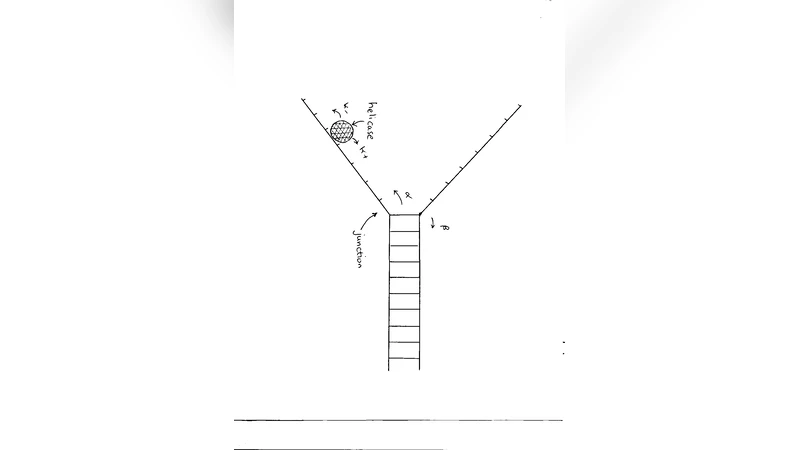
Three, interrelated biologically-relevant examples of biased random walks are presented: (1) A model for DNA melting, modelled as DNA unzipping, which provides a way to illustrate the role of the Boltzmann factor in a venue well-known to biology and pre-medical students; (2) the activity of helicase motor proteins in unzipping double-stranded DNA, for example, at the replication fork, which is an example of a Brownian ratchet; (3) force generation by actin polymerization, which is another Brownian ratchet, and for which the force and actin-concentration dependence of the velocity of actin polymerization is determined.
💡 Research Summary
The paper presents a pedagogical framework that integrates three biologically relevant examples of biased random walks—DNA melting (unzipping), helicase‑driven DNA unwinding, and actin polymerization—into an introductory physics curriculum aimed at biology and pre‑medical students. The authors argue that traditional physics courses often fail to engage these students because the material appears disconnected from their primary interests. To address this, a new sequence was introduced at Yale in the 2010‑2011 academic year, supplementing the usual mechanics, electromagnetism, and thermodynamics topics with probability, statistical mechanics, and the Boltzmann factor, all illustrated through concrete molecular‑biological processes.
1. DNA Melting as a Chemical Reaction and Random Walk
DNA melting is modeled as a reversible “zipping–unzipping” reaction. A DNA strand with i base pairs can transition to i − 1 (unzipping) with rate β or to i + 1 (zipping) with rate α. At equilibrium, the ratio of forward to backward probabilities follows the Boltzmann factor:
\
Comments & Academic Discussion
Loading comments...
Leave a Comment