Fast Optical and X-ray Variability in the UCXB 4U0614+09
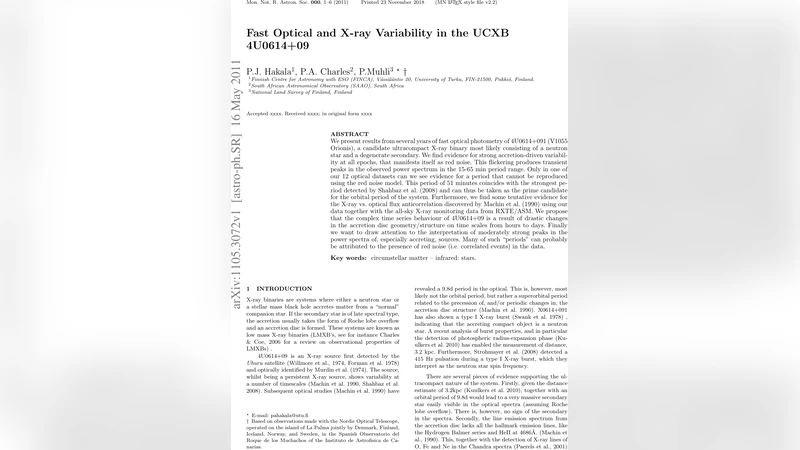
We present results from several years of fast optical photometry of 4U0614+091 (V1055 Orionis), a candidate ultracompact X-ray binary most likely consisting of a neutron star and a degenerate secondary. We find evidence for strong accretion-driven variability at all epochs, that manifests itself as red noise. This flickering produces transient peaks in the observed power spectrum in the 15-65 min period range. Only in one of our 12 optical datasets can we see evidence for a period that cannot be reproduced using the red noise model. This period of 51 minutes coincides with the strongest period detected by Shahbaz et al. (2008) and can thus be taken as the prime candidate for the orbital period of the system. Furthermore, we find some tentative evidence for the X-ray vs. optical flux anticorrelation discovered by Machin et al. (1990) using our data together with the all-sky X-ray monitoring data from RXTE/ASM. We propose that the complex time series behaviour of 4U0614+09 is a result of drastic changes in the accretion disc geometry/structure on time scales from hours to days. Finally we want to draw attention to the interpretation of moderately strong peaks in the power spectra of, especially accreting, sources. Many of such “periods” can probably be attributed to the presence of red noise (i.e. correlated events) in the data.
💡 Research Summary
The paper presents a comprehensive study of the fast optical and X‑ray variability of the ultracompact X‑ray binary candidate 4U 0614+09, using more than a decade of high‑time‑resolution white‑light photometry obtained with the Nordic Optical Telescope (NOT) and archival RXTE/ASM monitoring data. The authors aim to identify the orbital period of the system and to understand the origin of its complex variability.
First, twelve optical light curves spanning 1998–2009 were reduced using differential photometry against a nearby comparison star. Each dataset consists of 2–6 h of continuous observations with a typical cadence of 10–15 s, allowing sensitivity to periods as short as ~40 s. The X‑ray data consist of daily averaged ASM count rates covering the same epochs.
A two‑stage time‑series analysis was performed. In the initial stage, Lomb‑Scargle periodograms were computed for each optical series to locate any periodic signals. However, the authors recognized that standard false‑alarm probabilities assume white, uncorrelated noise, which is inappropriate for accreting systems that often exhibit red (correlated) noise due to stochastic flickering.
To address this, they modeled each light curve with an autoregressive (AR) process. By fitting AR models of increasing order (up to six) and examining the autocorrelation function, they found that a second‑order model, AR(2), adequately captures the correlation structure in virtually all datasets. The AR(2) model has the form Xₜ = α₁Xₜ₋₁ + α₂Xₜ₋₂ + N(σ), where N(σ) is a white‑noise term.
Using the fitted AR(2) parameters, they generated 100 000 synthetic light curves for each real dataset, preserving the original sampling and noise characteristics. Lomb‑Scargle periodograms of these synthetic series were then computed, and the distribution of the highest peak (expressed as relative power with respect to the mean power below 100 min) was used to construct confidence contours at the 95 %, 99 % and 99.9 % levels. The observed periodograms were over‑plotted on these contours to assess the significance of any peaks.
The analysis revealed that only one of the twelve optical datasets (the 2003‑01‑05 observation, labelled dataset #7) contains a peak that exceeds the 99.9 % confidence contour. This peak corresponds to a period of ≈50 min, which matches the strongest periodicity (51.3 min) reported by Shahbaz et al. (2008). All other apparent peaks, including those around 15 min (≈1.1 mHz) that are visually prominent, fall within the 95 % contour and are therefore consistent with red‑noise fluctuations rather than genuine periodicities.
The X‑ray analysis involved correlating the daily ASM count rates with the mean optical magnitudes of each dataset. A modest anti‑correlation (Spearman ρ ≈ ‑0.7) is seen when the two brightest optical points are included, but the correlation disappears when those points are removed, indicating that the apparent relationship is not statistically robust given the limited number of data points and the modest (~15 %) variability of the ASM flux. A short‑term (within a single ASM dwell) examination of the ASM light curve shows a possible 24–25 min flickering period, but red‑noise modeling reduces its significance to the 95 % level, suggesting it may also be a stochastic feature.
The authors interpret the dominant red‑noise behaviour as arising from rapid, stochastic changes in the accretion disc geometry and structure, which can occur on timescales from hours to days in ultracompact systems. The occasional emergence of a coherent ≈50 min signal could reflect a transient disc configuration that momentarily enhances a modulation tied to the binary orbit (e.g., a hot spot or disc precession). The study emphasizes that, in accreting sources, moderate peaks in power spectra are often artifacts of correlated noise, and rigorous statistical treatment—such as the AR‑based Monte Carlo approach employed here—is essential to avoid false period detections.
In conclusion, the paper provides strong evidence that the orbital period of 4U 0614+09 is likely around 51 minutes, based on a single highly significant detection. The majority of the observed variability is consistent with red‑noise flickering driven by disc dynamics, and any X‑ray/optical anti‑correlation remains tentative. The methodology presented offers a valuable template for future timing studies of compact binaries and other variable astrophysical sources.
Comments & Academic Discussion
Loading comments...
Leave a Comment