CASTRO: A New Compressible Astrophysical Solver. II. Gray Radiation Hydrodynamics
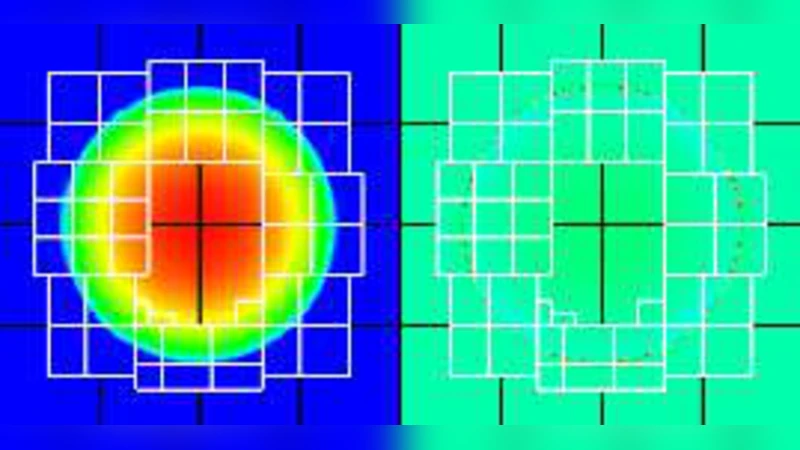
We describe the development of a flux-limited gray radiation solver for the compressible astrophysics code, CASTRO. CASTRO uses an Eulerian grid with block-structured adaptive mesh refinement based on a nested hierarchy of logically-rectangular variable-sized grids with simultaneous refinement in both space and time. The gray radiation solver is based on a mixed-frame formulation of radiation hydrodynamics. In our approach, the system is split into two parts, one part that couples the radiation and fluid in a hyperbolic subsystem, and another parabolic part that evolves radiation diffusion and source-sink terms. The hyperbolic subsystem is solved explicitly with a high-order Godunov scheme, whereas the parabolic part is solved implicitly with a first-order backward Euler method.
💡 Research Summary
This paper presents the development and implementation of a gray radiation‑hydrodynamics module for the compressible astrophysics code CASTRO. The authors adopt a mixed‑frame formulation, treating fluid quantities (density, pressure, temperature) in the laboratory frame while measuring opacities in the comoving frame, and retain terms up to O(v/c). Radiation transport is approximated with flux‑limited diffusion (FLD) using the Levermore‑Pomraning flux limiter, and the radiation pressure tensor is closed via an Eddington factor derived from the same limiter.
The governing equations are split into a hyperbolic subsystem and a parabolic subsystem. The hyperbolic part contains the usual mass, momentum, and total‑energy conservation equations together with a radiation‑pressure gradient term λ∇Er. By assuming the relation 3−f²=λ+1, the Jacobian becomes diagonalizable with four real eigenvalues (u−cs, u, u, u+cs), where the modified sound speed cs includes both gas pressure and radiation contributions. This subsystem is advanced explicitly using a high‑order Godunov method with a piecewise‑parabolic reconstruction (PPM) and an approximate Riemann solver that incorporates the radiation‑modified eigenvectors.
The parabolic subsystem comprises the diffusion term ∇·(cλχ_R∇Er) and the source‑sink term cκ_P(aT⁴−Er). Because these terms are stiff, they are integrated implicitly with a first‑order backward‑Euler scheme. The Lorentz‑transformation term 2λ(κ_P/χ_R)u·∇Er is usually treated explicitly, as it is of the same order as the hyperbolic advection term.
The algorithm proceeds in two stages per time step: (1) an explicit Godunov update of the hyperbolic subsystem, and (2) an implicit solve of the diffusion and source‑sink equations. The method is applied on each AMR level; finer levels use sub‑cycling in time, and fluxes at coarse‑fine interfaces are synchronized to preserve conservation.
A suite of verification tests demonstrates the solver’s accuracy: radiation‑driven shock tubes, radiative diffusion in optically thick/thin regimes, radiation‑pressure dominated expansion, and multi‑dimensional collapse with gravity. Energy conservation, correct wave speeds, and proper flux‑limiter behavior are confirmed. Strong scaling tests show near‑linear performance up to ~10⁴ cores, indicating that the module is suitable for large‑scale astrophysical simulations where radiation plays a dominant role.
In summary, the CASTRO gray radiation‑hydrodynamics solver combines a mixed‑frame FLD approach with a hyperbolic‑parabolic split, delivering a conservative, robust, and highly scalable tool for studying phenomena such as star formation, supernova explosions, and accretion flows where radiative transfer is essential.
Comments & Academic Discussion
Loading comments...
Leave a Comment