Wind modelling of very massive stars up to 300 solar masses
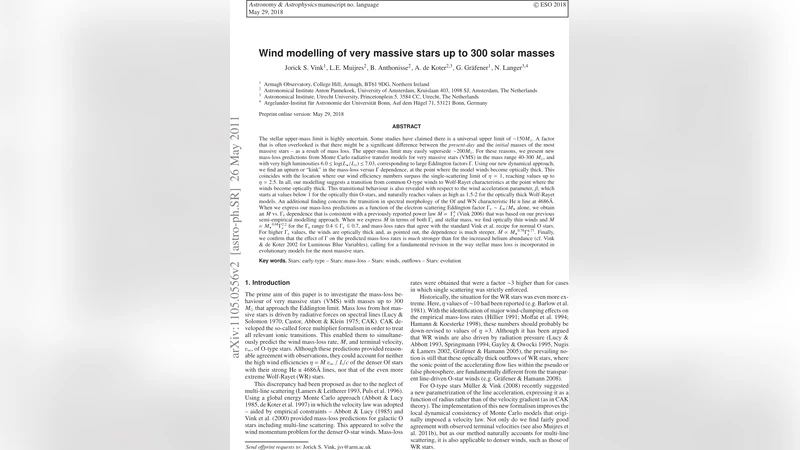
Some studies have claimed a universal stellar upper-mass limit of 150 Msun. A factor that is often overlooked is that there might be a difference between the current and initial masses of the most massive stars, as a result of mass loss. We present Monte Carlo mass-loss predictions for very massive stars in the range 40-300 Msun, with large luminosities and Eddington factors Gamma. Using our new dynamical approach, we find an upturn in the mass-loss vs. Gamma dependence, at the point where the winds become optically thick. This coincides with the location where wind efficiency numbers surpass the single-scattering limit of Eta = 1, reaching values up to Eta = 2.5. Our modelling suggests a transition from common O-type winds to Wolf-Rayet characteristics at the point where the winds become optically thick. This transitional behaviour is also revealed with respect to the wind acceleration parameter beta, which starts at values below 1 for the optically thin O-stars, and naturally reaches values as high as 1.5-2 for the optically thick Wolf-Rayet models. An additional finding concerns the transition in spectral morphology of the Of and WN characteristic He II line at 4686 Angstrom. When we express our mass-loss predictions as a function of the electron scattering Gamma_e (=L/M) only, we obtain a mass-loss Gamma dependence that is consistent with a previously reported power-law Mdot propto Gamma^5 (Vink 2006) that was based on our semi-empirical modelling approach. When we express Mdot in terms of both Gamma and stellar mass, we find Mdot propto M^0.8 Gamma^4.8 for our high Gamma models. Finally, we confirm that the Gamma-effect on the mass-loss predictions is much stronger than that of an increased helium abundance, calling for a fundamental revision in the way mass loss is incorporated in evolutionary models of the most massive stars.
💡 Research Summary
The paper investigates the mass‑loss behaviour of very massive stars (VMS) with masses ranging from 40 to 300 M☉, focusing on how their stellar winds evolve as the stars approach the Eddington limit. Using a Monte Carlo radiative‑transfer code that follows millions of photon packets through a pre‑computed ISA‑wind atmospheric structure, the authors calculate the momentum transfer from radiation to the outflowing gas. Crucially, they employ a new dynamical approach in which the wind velocity law is not imposed a priori; instead, the wind acceleration parameter β and the terminal velocity v∞ are solved self‑consistently together with the mass‑loss rate (Ṁ).
The model grid spans solar metallicity, a fixed effective temperature of 50 000 K, and electron‑scattering Eddington factors Γe from ~0.4 up to ~0.9. Three mass groups are considered (40–70 M☉, 70–120 M☉, 120–300 M☉) to explore how Γe, mass, and luminosity jointly affect wind properties.
Key findings:
-
Γ‑dependent “kink” – When Γe exceeds ≈0.7 the mass‑loss rate shows a sharp upturn. At this transition the wind efficiency η = Ṁ v∞/(L/c) surpasses the single‑scattering limit of 1, reaching values as high as 2.5. This indicates that multi‑line scattering dominates the driving in this regime.
-
Change in wind acceleration (β) – Optically thin O‑type winds have β < 1 (typically 0.7–0.9). Once the wind becomes optically thick, β rises to 1.5–2.0, reflecting a more gradual acceleration and the formation of a pseudo‑photosphere where the sonic point lies beneath the apparent photosphere – a hallmark of Wolf‑Rayet (WR) winds.
-
Spectral signature – The He II λ4686 line, a diagnostic of Of versus WN stars, switches from the weak “Of” profile to a strong WN‑type emission precisely at the Γ‑kink, confirming that the wind optical depth controls the line morphology.
-
Mass‑Γ scaling – For optically thin winds the authors recover the previously reported semi‑empirical relation Ṁ ∝ Γe^5 (Vink 2006). When both mass and Γe are included, the scaling becomes Ṁ ∝ M^0.78 Γe^4.77 for the high‑Γ, optically thick models, and Ṁ ∝ M^0.68 Γe^2.2 for the lower‑Γ, thin‑wind regime. Thus Γ exerts a far stronger influence than the modest increase in helium abundance explored in earlier work.
-
Implications for the upper‑mass limit – Because mass loss escalates dramatically near the Eddington limit, a star born with an initial mass well above 150 M☉ can shed a large fraction of its mass during the main‑sequence phase, potentially reconciling observations of apparently “over‑massive” objects (e.g., in the Arches cluster) with a lower true initial mass limit.
The authors argue that current stellar‑evolution codes, which largely rely on the Vink et al. (2000) prescription, underestimate mass loss for stars with Γe > 0.7 and therefore need to incorporate the new Γ‑ and mass‑dependent relations derived here. The work also highlights that rotation and wind clumping, while not included in the present models, could further modify the mass‑loss rates, especially for stars already close to the Eddington limit.
Overall, the paper provides the first self‑consistent, dynamical Monte Carlo demonstration that VMS winds undergo a transition from optically thin, line‑driven O‑type outflows to optically thick, WR‑like winds as they approach the Eddington limit, with profound consequences for the evolution, final fates, and feedback of the most massive stars.
Comments & Academic Discussion
Loading comments...
Leave a Comment