One-cut solution of the $beta$-ensembles in the Zhukovsky variable
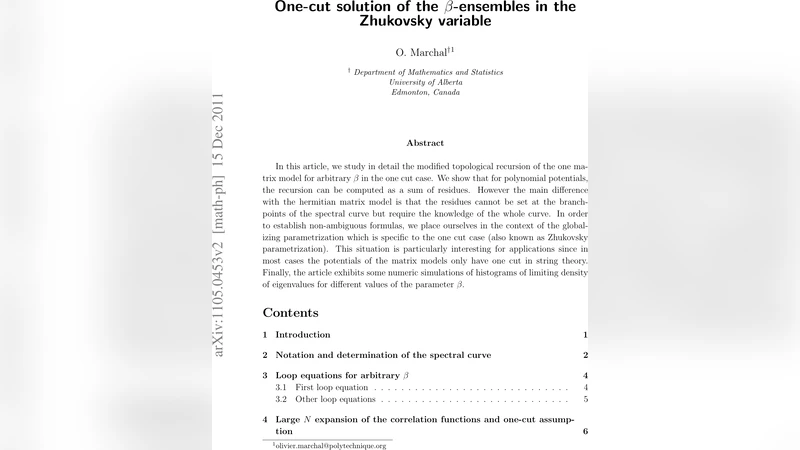
In this article, we study in detail the modified topological recursion of the one matrix model for arbitrary $\beta$ in the one cut case. We show that for polynomial potentials, the recursion can be computed as a sum of residues. However the main difference with the hermitian matrix model is that the residues cannot be set at the branchpoints of the spectral curve but require the knowledge of the whole curve. In order to establish non-ambiguous formulas, we place ourselves in the context of the globalizing parametrization which is specific to the one cut case (also known as Zhukovsky parametrization). This situation is particularly interesting for applications since in most cases the potentials of the matrix models only have one cut in string theory. Finally, the article exhibits some numeric simulations of histograms of limiting density of eigenvalues for different values of the parameter $\beta$.
💡 Research Summary
This paper presents a detailed study of the modified topological recursion for β‑ensembles in the one‑cut regime, using the global Zhukovsky (or Joukowski) parametrization. Starting from the definition of the β‑ensemble matrix integral with a polynomial potential of degree four, the authors derive the full set of loop equations for arbitrary β. Unlike the Hermitian case (β = 1), these equations contain a derivative term proportional to γ = β − 1/β, and the natural expansion parameter becomes τ = √β t₀ N. The correlation functions Wₙ(x₁,…,xₙ) are expanded simultaneously in powers of τ² and γ, leading to a double series where only finitely many γ‑powers appear at each order.
Assuming a one‑cut solution, the spectral curve is written as y² = U(x) = V′(x)²/4 − P₀(x) and is parametrized globally by the Zhukovsky variable z via x(z)=½(a+b)+(b−a)/4·(z+1/z). This mapping eliminates the need to place residues at the branch points; instead, residues are taken at the global poles of the curve (z = ±1, 0, ∞). A kernel K(z₁,z) is defined, and the refined loop equations are rewritten as a recursion: \
Comments & Academic Discussion
Loading comments...
Leave a Comment