Searching for the 511 keV annihilation line from galactic compact objects with the IBIS gamma ray telescope
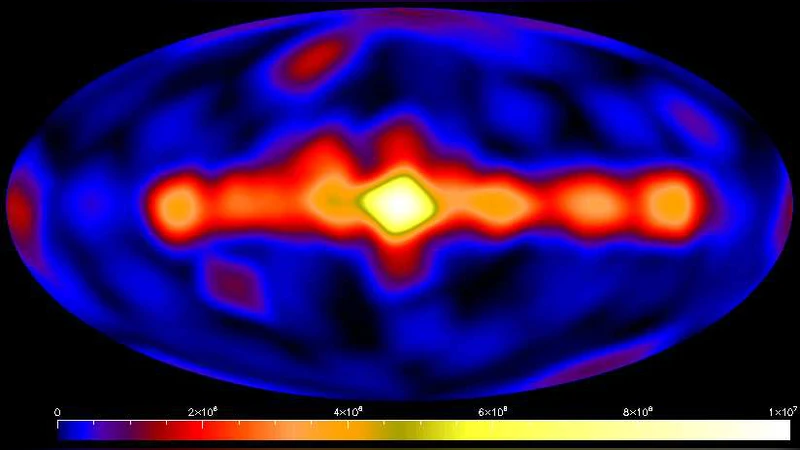
The first detection of a gamma ray line with an energy of about 500 keV from the center our Galaxy dates back to the early seventies. Thanks to the astrophysical application of high spectral resolution detectors, it was soon clear that this radiation was due to the 511 keV photons generated by electron-positron annihilation. Even though the physical process are known, the astrophysical origin of this radiation is still a mystery. The spectrometer SPI aboard the INTEGRAL gamma-ray satellite has been used to produce the first all-sky map in light of the 511 keV annihilation, but no direct evidence for 511 keV galactic compact objects has been found […] We present the first deep IBIS 511 keV all-sky map, obtained by applying standard analysis to about 5 years of data. Possible 511 keV signals are also searched over hour-day-month timescales. The IBIS sensitivity at 511 keV depends on the detector quantum efficiency at this energy and on the background. Both these quantities were estimated in this work. We find no evidence of Galactic 511 keV point sources. With an exposure of 10 Ms in the center of the Galaxy, we estimate a $1.6 \times 10^{-4},ph,cm^{-2},s^{-1}$ flux 2 sigma upper limit. A similar limit is given in a wide area in the Galactic center region with similar exposures. The IBIS 511 keV flux upper limits for microquasars and supernova remnants detected in the hard X domain ($E > 20, keV$) are also reported. Our results are consistent with a diffuse $e^{+}e^{-}$ annihilation scenario. If positrons are generated in compact objects, we expect that a significant fraction of them propagate in the interstellar medium before there are annihilated away from their birth places.
💡 Research Summary
The paper addresses the long‑standing question of whether the bright 511 keV electron‑positron annihilation line observed toward the Galactic centre originates from a few discrete compact sources (e.g., X‑ray binaries, supernova remnants) or from a truly diffuse distribution of positrons that annihilate after propagating through the interstellar medium. To investigate this, the authors exploit the INTEGRAL satellite’s IBIS imager, which offers a fine angular resolution (~12′) and a large field of view, making it uniquely suited to search for point‑like 511 keV emission.
Data set and reduction
All publicly available IBIS observations from launch (Oct 2002) to April 2008 were gathered, together with the Core Programme data, amounting to 39 413 science windows (each ~2000 s) and a total exposure of ~80 Ms. After filtering out periods affected by strong background (solar flares, radiation belts), the final exposure map peaks at ~10 Ms in the Galactic centre, exactly where the bulk of the annihilation signal measured by SPI is located. Standard OSA 7.0 analysis pipelines (Goldwurm et al. 2003) were used for image reconstruction, with the coded‑mask deconvolution providing sky images in the 511 keV band.
Monte‑Carlo modelling of the detector response
Because the IBIS sensitivity at 511 keV depends critically on the detector quantum efficiency and on the instrumental background, the authors built a detailed GEANT4‑based Monte‑Carlo model of the entire IBIS mass, calibrated against ground and in‑flight data. By simulating a mono‑energetic 511 keV parallel beam, they derived an effective area of 54.2 ± 0.2 cm². The mask transparency at this energy is t₁≈ 90 % for open elements and t₀≈ 3 % for closed ones; with the mask‑to‑detector pixel size ratio (d/m≈ 0.41) the imaging efficiency evaluates to ≈ 0.75. These numbers feed directly into the signal‑to‑noise calculation.
Background characterisation
The dominant background arises from cosmic‑ray interactions with the spacecraft and from solar activity. The authors show that the 511 keV background count rate fluctuates with the 3‑day INTEGRAL orbit and with the solar cycle, averaging ~10 counts s⁻¹ in a 1 FWHM energy bin centred on 511 keV. Periods of enhanced background (solar flares) were excluded from the analysis.
Sensitivity and upper limits
Using the standard Poissonian variance for coded‑mask imaging, the 2σ detection threshold for a source is S = 2 √(B/T). With the deepest exposure (10 Ms) and the measured background, the resulting 2σ flux upper limit for any point source at 511 keV is 1.6 × 10⁻⁴ ph cm⁻² s⁻¹. This limit is a factor of ~6 below the total flux measured by SPI (≈ 10⁻³ ph cm⁻² s⁻¹) in the same region, implying that the SPI signal cannot be dominated by a handful of bright point sources.
Targeted source constraints
The authors also examined a catalogue of hard X‑ray sources (E > 20 keV) detected by IBIS, including microquasars and supernova remnants. For each, they derived individual 511 keV upper limits, all of order 10⁻⁴ ph cm⁻² s⁻¹, again consistent with the diffuse‑annihilation picture.
Interpretation and implications
The non‑detection of any 511 keV point source, despite IBIS’s adequate sensitivity, supports scenarios where positrons are generated in compact objects but then travel significant distances (kpc scales) before thermalising and annihilating. This is compatible with the high positronium fraction (≈ 97 %) and narrow line width (≈ 3 keV) measured by SPI, which indicate annihilation in a warm, mildly ionised medium rather than in the immediate vicinity of the sources. The paper discusses several astrophysical candidates (LMXBs, supernovae, dark‑matter annihilation) and highlights that transport mechanisms—e.g., diffusion along Galactic magnetic fields—are required to reconcile the observed bulge‑dominated morphology with the spatial distribution of potential sources.
Future prospects
The authors conclude that deeper exposures with IBIS are unlikely to reveal point sources unless the fluxes are an order of magnitude higher than current limits. They advocate for next‑generation MeV‑range missions with superior energy resolution and larger effective area (e.g., e‑ASTROGAM, AMEGO) to map the diffuse annihilation component in greater detail and to possibly detect faint, transient 511 keV line episodes.
In summary, the comprehensive IBIS analysis presented here places stringent upper limits on 511 keV emission from known compact objects, reinforces the view that Galactic positron annihilation is predominantly diffuse, and sets the stage for future high‑sensitivity MeV gamma‑ray observations.
Comments & Academic Discussion
Loading comments...
Leave a Comment