Discovery and evolution of the new black hole candidate Swift J1539.2-6227 during its 2008 outburst
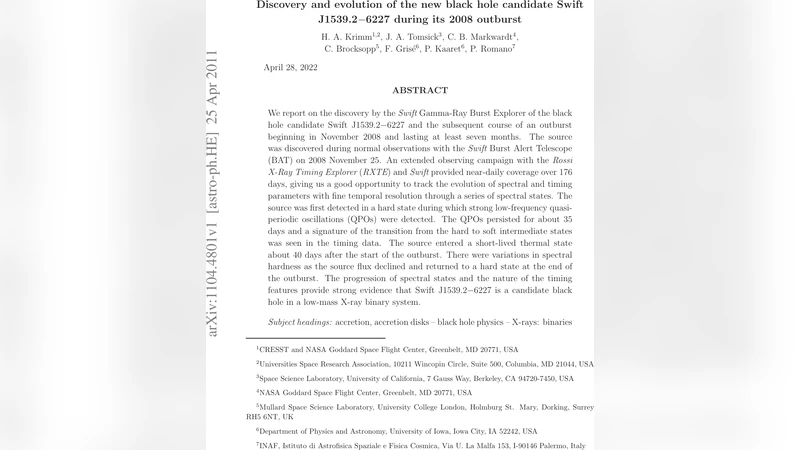
We report on the discovery by the Swift Gamma-Ray Burst Explorer of the black hole candidate Swift J1539.2-6227 and the subsequent course of an outburst beginning in November 2008 and lasting at least seven months. The source was discovered during normal observations with the Swift Burst Alert Telescope (BAT) on 2008 November 25. An extended observing campaign with the Rossi X-Ray Timing Explorer (RXTE) and Swift provided near-daily coverage over 176 days, giving us a good opportunity to track the evolution of spectral and timing parameters with fine temporal resolution through a series of spectral states. The source was first detected in a hard state during which strong low-frequency quasi-periodic oscillations (QPOs) were detected. The QPOs persisted for about 35 days and a signature of the transition from the hard to soft intermediate states was seen in the timing data. The source entered a short-lived thermal state about 40 days after the start of the outburst. There were variations in spectral hardness as the source flux declined and returned to a hard state at the end of the outburst. The progression of spectral states and the nature of the timing features provide strong evidence that Swift J1539.2-6227 is a candidate black hole in a low-mass X-ray binary system.
💡 Research Summary
The transient Swift J1539‑6227 was first detected by the Swift Burst Alert Telescope (BAT) on 2008 November 24 as a 5‑sigma hard X‑ray excess. Prompt follow‑up with the Rossi X‑ray Timing Explorer (RXTE) and Swift provided near‑daily coverage for 176 days, yielding a uniquely dense data set that captures the full evolution of the outburst. The campaign comprised 159 RXTE pointings (PCA and HEXTE) and six Swift pointed observations (XRT and UVOT).
In the first ∼30 days the source remained in a canonical hard state, characterized by a power‑law photon index Γ≈1.5, a high hardness ratio (HR≈0.8), and strong broadband variability (rms≈30 %). Low‑frequency quasi‑periodic oscillations (QPOs) were present throughout this interval, with centroid frequencies drifting from ≈0.2 Hz to ≈5 Hz, quality factors Q≈5–10 and rms amplitudes decreasing from ≈15 % to ≈10 % as the outburst progressed. This behavior matches the type‑C QPOs seen in many black‑hole transients and signals a relatively stable inner accretion flow.
Around MJD 54810 (≈35 days after discovery) the source entered a hard‑intermediate state. The hardness ratio fell sharply, the power‑law softened to Γ≈2.0, and a thermal disk component (diskbb) emerged with an inner‑disk temperature kT≈0.6 keV and increasing normalization, indicating that the disk moved inward. The QPOs persisted but with higher frequencies and lower rms, consistent with the gradual transition of the corona.
Approximately 40 days after the outburst onset (MJD 54830) the source briefly entered a thermal (soft) state. The disk temperature peaked at kT≈0.9 keV, the power‑law steepened to Γ≈2.5, and the power‑law contributed less than 10 % of the total 2–20 keV flux. Broadband variability collapsed to rms < 5 % and the QPOs vanished, as expected when the accretion flow becomes dominated by a geometrically thin, optically thick disk.
As the overall flux declined, the hardness ratio rose again and the source returned to a hard state near MJD 54900, completing a full hysteresis loop in the hardness‑intensity diagram (HID). The HID traced the familiar “q‑shaped” track observed in other black‑hole X‑ray binaries, and the rms‑hardness correlation followed the pattern described in the hardness‑rms diagram (HRD).
UVOT observations detected a faint UV counterpart (≈18 mag in uvw2/uvm2) and a Magellan/Clay optical spectrum obtained on 2009 February 23 showed a blue continuum but no Balmer or He II emission lines. The lack of typical emission features suggests a low‑mass main‑sequence or degenerate donor star, consistent with a low‑mass X‑ray binary (LMXB) classification. Two ATCA radio observations failed to detect the source, implying either a weak or absent compact jet during the hard phases, though the timing of the observations relative to the jet line crossing is uncertain.
Data reduction details are thoroughly described: PCA background was modeled with the VLE method, HEXTE spectra were extracted from the B cluster only (the rocking mechanism for background subtraction was still active), and XRT spectra were corrected for pile‑up by excising the central PSF region (inner radii of 16″ for early PC mode data and 10″ for later observations). Systematic uncertainties were accounted for by adding 2 % to the PCA background and by excluding the 0.3–0.6 keV band where residual calibration offsets persisted.
The combined spectral‑timing evolution provides strong evidence that Swift J1539‑6227 is a black‑hole candidate in a low‑mass X‑ray binary. Its state transitions, QPO behavior, and HID morphology closely match those of well‑studied black‑hole transients such as GX 339‑4 and XTE J1550‑564. The absence of optical emission lines and the faint UV counterpart further support a low‑mass donor. The paper highlights the value of densely sampled, multi‑instrument campaigns for constraining accretion physics and emphasizes the need for future distance and mass measurements (e.g., via optical/IR radial‑velocity studies) and deeper radio monitoring to probe jet activity.
Comments & Academic Discussion
Loading comments...
Leave a Comment