This paper studies compactifications of moduli spaces involving closed Riemann surfaces. The first main result identifies the homeomorphism types of these compactifications. The second main result introduces orbicell decompositions on these spaces using semistable ribbon graphs extending the earlier work of Looijenga.
Deep Dive into Compactifications of Moduli Spaces and Cellular Decompositions.
This paper studies compactifications of moduli spaces involving closed Riemann surfaces. The first main result identifies the homeomorphism types of these compactifications. The second main result introduces orbicell decompositions on these spaces using semistable ribbon graphs extending the earlier work of Looijenga.
By a Riemann surface or simply a curve we mean a compact connected complex manifold of complex dimension one. Denote by M g,n the moduli space of Riemann surfaces with genus g and n > 0 labeled points. The Deligne-Mumford compactification is denoted by M g,n . This is a space parameterizing stable Riemann surfaces. Here the word "stable" refers to the finiteness of the group of conformal automorphism of the surface. Geometrically it means that we only allow double point (also called node) singularities and that each irreducible component of the surface has negative Euler characteristic (taking the labeled points and nodes into account). We can further perform a real oriented blowup along the locus of degenerate surfaces to obtain the space M g,n . Intuitively, this space is similar to the Deligne-Mumford space but it also remembers the angle at each double point at which the surface degenerated.
The decorated moduli space is denoted by M dec g,n = M g,n × ∆ n-1 where ∆ n-1 is the (n -1) dimensional standard simplex. The decorations can be thought of as hyperbolic lengths of certain horocycles or as quadratic residues of Jenkins-Strebel differentials on a Riemann surface. By choosing an appropriate notion of decoration on a stable Riemann Surface it is possible to construct compactifications M dec g,n and M dec g,n . The first main result of this paper identifies the homeomorphism type of these compactifications. Let P be a finite set of labels.
Corollary 3.12.
M dec g,P ∼ = M g,P × ∆ P and therefore M dec g,P is Hausdorff and compact.
Theorem 3.14. There is a map M dec g,P → M g,P × ∆ P which is a homeomorphism in the interior and has conical singularities along the boundary of M dec g,P and is thus a homotopy equivalence.
It is a known result of Harer, Mumford, Thurston [Har86], Penner [Pen87], Bowditch, Epstein [BE88], that the decorated moduli space is homeomorphic to the moduli space of metric ribbon graphs denoted by M comb g,n . This later space comes with a natural orbi-cellular structure given by ribbon graphs. In [Kon92] Kontsevich introduces a way to compactify this space in order to prove Witten’s conjecture. Later on Looijenga formalized and extended these ideas in [Loo95] in connection with the arc complex. The second part of this paper describes a cellular compactification of the ribbon graph space, extending the work of Looijenga. The main results are the following.
Theorem 5.14. The map Ψ : M comb g,P → M dec g,P is a homeomorphism.
Theorem 5.18. The map Ψ : M comb g,P → M dec g,P is a homeomorphism. This new compactification covers Looijenga’s and Kontsevich’s compactifications and is finer, meaning that it encodes more information. It also seems more relevant to quantum field theory purposes. In particular, it should be possible to describe a BV structure on the cellular chains of our compactification and construct a solution to the quantum master equation in a future work. This solution is purely combinatorial and so it avoids the use of string vertices or geometric chains.
I would like to thank Sasha Voronov for his generosity and guidance, Eduard Looijenga for his patience answering my questions, and Kevin Costello for sharing his own ideas about this work with me. I am also grateful to Jim Stasheff for reviewing an early draft of this paper. Finally I would like to acknowledge the enormous contribution made by the referee to the quality and clarity of the present exposition.
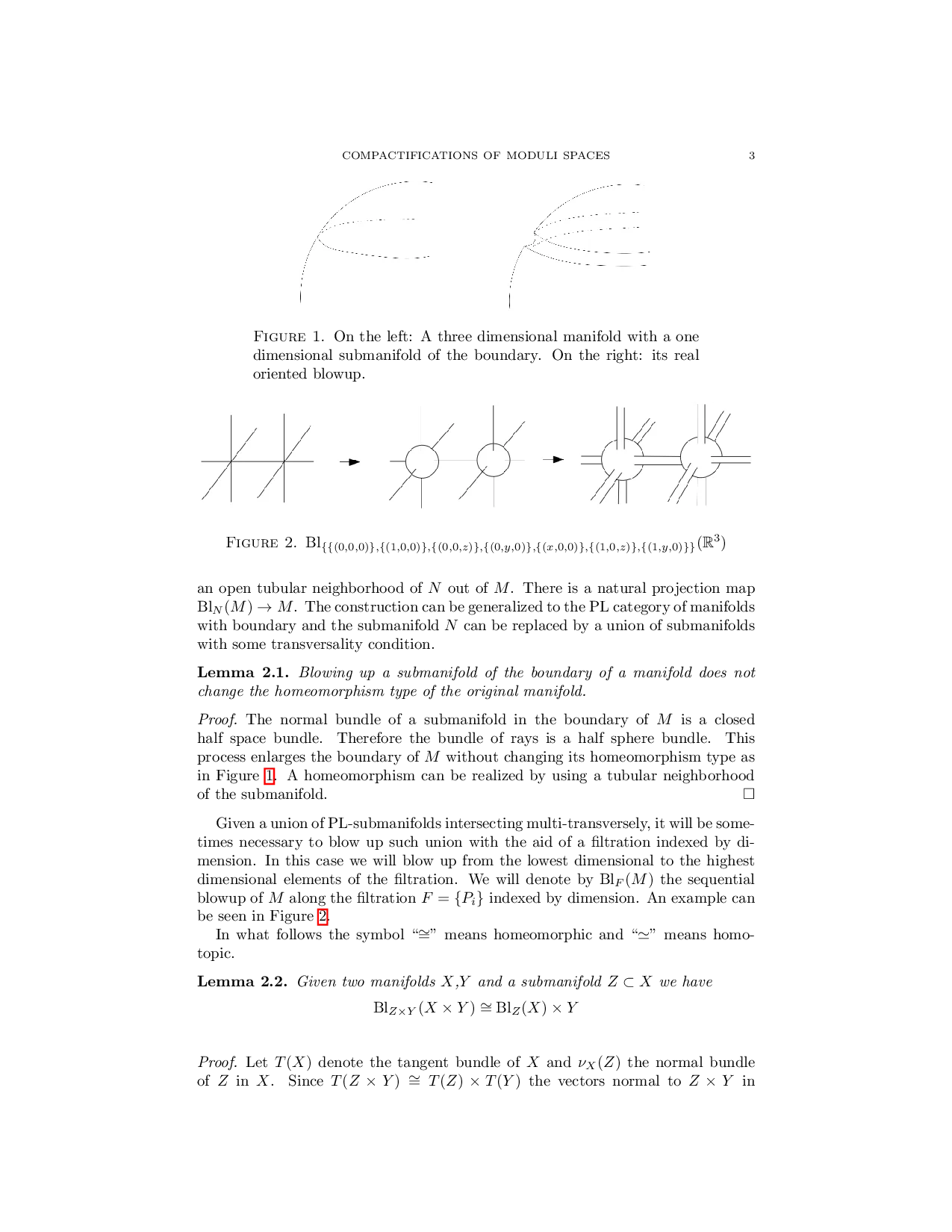
We will use a blowup construction in the PL category. Given a manifold M and a closed submanifold N the real (or directional) oriented blowup Bl N (M ) can be defined by gluing M -N to the (codim N -1)-dimensional spherical bundle of rays of the normal bundle of N in M . This is homeomorphic to the result of carving Figure 2. Bl {{(0,0,0)},{(1,0,0)},{(0,0,z)},{(0,y,0)},{(x,0,0)},{(1,0,z)},{(1,y,0)}} (R 3 ) an open tubular neighborhood of N out of M . There is a natural projection map Bl N (M ) → M . The construction can be generalized to the PL category of manifolds with boundary and the submanifold N can be replaced by a union of submanifolds with some transversality condition.
Lemma 2.1. Blowing up a submanifold of the boundary of a manifold does not change the homeomorphism type of the original manifold.
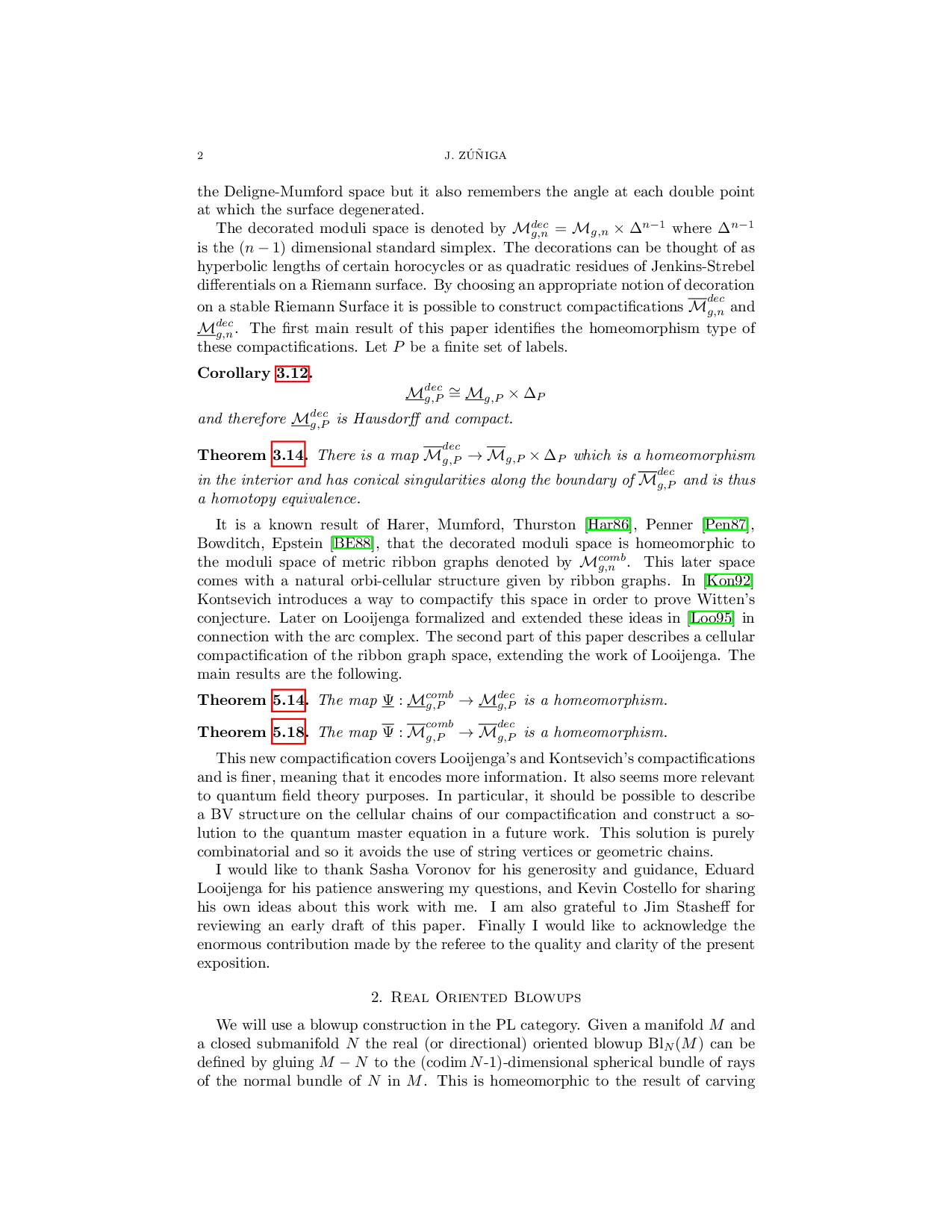
Proof. The normal bundle of a submanifold in the boundary of M is a closed half space bundle. Therefore the bundle of rays is a half sphere bundle. This process enlarges the boundary of M without changing its homeomorphism type as in Figure 1. A homeomorphism can be realized by using a tubular neighborhood of the submanifold.
Given a union of PL-submanifolds intersecting multi-transversely, it will be sometimes necessary to blow up such union with the aid of a filtration indexed by dimension. In this case we will blow up from the lowest dimensional to the highest dimensional elements of the filtration. We will denote by Bl F (M ) the sequential blowup of M along the filtration F = {P i } indexed by d
…(Full text truncated)…
This content is AI-processed based on ArXiv data.