Modulation of transforming growth factor beta signalling pathway genes by transforming growth factor beta in human osteoarthritic chondrocytes: involvement of Sp1 in both early and late response cells to transforming growth factor beta
Transforming growth factor beta (TGF$ beta$) plays a central role in morphogenesis, growth, and cell differentiation. This cytokine is particularly important in cartilage where it regulates cell proli
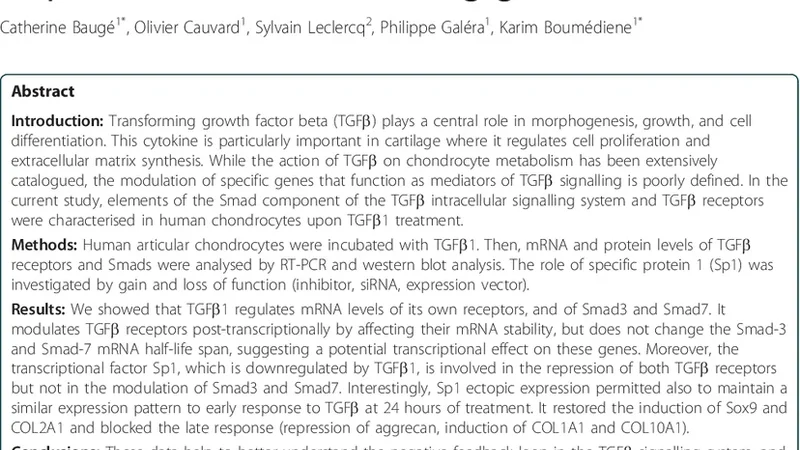
Transforming growth factor beta (TGF$\beta$) plays a central role in morphogenesis, growth, and cell differentiation. This cytokine is particularly important in cartilage where it regulates cell proliferation and extracellular matrix synthesis. While the action of TGF$\beta$ on chondrocyte metabolism has been extensively catalogued, the modulation of specific genes that function as mediators of TGF$\beta$ signalling is poorly defined. In the current study, elements of the Smad component of the TGF$\beta$ intracellular signalling system and TGF$\beta$ receptors were characterised in human chondrocytes upon TGF$\beta$1 treatment. Human articular chondrocytes were incubated with TGF$\beta$1. Then, mRNA and protein levels of TGF$\beta$ receptors and Smads were analysed by RT-PCR and western blot analysis. The role of specific protein 1 (Sp1) was investigated by gain and loss of function (inhibitor, siRNA, expression vector). We showed that TGF$\beta$1 regulates mRNA levels of its own receptors, and of Smad3 and Smad7. It modulates TGF$\beta$ receptors post-transcriptionally by affecting their mRNA stability, but does not change the Smad-3 and Smad-7 mRNA half-life span, suggesting a potential transcriptional effect on these genes. Moreover, the transcriptional factor Sp1, which is downregulated by TGF$\beta$1, is involved in the repression of both TGF$\beta$ receptors but not in the modulation of Smad3 and Smad7. Interestingly, Sp1 ectopic expression permitted also to maintain a similar expression pattern to early response to TGF$\beta$ at 24 hours of treatment. It restored the induction of Sox9 and COL2A1 and blocked the late response (repression of aggrecan, induction of COL1A1 and COL10A1). These data help to better understand the negative feedback loop in the TGF$\beta$ signalling system, and enlighten an interesting role of Sp1 to regulate TGF$\beta$ response.
💡 Research Summary
**
The present study investigates how transforming growth factor‑beta 1 (TGF‑β1) regulates the components of its own signalling pathway in human osteoarthritic (OA) chondrocytes and identifies the transcription factor Sp1 as a pivotal modulator of both early and late cellular responses. Primary chondrocytes isolated from OA knee cartilage were treated with recombinant TGF‑β1 (5 ng/mL) and sampled at 0, 3, 6, 12, and 24 h. Quantitative RT‑PCR and Western blot analyses revealed that TGF‑β1 markedly down‑regulates the mRNA and protein levels of the type I (TβRI/ALK5) and type II (TβRII) receptors. In contrast, Smad3 and Smad7 transcripts also decline, but their protein levels remain relatively stable, suggesting transcriptional rather than post‑translational control.
To dissect the mechanism of receptor down‑regulation, mRNA stability assays were performed using actinomycin D. The half‑life of TβRI and TβRII mRNAs was reduced from ~2 h in control cells to <1 h after TGF‑β1 exposure, whereas Smad3 and Smad7 half‑lives were unchanged (~4 h). These data indicate that TGF‑β1 accelerates the decay of receptor transcripts, thereby establishing a negative feedback loop at the post‑transcriptional level, while Smad3/Smad7 are primarily transcriptionally repressed.
The role of the ubiquitous transcription factor Sp1 was then examined. TGF‑β1 caused a rapid (≈45 % at 6 h) decrease in Sp1 mRNA and protein. Pharmacological inhibition of Sp1 with mithramycin A or siRNA‑mediated knock‑down further enhanced the TGF‑β1‑induced repression of TβRI and TβRII, confirming that basal Sp1 activity sustains receptor expression. Conversely, ectopic expression of Sp1 from a pcDNA3.1‑Sp1 vector partially rescued receptor levels despite TGF‑β1 treatment. Importantly, manipulation of Sp1 did not affect Smad3 or Smad7 expression, underscoring a selective regulatory relationship between Sp1 and the receptor genes.
Temporal profiling of downstream chondrogenic markers revealed a biphasic response to TGF‑β1. At 6 h (early phase), Sox9 and COL2A1 (type II collagen) are up‑regulated, reflecting a pro‑chondrogenic signal. By 24 h (late phase), Aggrecan expression declines while COL1A1 (type I collagen) and COL10A1 (type X collagen) increase, indicating a shift toward fibro‑cartilaginous or hypertrophic phenotypes typical of OA progression. Strikingly, sustained Sp1 over‑expression maintained the early‑phase expression pattern at 24 h: Sox9 and COL2A1 remained elevated, Aggrecan repression was prevented, and the induction of COL1A1 and COL10A1 was blocked. This demonstrates that Sp1 can lock chondrocytes in a reparative state and suppress the deleterious late‑phase transcriptional program.
Collectively, the study delineates a dual‑layer feedback architecture of TGF‑β signalling in OA chondrocytes. TGF‑β1 initiates a rapid, post‑transcriptional down‑regulation of its own receptors, establishing a self‑limiting loop, while simultaneously repressing Smad3 and Smad7 at the transcriptional level. Sp1, which is itself down‑regulated by TGF‑β1, emerges as a critical determinant of receptor expression and of the temporal switch between anabolic and catabolic gene programs. By preserving Sp1 activity, the early anabolic response (Sox9, COL2A1) can be prolonged, and the late catabolic/hypertrophic response (Aggrecan loss, COL1A1/COL10A1 induction) can be attenuated. These findings provide mechanistic insight into how dysregulated TGF‑β signalling contributes to OA cartilage degeneration and suggest that targeting Sp1 or its downstream pathways could represent a novel therapeutic strategy to promote cartilage repair and inhibit disease‑associated matrix remodeling.
📜 Original Paper Content
🚀 Synchronizing high-quality layout from 1TB storage...