First VLF detections of ionospheric disturbances due to Soft Gamma ray Repeater SGR J1550-5418 and Gamma Ray Burst GRB 090424
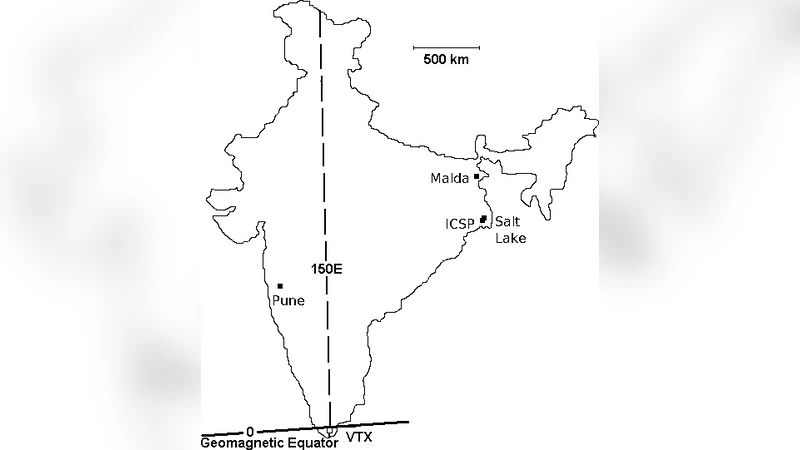
We present the first report of the detection of sudden ionospheric disturbances (SIDs) due to a Soft Gamma Ray Repeater (SGR) SGR J1550-5418 and a Gamma Ray Burst (GRB) GRB 090424. These detections were made with receiving stations of Indian Centre for Space Physics which were monitoring Very Low Frequency signals (VLFs) from the VTX transmitter located at the southern tip of Indian sub-continent. These positive detections add to the list of a handful of similar detections of other GRBs and SGRs throughout the world.
💡 Research Summary
The authors report the first detections of sudden ionospheric disturbances (SIDs) associated with a soft gamma‑ray repeater (SGR J1550 5418) and a gamma‑ray burst (GRB 090424) using very low frequency (VLF) radio monitoring carried out by the Indian Centre for Space Physics (ICSP). ICSP operates several VLF receiving stations (Malda, Salt Lake, Garia, and Pune) that continuously record the 18.2 kHz signal transmitted by the VTX transmitter located near the southern tip of the Indian sub‑continent. Because VLF waves propagate within the Earth‑ionosphere waveguide, any rapid change in the ionospheric conductivity—such as that caused by high‑energy photons—produces a measurable change in signal amplitude and phase, which is the basis for SID detection.
On 22 January 2009 at 00:53:52 UT, SGR J1550 5418 emitted a series of intense bursts that were simultaneously observed by the Fermi satellite and other high‑energy instruments. The VLF records from the Indian stations showed 73 distinct, fast‑rise exponential‑decay (FRED) events that coincided with the satellite‑reported burst times within a few seconds. Each VLF perturbation was well described by the Kocevsky model, allowing the authors to extract rise and decay indices and to confirm that the ionospheric response was directly driven by the incoming gamma‑ray flux.
The second event, GRB 090424, occurred on 24 April 2009 at 14:12:09 UT. In the 8–1000 keV band the burst fluence was measured as 5.2 × 10⁻⁵ erg cm⁻². VLF amplitude disturbances were observed at three eastern Indian stations (Salt Lake, Malda, and Garia) a few seconds after the satellite trigger, while the western Pune station showed no response, highlighting the strong dependence of SID visibility on the geometry between the sub‑flare point, the transmitter, and the receiver.
These detections add two new cases to the very limited global catalog of GRB/SGR‑induced ionospheric disturbances. The work demonstrates that even SGRs located several kiloparsecs away can produce sufficient high‑energy photon flux to ionize the lower ionosphere (≈30 km altitude), altering its conductivity and thereby affecting VLF propagation. The authors discuss the broader implications: the ionosphere acts as a natural, low‑cost detector for high‑energy astrophysical phenomena, and its response provides insight into atmospheric chemistry under extreme radiation conditions. Moreover, they note the astrobiological relevance—repeated ionospheric ionization by extragalactic gamma‑ray events could pose a radiation hazard to life on Earth, a concern previously raised in studies of the giant flare from SGR 1806‑20.
In conclusion, the paper validates VLF monitoring as an effective tool for real‑time detection of high‑energy cosmic transients and underscores the need for expanded, coordinated VLF networks to improve global coverage. Ongoing analysis aims to quantify the ionospheric electron density changes and to develop predictive models linking burst fluence, spectral characteristics, and SID signatures. This line of research bridges space‑weather monitoring, high‑energy astrophysics, and planetary habitability studies.
Comments & Academic Discussion
Loading comments...
Leave a Comment