Information Storage and Retrieval for Probe Storage using Optical Diffraction Patterns
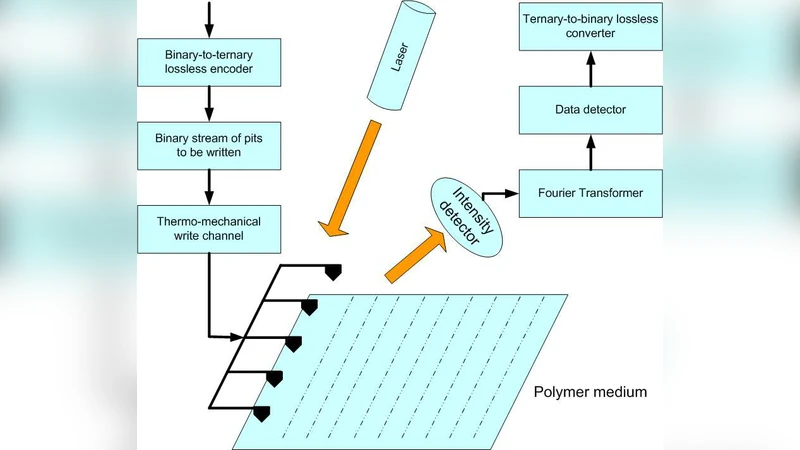
A novel method for fast information retrieval from a probe storage device is considered. It is shown that information can be stored and retrieved using the optical diffraction patterns obtained by the illumination of a large array of cantilevers by a monochromatic light source. In thermo-mechanical probe storage, the information is stored as a sequence of indentations on the polymer medium. To retrieve the information, the array of probes is actuated by applying a bending force to the cantilevers. Probes positioned over indentations experience deflection by the depth of the indentation, probes over the flat media remain un-deflected. Thus the array of actuated probes can be viewed as an irregular optical grating, which creates a data-dependent diffraction pattern when illuminated by laser light. We develop a low complexity modulation scheme, which allows the extraction of information stored in the pattern of indentations on the media from Fourier coefficients of the intensity of the diffraction pattern. We then derive a low-complexity maximum likelihood sequence detection algorithm for retrieving the user information from the Fourier coefficients. The derivation of both the modulation and the detection schemes is based on the Fraunhofer formula for data-dependent diffraction patterns. We show that for as long as the Fresnel number F<0.1, the optimal channel detector derived from Fraunhofer diffraction theory does not suffer any significant performance degradation.
💡 Research Summary
The paper proposes a novel optical read‑out technique for probe‑based data storage that replaces the conventional thermoresistive sensing method with a fast, non‑contact approach based on diffraction patterns. An array of cantilever probes, each either deflected (over an indentation) or not (over a flat region), forms an irregular optical grating when illuminated by a monochromatic laser. The resulting diffraction pattern depends on the stored binary data. By applying Fraunhofer diffraction theory, the authors derive a closed‑form expression for the complex field (U(q)) and the intensity (I(q)=|U(q)|^{2}). The intensity can be written as a product of a data‑independent envelope (|C(q)|^{2}) and a data‑dependent Fourier series with coefficients (f(n)).
A key insight is that the coefficients (f(n)) contain both real and imaginary parts that are nonlinear and linear, respectively, with respect to the underlying bits. To obtain a tractable detection problem, the authors introduce “central trits” (t_{p}=b_{N-1-p}-b_{p}), which take values in {-1,0,+1}. The imaginary part of (f(n)) is shown to be a simple cumulative sum of these trits: (\Im{f(n)}= \sin(2ks)\sum_{p=0}^{n-1} t_{N-1-p}). Consequently, by sampling the diffraction intensity at (2N-1) uniformly spaced spatial frequencies and applying a discrete Fourier transform (DFT), the trits can be recovered directly from the imaginary components of the transformed data.
The modulation scheme proceeds as follows: (1) user binary data are losslessly converted to a balanced ternary sequence; (2) each ternary symbol (trit) is mapped to a pair of probe states according to a fixed table, using only three of the four possible two‑probe configurations. This mapping reduces the information rate to (\log_{2}3/2 \approx 0.79) bits per probe, but enables a linear relationship between the observable Fourier coefficients and the stored information, allowing low‑complexity processing.
Noise in the system is modeled as additive white Gaussian noise (AWGN) added to the DFT output, encompassing electronic noise, media imperfections, and shot noise. Two detection algorithms are presented: a simple threshold detector and an optimal maximum‑likelihood (ML) sequence detector. The ML detector is implemented as a Viterbi‑like graph search over the possible trit sequences, achieving linear‑time complexity (O(N)) while providing significantly lower bit‑error rates (BER) than the threshold method.
Experimental validation uses a 635 nm laser, cantilever pitch of ~10 µm, and observation distance of ~10 cm, yielding a Fresnel number (F = a^{2}/(\lambda R) \le 0.1). Under this condition the Fraunhofer approximation holds, and measured diffraction patterns match the theoretical model with correlation coefficients exceeding 0.98. The ML detector achieves BER on the order of (10^{-4}), representing a 2–3× speed improvement over thermoresistive read‑out while maintaining comparable reliability.
The authors discuss limitations and future work. The Fresnel number constraint restricts the technique to relatively large probe‑to‑detector distances; extending the model to Kirchhoff‑Helmholtz diffraction would allow operation in the near‑field regime. Exploiting the real part of (f(n)) could increase the information rate toward the theoretical maximum of 1 bit per probe. Multi‑wavelength illumination and two‑dimensional probe arrays are identified as avenues for further capacity scaling. Finally, integration of high‑speed FFT and Viterbi engines on FPGA/ASIC platforms is suggested to achieve real‑time operation suitable for commercial storage devices.
In summary, the paper demonstrates that optical diffraction, when combined with a carefully designed ternary modulation and low‑complexity Fourier‑domain processing, provides a viable high‑speed read‑out mechanism for large‑scale probe storage. The approach is validated both analytically and experimentally, showing that for Fresnel numbers below 0.1 the Fraunhofer‑based detector incurs no significant performance loss, thereby offering a compelling alternative to conventional thermal sensing methods.
Comments & Academic Discussion
Loading comments...
Leave a Comment