Supernova Fallback onto Magnetars and Propeller-Powered Supernovae
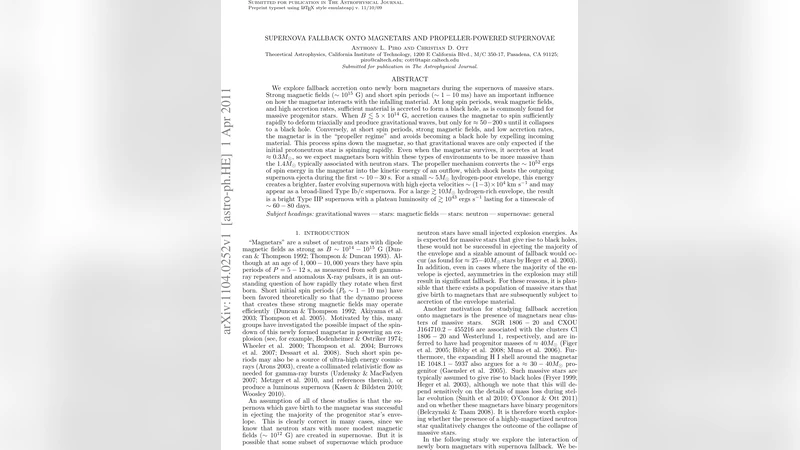
We explore fallback accretion onto newly born magnetars during the supernova of massive stars. Strong magnetic fields (~10^{15} G) and short spin periods (~1-10 ms) have an important influence on how the magnetar interacts with the infalling material. At long spin periods, weak magnetic fields, and high accretion rates, sufficient material is accreted to form a black hole, as is commonly found for massive progenitor stars. When B<5*10^{14} G, accretion causes the magnetar to spin sufficiently rapidly to deform triaxially and produce gravitational waves, but only for ~50-200 s until it collapses to a black hole. Conversely, at short spin periods, strong magnetic fields, and low accretion rates, the magnetar is in the “propeller regime” and avoids becoming a black hole by expelling incoming material. This process spins down the magnetar, so that gravitational waves are only expected if the initial protoneutron star is spinning rapidly. Even when the magnetar survives, it accretes at least ~0.3 solar masses, so we expect magnetars born within these types of environments to be more massive than the 1.4 solar masses typically associated with neutron stars. The propeller mechanism converts the ~10^{52} ergs of spin energy in the magnetar into the kinetic energy of an outflow, which shock heats the outgoing supernova ejecta during the first ~10-30 s. For a small ~5 solar mass hydrogen-poor envelope, this energy creates a brighter, faster evolving supernova with high ejecta velocities ~(1-3)*10^4 km/s and may appear as a broad-lined Type Ib/c supernova. For a large >10 solar mass hydrogen-rich envelope, the result is a bright Type IIP supernova with a plateau luminosity of ~10^{43} ergs/s lasting for a timescale of ~60-80 days.
💡 Research Summary
The paper investigates how fallback accretion onto newly‑born magnetars influences both the fate of the compact object and the observable properties of the associated supernova. Magnetars are assumed to possess dipole magnetic fields of order 10¹⁴–10¹⁵ G and initial spin periods of 1–10 ms, consistent with dynamo‑driven field amplification in rapidly rotating cores. The authors first establish the conditions under which fallback material can reach the neutron star despite the outward pressure of dipole radiation and a neutrino‑driven wind. By comparing the radial dependence of dipole pressure (∝ r⁻²) with the ram pressure of spherical accretion (∝ r⁻⁵⁄²), they derive critical accretion rates (∼10⁻⁵–10⁻⁴ M⊙ s⁻¹) above which fallback dominates. These rates are comfortably exceeded in massive‑star explosions that suffer weak explosions (∼10⁵⁰ erg) and thus retain a substantial amount of bound material.
A central concept is the competition between the Alfvén radius (rₘ) and the corotation radius (r_c). When rₘ < r_c, the inflowing gas is funneled along magnetic field lines onto the stellar surface, adding angular momentum and mass. When rₘ > r_c, the gas must be spun up to super‑Keplerian speeds to enter corotation; the resulting centrifugal barrier ejects the material – the so‑called “propeller regime.” The authors provide analytic expressions for the critical accretion rate separating these regimes, showing a strong dependence on magnetic field strength and spin period (e.g., for B ≈ 10¹⁵ G and P ≈ 2 ms, the propeller regime is entered for \dot M ≲ 6 × 10⁻³ M⊙ s⁻¹).
The spin evolution is modeled by integrating the torque equation I dΩ/dt = N_dip + N_acc, where N_dip = –μ²Ω³/(6c³) and N_acc is taken from the prescription of Ekşi et al. (2005): N_acc = (1 – ω) \dot M √(GM rₘ) for rₘ > R, with the fastness parameter ω = Ω/Ω_K(rₘ). This formulation yields a continuous torque that switches sign at the corotation radius, reproducing spin‑up when the star is slow and spin‑down in the propeller phase. The authors also track the rotational kinetic energy fraction β = T/|W|, noting that β > 0.27 triggers dynamical bar‑mode instability and β > 0.14 can drive secular gravitational‑wave emission. For magnetars with modest fields (B < 5 × 10¹⁴ G) and relatively long initial periods, accretion can spin the star up to β ≈ 0.3, sustaining a bar‑mode for 50–200 s and producing a potentially detectable gravitational‑wave signal before the star collapses to a black hole. In contrast, strong‑field, fast‑spinning magnetars typically enter the propeller regime early, spin down rapidly, and therefore emit negligible gravitational waves.
Mass growth is another key outcome. Even when the propeller effect prevents catastrophic accretion, the star still assimilates at least ∼0.3 M⊙ of fallback material, raising its final mass to ≈ 1.7–2.0 M⊙, significantly above the canonical 1.4 M⊙ neutron‑star mass. If the magnetic field is weak and the spin period long, the accretion rate can be high enough to push the mass beyond the maximum neutron‑star mass, leading to black‑hole formation.
The expelled material in the propeller regime carries away the magnetar’s rotational energy, which is of order 10⁵² erg. This energy is deposited into the supernova ejecta over the first 10–30 s, shock‑heating the outer layers. The authors explore two limiting envelope configurations. For a stripped, low‑mass (≈ 5 M⊙) hydrogen‑poor envelope, the extra energy yields a bright, rapidly evolving, broad‑lined Type Ib/c supernova with ejecta velocities of (1–3) × 10⁴ km s⁻¹. For a more massive (≳ 10 M⊙) hydrogen‑rich envelope, the same energy produces a luminous Type IIP plateau with a luminosity ∼10⁴³ erg s⁻¹ lasting 60–80 days. Thus, the propeller mechanism provides a natural explanation for a subset of unusually bright or fast supernovae that may be linked to magnetar birth.
In summary, the paper delineates three regimes of fallback onto magnetars: (1) high‑accretion, weak‑field cases that lead to black‑hole formation; (2) moderate‑field, moderate‑spin cases that can temporarily sustain bar‑mode instabilities and emit gravitational waves before collapsing; and (3) strong‑field, rapid‑spin cases that enter the propeller regime, avoid collapse, gain modest mass, and convert rotational energy into observable supernova brightening. The work highlights how the interplay of magnetic field strength, spin period, and fallback rate determines both the compact‑object outcome and the electromagnetic signature, offering testable predictions for future gravitational‑wave detectors and time‑domain supernova surveys.
Comments & Academic Discussion
Loading comments...
Leave a Comment