Effect of depreciation of the public goods in spatial public goods games
In this work, depreciated effect of the public goods is considered in the public goods games, which is realized by rescaling the multiplication factor r of each group as r' = r(nc/G)^beta (beat>= 0).
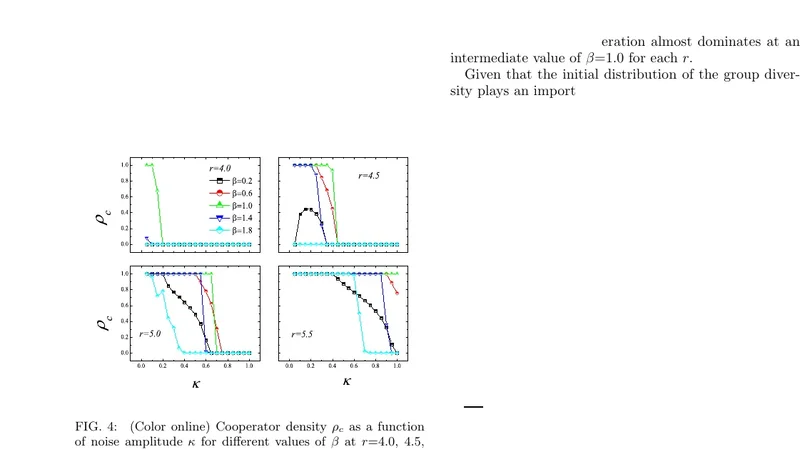
In this work, depreciated effect of the public goods is considered in the public goods games, which is realized by rescaling the multiplication factor r of each group as r’ = r(nc/G)^beta (beat>= 0). It is assumed that each individual enjoys the full profit of the public goods if all the players of this group are cooperators, otherwise, the value of the public goods is reduced to r’. It is found that compared with the original version (beta = 0), emergence of cooperation is remarkably promoted for beta > 0, and there exit optimal values of beta inducing the best cooperation. Moreover, the optimal plat of beta broadens as r increases. Furthermore, effect of noise on the evolution of cooperation is studied, it is presented that variation of cooperator density with the noise is dependent of the value of beta and r, and cooperation dominates over most of the range of noise at an intermediate value of beta = 1.0. We study the initial distribution of the multiplication factor at beta = 1.0, and find that all the distributions can be described as Gauss distribution.
💡 Research Summary
In this paper the authors introduce a depreciation mechanism for the public good in spatial public‑goods games (PGG) and investigate how it influences the evolution of cooperation. In the classic PGG each group is characterized by a fixed multiplication factor r, which amplifies the total contribution of cooperators and is then shared equally among all group members. This formulation assumes that the value of the public good does not depend on how many participants actually contribute. To capture the realistic situation where a public good loses value when not fully supported, the authors rescale r according to the proportion of cooperators in the group:
r′ = r · (nc / G)^β,
where nc is the number of cooperators, G the group size, and β ≥ 0 a parameter controlling the strength of depreciation. When β = 0 the model reduces to the traditional version; for β > 0 the public good is fully effective only if every member cooperates, otherwise its value is diminished.
The evolutionary dynamics are simulated on a two‑dimensional square lattice (typically 100 × 100). Each player belongs to five overlapping groups (its own and those of its four nearest neighbours). Players adopt either cooperation (C) or defection (D). Cooperators contribute a fixed amount c, defectors contribute nothing. After contributions are multiplied by r′, the resulting benefit is divided equally among all group members. The total payoff of a player is the sum of payoffs obtained from all groups to which it belongs.
Strategy updating follows a pairwise imitation rule: a focal player i randomly selects a neighbour j and adopts j’s strategy with probability given by the Fermi function
P(i ← j) = 1 /
📜 Original Paper Content
🚀 Synchronizing high-quality layout from 1TB storage...