On the reliability of proxies for globular cluster collision rates
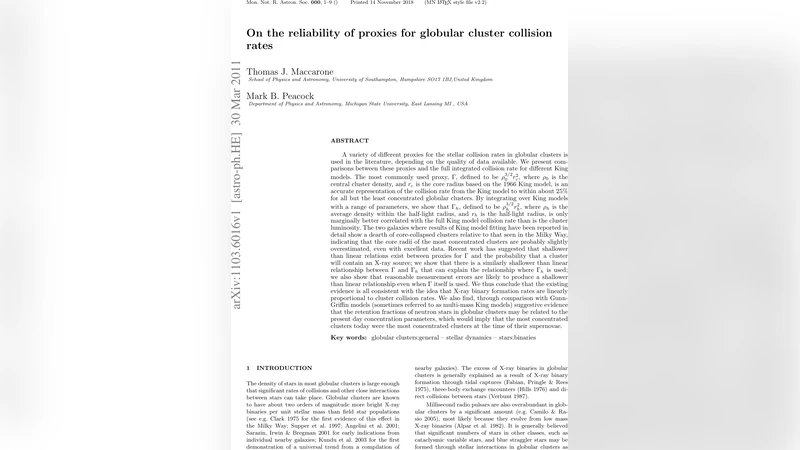
(Abridged) Proxies for the stellar collision rates in globular clusters are often used. We present comparisons between these proxies and the full integrated collision rate for King models. Gamma, defined to be rho_0^3/2 r_c^2$, where $\rho_0$ is the central cluster density, and r_c is the core radius, is an accurate representation of the collision rate from the King model to within about 25% for all but the least concentrated clusters. Gamma_h, defined to be rho_h^3/2 r_h^2, where rho_h is the average density within the half-light radius, and $r_h$ is the half-light radius, is only marginally better correlated with the full King model collision rate than is the cluster luminosity. The two galaxies where results of King model fitting have been reported in detail show a dearth of core-collapsed clusters relative to that seen in the Milky Way, indicating that the core radii of the most concentrated clusters are probably slightly overestimated. Recent work has suggested that shallower than linear relations exist between proxies for Gamma and the probability that a cluster will contain an X-ray source; we show that there is a similarly shallow relationship between Gamma and Gamma_h; we also show that measurement errors are likely to produce a shallower than linear relationship even when Gamma itself is used. The evidence is thus consistent with the idea that X-ray binary formation rates are linearly proportional to cluster collision rates. We also find, through comparison with multimass models, suggestive evidence that the retention fractions of neutron stars in globular clusters may be related to the present day concentration parameters, which would imply that the most concentrated clusters today were the most concentrated clusters at the time of their supernovae.
💡 Research Summary
The paper conducts a systematic assessment of the reliability of commonly used proxies for stellar collision rates in globular clusters, focusing on two quantities: Γ = ρ₀^{3/2} r_c² (central density and core radius) and Γ_h = ρ_h^{3/2} r_h² (average density and half‑light radius). Using a suite of single‑mass King (1966) models spanning a wide range of central potentials (W₀ = 3–12), the authors compute the full integrated collision rate by integrating the local rate proportional to ρ²/σ over the entire cluster. They then compare this “true” rate to the values given by the two proxies.
The analysis shows that Γ reproduces the integrated rate to within about 25 % for all but the least concentrated clusters (W₀ ≈ 3), where the discrepancy can reach ~50 %. The approximation improves for higher concentration (W₀ ≥ 5), confirming that the classic Verbut & Hut (1987) formulation is robust for realistic globular‑cluster parameters. In contrast, Γ_h correlates only marginally better with the integrated rate than does the simple cluster luminosity; it essentially provides no substantial improvement over using mass (or light) alone.
The authors also examine King‑model fits for globular clusters in two external galaxies (NGC 4472 and NGC 5128). Both samples display a noticeable deficit of core‑collapsed clusters compared with the Milky Way, suggesting that core radii of the most concentrated objects may be systematically overestimated in extragalactic studies.
A key part of the paper addresses the frequently reported sub‑linear scaling between collision‑rate proxies and the probability that a cluster hosts an X‑ray binary. By generating synthetic data with realistic measurement uncertainties, the authors demonstrate that even if the intrinsic relation is perfectly linear (P ∝ Γ), observational errors in ρ₀ and r_c can produce an apparent power‑law index of ≈0.8. The same effect explains the similarly shallow relationship observed between Γ and Γ_h. Consequently, the previously claimed “shallower‑than‑linear” dependence does not necessarily reflect physical binary destruction; it can be fully accounted for by measurement scatter.
Finally, the paper compares the single‑mass King results with multimass Gunn‑Griffin models to explore neutron‑star retention. The authors find suggestive evidence that clusters with higher present‑day concentration parameters retain a larger fraction of neutron stars, implying that the most concentrated clusters today were also the most concentrated at the epoch of supernova explosions.
In summary, the study concludes that (1) Γ is a reliable proxy for the true collision rate across the typical range of globular‑cluster concentrations, (2) Γ_h offers little advantage over simple luminosity‑based estimates, (3) measurement uncertainties can masquerade as sub‑linear scaling in observational studies, and (4) after accounting for these biases, the formation rate of X‑ray binaries appears to be linearly proportional to the stellar collision rate. This work clarifies the proper use of collision‑rate proxies and underscores the importance of accurate structural measurements when interpreting dynamical formation channels of compact binaries in globular clusters.
Comments & Academic Discussion
Loading comments...
Leave a Comment