Common envelope: enthalpy consideration
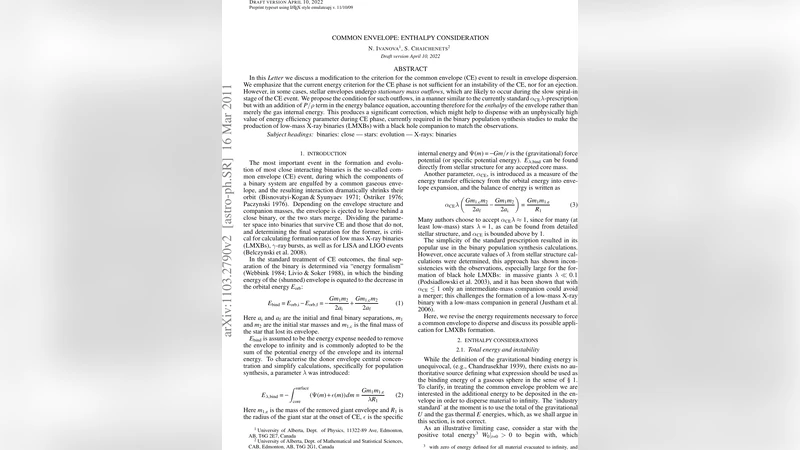
In this Letter we discuss a modification to the criterion for the common envelope (CE) event to result in envelope dispersion. We emphasize that the current energy criterion for the CE phase is not sufficient for an instability of the CE, nor for an ejection. However, in some cases, stellar envelopes undergo stationary mass outflows, which are likely to occur during the slow spiral-in stage of the CE event. We propose the condition for such outflows, in a manner similar to the currently standard $\alpha_{\rm CE}\lambda$-prescription but with an addition of $P/\rho$ term in the energy balance equation, accounting therefore for the enthalpy of the envelope rather than merely the gas internal energy. This produces a significant correction, which might help to dispense with an unphysically high value of energy efficiency parameter during CE phase, currently required in the binary population synthesis studies to make the production of low-mass X-ray binaries (LMXBs) with a black hole companion to match the observations.
💡 Research Summary
In this Letter the authors revisit the energy budget that determines whether a common‑envelope (CE) event can successfully eject the donor’s envelope. The standard prescription, widely used in binary population‑synthesis studies, equates the decrease in orbital energy to the binding energy of the envelope, which is taken as the sum of the gravitational potential (Ψ) and the internal (thermal) energy (ε) of the gas. This leads to the familiar α_CE λ formalism, where α_CE is the efficiency with which orbital energy is transferred to the envelope and λ parametrises the structure of the donor.
However, observations of low‑mass X‑ray binaries (LMXBs) with black‑hole accretors reveal a serious inconsistency: with realistic λ values for massive giants (λ ≪ 1) the α_CE λ product would have to exceed unity in order for a low‑mass companion to survive the CE phase, which is physically implausible. The authors argue that the standard binding‑energy definition is incomplete because it neglects the work term P dV that appears in the first law of thermodynamics. By writing the first law in Lagrangian form, δE = δQ − P δ(1/ρ), and integrating over each mass shell, they obtain an energy conservation equation that contains an additional term P/ρ. This term is precisely the pressure‑to‑density contribution that, together with the internal energy, forms the specific enthalpy h = ε + P/ρ.
The authors therefore define a new binding energy, E_h,bind = −∫(Ψ + h) dm, and introduce a corresponding structural parameter λ_h through E_h,bind = G M₁ M₁,e / (λ_h R₁). They show that λ_h is typically 2–5 times larger than the traditional λ for a wide range of giant models (2 M_⊙ – 30 M_⊙). The increase stems from the fact that the enthalpy term can be comparable to, or even dominate, the internal energy term, especially in regions where radiation pressure or ionisation contributes significantly to the pressure.
A key physical insight is the introduction of the quantity Σ = Ψ + h, which is essentially the Bernoulli function for a static flow. When Σ becomes positive in a layer, that layer is no longer bound and will launch a quasi‑steady outflow, regardless of the sign of the total energy of the whole envelope. The authors point out that low‑mass red giants naturally develop a “boiling‑pot zone” (BPZ) where Σ > 0 because of the high P/ρ term. The mass contained in the BPZ can be as large as several solar masses in massive giants, and once this zone is uncovered (for example by the companion’s inspiral), the overlying material can escape without further mechanical work.
Using detailed stellar models from Ivanova (2011), the authors compute λ, λ_h, the core mass definition (maximum P/ρ inside the H‑burning shell), and the minimum companion mass that would avoid a merger. Table 1 demonstrates that, under the traditional α_CE λ formalism, the minimum surviving companion mass for massive giants is several solar masses, effectively precluding the formation of black‑hole LMXBs with low‑mass donors unless α_CE > 1. In contrast, the enthalpy‑based formalism reduces the required companion mass by factors of 2–5, allowing even sub‑solar‑mass companions to survive the CE phase.
The Letter concludes that the omission of the P/ρ term in the standard energy balance is a serious oversight. Including enthalpy yields a more realistic estimate of the energy required to unbind the envelope, especially for massive giants where λ is small. This modification naturally resolves the “α_CE > 1” problem in binary population synthesis and provides a physically motivated criterion (Σ > 0) for the onset of quasi‑steady envelope outflows during the slow, self‑regulated spiral‑in phase of a CE event. The authors suggest that future population‑synthesis codes adopt λ_h and the Σ > 0 condition to improve predictions of post‑CE binary populations, including the formation rates of black‑hole LMXBs, double neutron‑star systems, and other compact‑object binaries.
Comments & Academic Discussion
Loading comments...
Leave a Comment