An XMM-Newton spectral survey of 12 micron selected galaxies. II. Implications for AGN selection and unification
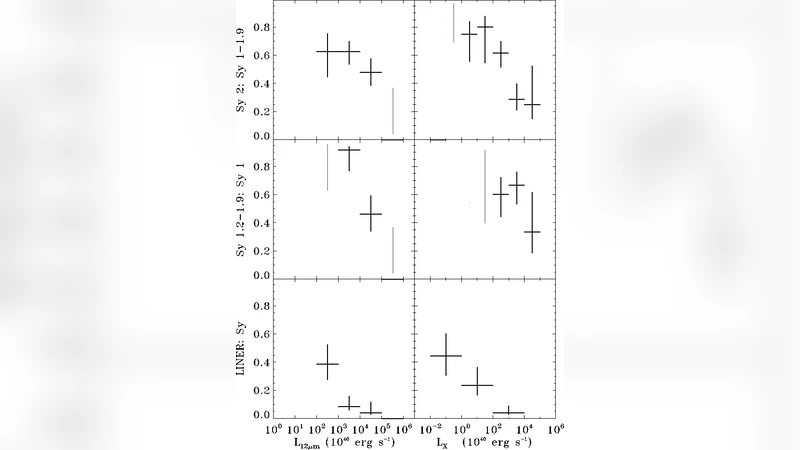
We present a multi-waveband analysis of a 126 galaxy sub-sample of the 12 micron galaxy sample (12MGS), for which we have carried out a detailed X-ray spectral analysis of in a previous paper. We present optical activity classes and we characterise these by their X-ray, 12 um and [OIII] luminosities and by their X-ray spectral properties. Our most interesting results are: Seyfert (Sy) 1s and Sy 2s show significantly different LX distributions from each other; Sy 2s with a detection of an HBLR show a significantly higher LX than those without a detection; Sy 1s also present a significantly different L(12um) distribution from both Sy1.2-1.9s and Sy 2s; the Sy 2 fraction decreases towards high LX; X-ray indications of AGN power agree well with the optical classifications; There is X-ray evidence for the presence of an AGN in 17% of HII/AGN composites and 40% of LINERs; we advocate the use of a LX >10^41 erg/s in the X-ray selection of AGN, which gives a contamination rate of only 3% from star-forming galaxies; Sy 1s and Sy 2 have the same intrinsic {\Gamma}; in 24% of cases the absorption measured in X-rays does not correspond directly with that implied in the optical band from the visibility of the BLRs; the obscured fraction in AGN is a strong function of LX peaking at 10^42 erg/s; The average obscured and Compton thick fractions for this sample are 62\pm5% and 20\pm4% respectively, which are higher than hard X-ray and optically selected samples; we assess the use of the T ratio (FX/F[OIII]) for selecting Compton thick candidates. We conclude here that this quantity can often be unreliable due uncertainties in the extinction corrections to the [OIII] flux. These results have important impacts on AGN selection and unification and the results from the 12MGS are particularly useful as a local analogue to z=1 24 um samples.
💡 Research Summary
This paper presents a comprehensive multi‑wavelength analysis of a well‑defined subsample of 126 galaxies drawn from the IRAS 12 µm Galaxy Sample (12MGS). The authors build on their previous work (Brightman & Nandra 2010) in which they performed detailed X‑ray spectral fitting of XMM‑Newton observations for these objects, deriving intrinsic 2–10 keV luminosities (L_X), photon indices (Γ), and line‑of‑sight column densities (N_H). In the current study they first classify the optical activity type of each galaxy using the classic BPT diagnostic diagrams (Kewley et al. 2006), employing line ratios
Comments & Academic Discussion
Loading comments...
Leave a Comment