How does the earth system generate and maintain thermodynamic disequilibrium and what does it imply for the future of the planet?
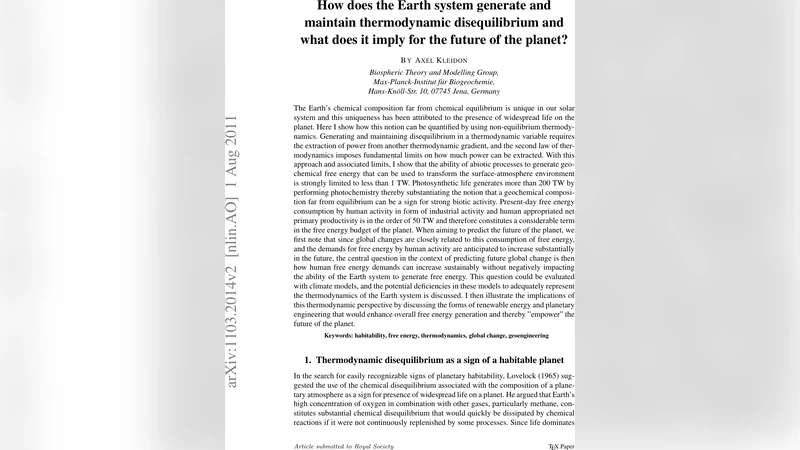
The chemical composition of the earths atmosphere far from equilibrium is unique in the solar system and has been attributed to the presence of widespread life. Here I show that this perspective can be quantified using non-equilibrium thermodynamics. Generating disequilibrium in a thermodynamic variable requires the extraction of power from another thermodynamic gradient, and the second law of thermodynamics imposes fundamental limits on how much power can be extracted. When applied to complex earth system processes, where several irreversible processes compete to deplete the same gradients, it is easily shown that the maximum thermodynamic efficiency is much less than the classic Carnot limit, so that the ability of the earth system to generate power and disequilibrium is limited. This approach is used to quantify how much free energy is generated by various earth system processes to generate chemical disequilibrium. It is shown that surface life generates orders of magnitude more chemical free energy than any abiotic surface process, therefore being the primary driving force for shaping the geochemical environment at the planetary scale. To apply this perspective to the possible future of the planet, we first note that the free energy consumption by human activity is a considerable term in the free energy budget of the planet, and that global changes are closely related to this consumption of free energy. Since human activity and demands for free energy is going to increase in the future, the central question is how human free energy demands can increase sustainably without negatively impacting the ability of the earth system to generate free energy. I illustrate the implications of this thermodynamic perspective by discussing the forms of renewable energy and planetary engineering that would enhance overall free energy generation and thereby “empower” the future of the planet.
💡 Research Summary
**
The paper by Axel Kleidon provides a comprehensive thermodynamic framework for understanding why Earth’s atmosphere and surface remain far from chemical equilibrium and what this implies for the planet’s future. It begins by noting that Earth’s atmospheric composition—high O₂ together with reduced gases such as CH₄—is a striking disequilibrium that would quickly disappear without a continuous source of free energy. The author argues that this source is life, especially photosynthetic organisms, and sets out to quantify the claim using non‑equilibrium thermodynamics.
Kleidon first defines the Earth system as a closed system bounded at the top of the atmosphere, where the dominant exchanges are low‑entropy solar radiation in and higher‑entropy terrestrial radiation out. The first law (energy conservation) is written in a form that separates heat input, work extraction, and dissipative heating. The second law introduces entropy production associated with irreversible processes such as heat diffusion between warm and cold reservoirs. By combining the two, the author derives a simple balance for the system’s free energy A: dA/dt = P − D, where P is the power extracted from the solar‑driven heat gradient and D is the rate at which that free energy is irreversibly dissipated (often expressed as A/τ). The magnitude of the disequilibrium, measured as the non‑equilibrium part of the entropy, is directly proportional to A/T.
A central insight is that the classic Carnot efficiency severely overestimates the actual conversion efficiency of planetary processes. In the Earth system many irreversible processes (atmospheric circulation, ocean mixing, weathering, biogeochemical cycles) compete for the same temperature or chemical potential gradients, limiting the usable fraction of the solar input to only a few percent. This leads to the “Maximum Power Principle” and the related “Maximum Entropy Production” hypothesis, which together set a realistic upper bound on the power that can be generated from a given gradient.
Applying this framework, the paper estimates the free‑energy production of various Earth processes. Abiotic surface processes—volcanism, weathering, physical erosion—together generate less than 1 TW of chemical free energy. By contrast, photosynthetic life converts solar photons into chemical bonds at a rate exceeding 200 TW, confirming that biotic activity dominates the maintenance of atmospheric and surface chemical disequilibrium. Human civilization presently consumes about 50 TW of free energy, a substantial fraction of the total planetary free‑energy budget. Because future economic and population growth will raise this demand, the author asks how humanity can increase its energy use without degrading the Earth system’s ability to generate free energy.
The paper critiques current Earth system and climate models for largely ignoring the detailed free‑energy pathways and entropy production rates, which may lead to under‑estimation of feedbacks and resilience limits. Kleidon suggests that incorporating non‑equilibrium thermodynamic modules—explicitly tracking power extraction, transfer, and dissipation—could improve model fidelity.
Finally, the author explores pathways to “empower” the planet. Renewable energy technologies (solar photovoltaics, wind, ocean‑thermal conversion) directly tap the solar gradient and can increase the total planetary power without depleting natural gradients. Planetary engineering concepts such as artificial photosynthesis, large‑scale carbon capture and storage, albedo modification, and soil carbon enhancement are presented as ways to augment the Earth’s free‑energy generation capacity. By aligning human energy use with processes that add to, rather than subtract from, the planetary free‑energy budget, humanity could sustain higher energy consumption while preserving the disequilibrium that characterizes a habitable world. The paper thus frames the future of Earth as a thermodynamic challenge: to balance growing anthropogenic power demands with the planet’s limited ability to produce and maintain non‑equilibrium states.
Comments & Academic Discussion
Loading comments...
Leave a Comment