Advances in Global and Local Helioseismology: an Introductory Review
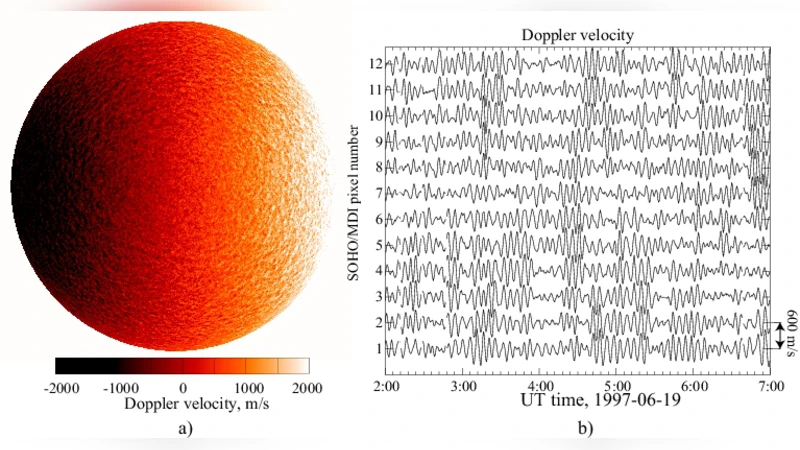
Helioseismology studies the structure and dynamics of the Sun’s interior by observing oscillations on the surface. These studies provide information about the physical processes that control the evolution and magnetic activity of the Sun. In recent years, helioseismology has made substantial progress towards the understanding of the physics of solar oscillations and the physical processes inside the Sun, thanks to observational, theoretical and modeling efforts. In addition to the global seismology of the Sun based on measurements of global oscillation modes, a new field of local helioseismology, which studies oscillation travel times and local frequency shifts, has been developed. It is capable of providing 3D images of the subsurface structures and flows. The basic principles, recent advances and perspectives of global and local helioseismology are reviewed in this article.
💡 Research Summary
The paper provides a comprehensive review of both global and local helioseismology, tracing their historical development, theoretical foundations, observational breakthroughs, and future prospects. Beginning with the discovery of the 5‑minute solar oscillations in 1960 by Leighton, Noyes, and Simon, the authors recount early debates over whether these were acoustic or gravity waves. The pivotal work of Mein (1962) and Frasier (1965) introduced Fourier analyses that identified the oscillations as standing acoustic modes (p‑modes). Subsequent long‑duration observations by Deubner (1974‑75) produced clear k‑ω diagrams, confirming the existence of discrete ridges corresponding to radial orders and angular degrees.
In the global helioseismology section, the paper explains how the Sun is modeled as a spherically symmetric fluid body, leading to a fourth‑order differential eigenvalue problem whose solutions are the p‑, g‑, and f‑modes. The authors discuss how rotation lifts the azimuthal degeneracy, producing frequency splittings that encode the internal rotation profile. The regular spacing of p‑mode frequencies (Δν ≈ 67.8 µHz) is linked to the acoustic travel time across the solar diameter, providing a powerful diagnostic of the solar interior, including constraints on metallicity and the solar neutrino problem. Observational advances—from ground‑based networks to space‑borne instruments such as SOHO/MDI and SDO/HMI—have delivered continuous, high‑resolution Doppler velocity and vector magnetic field data, enabling precise measurement of low‑ℓ global modes and their temporal evolution.
The local helioseismology portion focuses on time‑distance helioseismology and helioseismic holography. By measuring travel‑time perturbations of acoustic waves between surface points, or by analyzing local frequency shifts, researchers can construct three‑dimensional maps of subsurface flows, sound‑speed anomalies, and magnetic structures. This approach reveals shallow features inaccessible to global modes, such as supergranular flows, sunspot‑associated wave absorption, and emerging active regions. Recent methodological developments include the incorporation of machine‑learning techniques for inversion and the use of multi‑height observations to improve depth resolution.
Finally, the review outlines current challenges: non‑linear interactions between convection and waves, the detection of elusive g‑modes, and the accurate modeling of strong magnetic fields. The authors anticipate that next‑generation facilities—DKIST, Solar Orbiter, and expanded ground networks—combined with sophisticated numerical simulations and data‑driven inversion methods, will bridge these gaps. They argue that an integrated global‑local helioseismic framework is essential for a full understanding of solar interior dynamics, with implications for solar activity forecasting and space‑weather modeling.
Comments & Academic Discussion
Loading comments...
Leave a Comment