The Fermi Bubbles. I. Possible Evidence for Recent AGN Jet Activity in the Galaxy
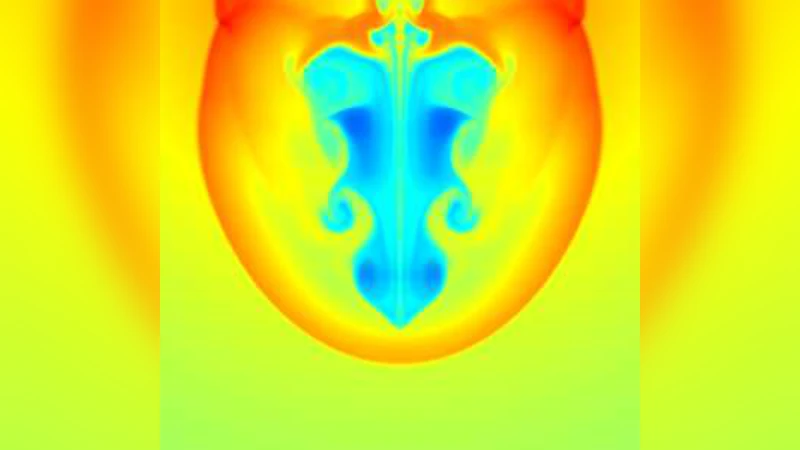
The Fermi Gamma-ray Space Telescope reveals two large gamma-ray bubbles in the Galaxy, which extend about 50 degrees (~ 10 kpc) above and below the Galactic center (GC) and are symmetric about the Galactic plane. Using axisymmetric hydrodynamic simulations with a self-consistent treatment of the dynamical cosmic ray (CR) - gas interaction, we show that the bubbles can be created with a recent active galactic nucleus (AGN) jet activity about 1 - 3 Myr ago, which was active for a duration of ~ 0.1 - 0.5 Myr. The bipolar jets were ejected into the Galactic halo along the rotation axis of the Galaxy. Near the GC, the jets must be moderately light with a typical density contrast 0.001 <~ \eta <~ 0.1 relative to the ambient hot gas. The jets are energetically dominated by kinetic energy, and over-pressured with either CR or thermal pressure which induces lateral jet expansion, creating fat CR bubbles as observed. The sharp edges of the bubbles imply that CR diffusion across the bubble surface is strongly suppressed. The jet activity induces a strong shock, which heats and compresses the ambient gas in the Galactic halo, potentially explaining the ROSAT X-ray shell features surrounding the bubbles. The Fermi bubbles provide plausible evidence for a recent powerful AGN jet activity in our Galaxy, shedding new insights into the origin of the halo CR population and the channel through which massive black holes in disk galaxies release feedback energy during their growth.
💡 Research Summary
The paper investigates the origin of the two giant gamma‑ray structures discovered by the Fermi Gamma‑ray Space Telescope, commonly referred to as the “Fermi bubbles.” These bubbles extend roughly 50° (≈10 kpc) above and below the Galactic Center (GC), are symmetric about the Galactic plane, display a nearly uniform surface brightness, and possess sharply defined edges. The authors propose that the bubbles are the relics of a recent episode of active‑galactic‑nucleus (AGN) jet activity in the Milky Way, and they test this hypothesis with axisymmetric hydrodynamic simulations that self‑consistently treat the dynamical coupling between cosmic rays (CRs) and the thermal gas.
Physical Model and Numerical Setup
The simulations solve the standard set of fluid equations for a two‑component medium: (1) mass continuity, (2) momentum conservation including both thermal gas pressure (P) and CR pressure (P_c), (3) energy equation for the thermal gas, and (4) energy equation for the CR component, which includes advection with the gas flow and isotropic diffusion with coefficient κ. The CR pressure is related to the CR energy density by P_c = (γ_c − 1) e_c with γ_c = 4/3, while the gas obeys an ideal‑gas law with γ = 5/3. Radiative cooling is neglected because the simulated evolution spans only 0.1–3 Myr, a timescale short enough that cooling does not dominate the dynamics.
The initial Galactic halo is modeled as a hot, low‑density atmosphere (T ≈ 2 × 10⁶ K, ρ ≈ 10⁻³ cm⁻³) in hydrostatic equilibrium within a fixed gravitational potential composed of bulge, disk, and dark‑matter halo components. The CR energy density is initially zero throughout the halo.
Jet Injection Parameters
Bipolar jets are launched from the GC along the rotation axis. The key jet parameters explored are:
- Density contrast (η = ρ_jet/ρ_ambient): Successful bubbles are produced only for 10⁻³ ≲ η ≲ 10⁻¹. Jets lighter than this fail to generate sufficient pressure, while heavier jets decelerate too quickly.
- Kinetic power and duration: Total injected energy in the fiducial run is ≈10⁵⁷ erg, but the authors note that the actual energy could range from 10⁵⁵ to 10⁵⁷ erg depending on the uncertain halo density. The jet activity lasts 0.1–0.5 Myr.
- Velocity: Jets are assumed to be mildly relativistic (∼0.1 c), providing the required transport speed for CRs (≈10⁴ km s⁻¹) to reach 10 kpc within the bubble age.
- Composition: The simulations treat the jet as a mixture of thermal gas and CRs, with the CR component dominating the pressure budget, leading to over‑pressured “fat” bubbles.
Results – Bubble Morphology and Dynamics
When the jets propagate, a strong forward shock forms, heating and compressing the ambient halo gas. This shock naturally reproduces the ROSAT X‑ray shell observed surrounding the Fermi bubbles. Inside the shock, the jet material inflates a pair of lobes that expand laterally because of the high internal CR (or thermal) pressure. The resulting structures are roughly spherical in the vertical direction and have a broad, “fat” appearance, matching the observed width (≈40° in longitude) and height (≈10 kpc).
The simulations demonstrate that the sharp edges of the bubbles require a suppression of CR diffusion across the bubble surface. By adopting a diffusion coefficient κ inside the bubble that is at least an order of magnitude lower than the canonical Galactic value (κ ≈ 3 × 10²⁸ cm² s⁻¹), the CR distribution remains uniform within the bubble and drops abruptly at the boundary, reproducing the observed sharp gamma‑ray edges. Larger κ values produce blurred edges inconsistent with observations.
Implications for Cosmic‑Ray Transport
The authors argue that pure diffusion cannot account for the rapid transport of CRs from the GC to the bubble caps; the required diffusion coefficient would be ≳10³¹ cm² s⁻¹, far exceeding measured Galactic values and incompatible with the observed edge sharpness. Instead, advection by the jet‑driven flow provides the necessary transport speed (≈10⁴ km s⁻¹). The jet‑induced wind also explains why the bubbles are centered on the GC rather than being displaced, as would be expected for a wind launched from a distributed star‑forming disk.
Comparison with Alternative Scenarios
The paper contrasts the jet model with starburst‑driven wind or supernova‑driven bubble scenarios. While galactic winds can reach velocities of a few hundred km s⁻¹, they are generally too slow to transport CRs over 10 kpc within a few Myr, and they often contain multi‑phase gas that would produce observable H α or molecular emission, which is not seen in the Fermi bubbles. Moreover, wind‑driven bubbles would likely exhibit more gradual surface brightness gradients, contrary to the sharp gamma‑ray edges.
Conclusions and Future Work
The study concludes that a recent (1–3 Myr ago) episode of AGN jet activity, lasting 0.1–0.5 Myr and with a modest density contrast, can simultaneously explain the morphology, size, sharp edges, and associated X‑ray shell of the Fermi bubbles. The required jet power is comparable to that observed in low‑luminosity AGN, suggesting that the Milky Way’s central supermassive black hole underwent a brief, powerful outburst in the recent past.
The authors acknowledge that additional physics—such as anisotropic CR diffusion, magnetic tension, viscosity, and detailed radiative processes—could refine the model. They also note that forthcoming observations (e.g., high‑resolution X‑ray spectroscopy, radio polarization mapping) will be crucial for testing the jet hypothesis and for constraining the magnetic field structure that governs CR diffusion at the bubble boundaries.
Comments & Academic Discussion
Loading comments...
Leave a Comment