A new method to calibrate ionospheric pulse dispersion for UHE cosmic ray and neutrino detection using the Lunar Cherenkov technique
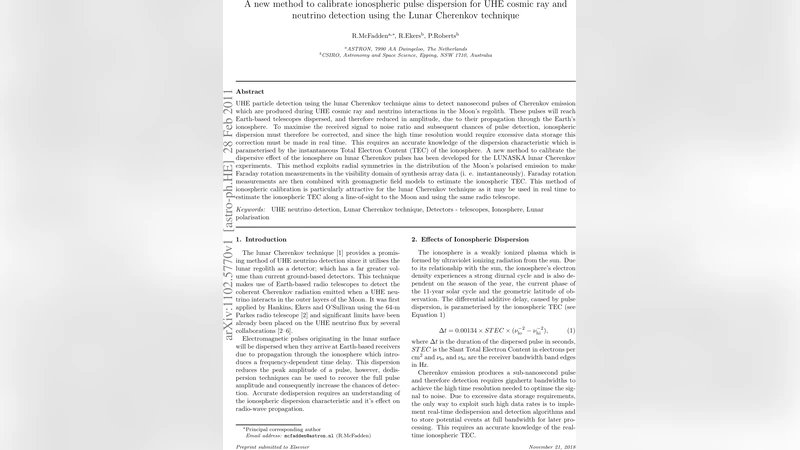
UHE particle detection using the lunar Cherenkov technique aims to detect nanosecond pulses of Cherenkov emission which are produced during UHE cosmic ray and neutrino interactions in the Moon’s regolith. These pulses will reach Earth-based telescopes dispersed, and therefore reduced in amplitude, due to their propagation through the Earth’s ionosphere. To maximise the received signal to noise ratio and subsequent chances of pulse detection, ionospheric dispersion must therefore be corrected, and since the high time resolution would require excessive data storage this correction must be made in real time. This requires an accurate knowledge of the dispersion characteristic which is parameterised by the instantaneous Total Electron Content (TEC) of the ionosphere. A new method to calibrate the dispersive effect of the ionosphere on lunar Cherenkov pulses has been developed for the LUNASKA lunar Cherenkov experiments. This method exploits radial symmetries in the distribution of the Moon’s polarised emission to make Faraday rotation measurements in the visibility domain of synthesis array data (i. e. instantaneously). Faraday rotation measurements are then combined with geomagnetic field models to estimate the ionospheric TEC. This method of ionospheric calibration is particularly attractive for the lunar Cherenkov technique as it may be used in real time to estimate the ionospheric TEC along a line-of-sight to the Moon and using the same radio telescope.
💡 Research Summary
The paper addresses a critical obstacle in the Lunar Cherenkov technique for detecting ultra‑high‑energy (UHE) cosmic rays and neutrinos: the dispersive delay introduced by the Earth’s ionosphere, which spreads nanosecond‑scale Cherenkov pulses and reduces their peak amplitude. Accurate real‑time dedispersion requires an instantaneous measurement of the ionospheric total electron content (TEC) along the line of sight (LOS) to the Moon. Traditional TEC sources—dual‑frequency GPS data and ionosonde foF2 measurements—are either delayed by hours or provide only vertical TEC (VTEC) that must be converted to slant TEC (STEC) with additional modeling, making them unsuitable for real‑time correction.
The authors propose a novel calibration method that exploits the intrinsic radial polarisation of the Moon’s thermal emission. Because of Brewster‑angle effects, the lunar limb exhibits a net linear polarisation that is radially symmetric about the centre of the disc. By observing the Moon with the Australia Telescope Compact Array (ATCA) at a centre frequency of 138.4 MHz, they extract the polarisation angle directly in the visibility (uv) domain, avoiding any Fourier imaging step. The measured position angle of the polarised emission is compared with the theoretical radial angle expected for a given uv‑coordinate; the discrepancy is attributed to Faraday rotation incurred while the signal traverses the ionosphere.
Faraday rotation, Ω, follows the well‑known relation
\
Comments & Academic Discussion
Loading comments...
Leave a Comment