Spin-Up/Spin-Down models for Type Ia Supernovae
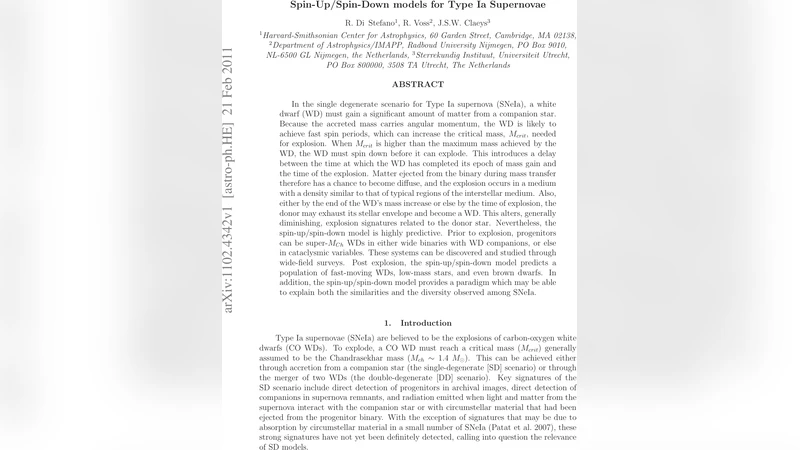
In the single degenerate scenario for Type Ia supernova (SNeIa), a white dwarf (WD) must gain a significant amount of matter from a companion star. Because the accreted mass carries angular momentum, the WD is likely to achieve fast spin periods, which can increase the critical mass, $M_{crit}$, needed for explosion. When $M_{crit}$ is higher than the maximum mass achieved by the WD, the WD must spin down before it can explode. This introduces a delay between the time at which the WD has completed its epoch of mass gain and the time of the explosion. Matter ejected from the binary during mass transfer therefore has a chance to become diffuse, and the explosion occurs in a medium with a density similar to that of typical regions of the interstellar medium. Also, either by the end of the WD’s mass increase or else by the time of explosion, the donor may exhaust its stellar envelope and become a WD. This alters, generally diminishing, explosion signatures related to the donor star. Nevertheless, the spin-up/spin-down model is highly predictive. Prior to explosion, progenitors can be super-$M_{Ch}$ WDs in either wide binaries with WD companions, or else in cataclysmic variables. These systems can be discovered and studied through wide-field surveys. Post explosion, the spin-up/spin-down model predicts a population of fast-moving WDs, low-mass stars, and even brown dwarfs. In addition, the spin-up/spin-down model provides a paradigm which may be able to explain both the similarities and the diversity observed among SNeIa.
💡 Research Summary
The paper presents a comprehensive framework for Type Ia supernovae (SNe Ia) within the single‑degenerate (SD) channel that incorporates the effects of angular momentum accretion on the white dwarf (WD). The authors argue that as a WD gains mass from a companion, the infalling material inevitably spins it up to near‑critical rotation. This rapid rotation raises the critical mass (M_crit) required for thermonuclear runaway, potentially well above the canonical Chandrasekhar limit (M_Ch≈1.4 M⊙). The increase in M_crit depends on the internal angular‑momentum distribution: a rigid rotator yields a modest ≈5 % boost, whereas differential rotation can allow stable configurations up to ≈2–4 M⊙ according to earlier theoretical work (Anand 1965; Roxburgh 1965; Ostriker & Bodenheimer 1968; Hachisu 1986; Yoon & Langer 2005).
If the WD’s actual mass after accretion remains below the elevated M_crit, the system must undergo a spin‑down phase before explosion. Spin‑down can be driven by magnetic braking, gravitational‑wave emission, or angular‑momentum loss in low‑accretion states, with timescales ranging from <10⁶ yr to >10⁹ yr. During this interval, material previously expelled from the binary has time to disperse, leaving the eventual supernova to explode in an interstellar‑medium‑like environment rather than a dense circumstellar shell. Moreover, the donor star may have exhausted its envelope, evolving into a compact object (a white dwarf, low‑mass star, or even a brown dwarf). Consequently, many of the classic SD signatures—early‑time shock emission from ejecta–companion interaction, persistent supersoft X‑ray emission, or strong circumstellar absorption—are expected to be weak or absent, consistent with the paucity of such detections in observed SNe Ia.
The authors outline several observable predictions. Prior to explosion, super‑M_Ch WDs should appear either as wide double‑white‑dwarf binaries (showing two hot spectral components) or as cataclysmic variables with unusually massive primaries. Large‑scale surveys (SDSS, Pan‑STARRS, LSST) combined with X‑ray catalogs can identify these progenitor candidates. After explosion, the model predicts a population of high‑velocity (>500 km s⁻¹) solitary WDs, low‑mass stars, or brown dwarfs that were the former donors, as well as remnants of the disrupted binary. Their detection would be facilitated by astrometric missions (Gaia) and time‑domain surveys capable of recognizing fast proper motions.
In the discussion of cosmological implications, the paper notes that if a substantial fraction (parameter f) of SNe Ia follow the spin‑up/spin‑down pathway, the systematic uncertainty due to variable circumstellar absorption is reduced, because most explosions would occur in low‑density environments regardless of redshift. Nonetheless, the model does not preclude prompt explosions (within ≈10⁸ yr of star formation) for systems where the mass gain outpaces the increase in M_crit, thereby preserving the observed “prompt” component of the SN Ia rate.
Overall, the spin‑up/spin‑down paradigm offers a unified explanation for both the remarkable homogeneity of SNe Ia light curves (when rotation is modest) and the observed diversity (when rotation is significant and spin‑down times vary). By measuring the mass distribution of pre‑explosion WDs, the maximum M_crit, and the demographics of post‑explosion high‑velocity remnants, the model can be rigorously tested. Successful validation would not only clarify the progenitor problem but also strengthen the reliability of SNe Ia as cosmological distance indicators.
Comments & Academic Discussion
Loading comments...
Leave a Comment