Long-Term evolution of Discs around Magnetic Stars
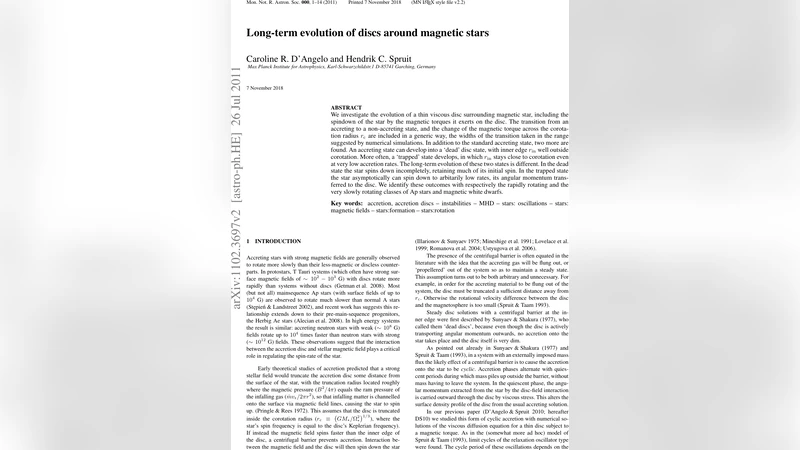
We investigate the evolution of a thin viscous disc surrounding magnetic star, including the spindown of the star by the magnetic torques it exerts on the disc. The transition from an accreting to a non-accreting state, and the change of the magnetic torque across the corotation radius are included in a generic way, the widths of the transition taken in the range suggested by numerical simulations. In addition to the standard accreting state, two more are found. An accreting state can develop into a ‘dead’ disc state, with inner edge well outside corotation. More often, a ’trapped’ state develops, in which the inner disc edge stays close to corotation even at very low accretion rates. The long-term evolution of these two states is different. In the dead state the star spins down incompletely, retaining much of its initial spin. In the trapped state the star asymptotically can spin down to arbitarily low rates, its angular momentum transferred to the disc. We identify these outcomes with respectively the rapidly rotating and the very slowly rotating classes of Ap stars and magnetic white dwarfs.
💡 Research Summary
The paper presents a comprehensive theoretical study of the long‑term evolution of a thin viscous accretion disc surrounding a magnetised star, explicitly coupling the disc’s viscous evolution to the star’s spin evolution. The authors adopt the framework developed in their earlier work (D’Angelo & Spruit 2010) and introduce two smooth “connecting functions” – y_Σ for the magnetic torque and y_m for the mass‑accretion rate – that transition across the corotation radius r_c over a narrow width Δr (and Δr₂ for the accretion rate). These functions are expressed as hyperbolic‑tangent profiles, ensuring a gradual switch from the accreting regime (r_in < r_c, zero magnetic torque) to the non‑accreting, torque‑dominated regime (r_in > r_c).
Viscosity is modelled with the standard α‑prescription (ν = α c_s H) and a constant aspect ratio, allowing the authors to solve the thin‑disc diffusion equation with modified inner‑boundary conditions. The magnetic torque at the inner edge is given by T_B ≈ η μ² Δr / r_in³ · (r_c/r_in)^{3/2} · y_m · y_Σ, where μ is the stellar dipole moment and η ~ 1. The mass‑flow rate entering the star is ṁ_co = y_m ṁ_a − 2π r_in Σ(r_in) ṙ_in, linking the motion of the inner edge to the external mass supply.
The star’s angular momentum evolves according to I_* dΩ_/dt = ṁ_co r_in² Ω_K(r_in) − T_B, and the corotation radius evolves as dr_c/dt = −(2/3)(dJ/dt)/I_ · (GM_*)^{−1/2} r_c^{5/2}. This coupling introduces three distinct evolutionary states:
- Accreting State (r_in < r_c) – The disc feeds the star, the star spins up, and r_c moves inward.
- Dead Disc State (r_in ≫ r_c) – Magnetic torque extracts angular momentum, no mass reaches the star, and the star spins down continuously; the disc remains static at large radii.
- Trapped State (|r_in − r_c| ≲ Δr) – The inner edge hovers near corotation over a wide range of low accretion rates. The net torque can be either positive or negative, but the system can evolve toward arbitrarily low stellar spin rates because the torque scales with the tiny residual accretion.
The authors identify the ratio of the stellar spin‑down timescale (T_SD) to the disc viscous timescale (T_visc) as the key parameter determining which state the system ultimately adopts. If T_SD ≪ T_visc (i.e., the disc can redistribute angular momentum faster than the star loses it), the system is driven into the trapped state; if T_SD ≫ T_visc, the disc cannot keep up and the system settles into the dead disc configuration. Initial conditions—such as the initial inner radius, disc mass, and external mass supply—also influence the outcome.
Numerical integrations illustrate that many realistic parameter sets lead to the trapped state, especially for isolated stars or binaries in quiescence where the mean accretion rate is low. In this regime the star can be spun down to extremely long periods (decades to centuries), providing a natural explanation for the very slow rotators among magnetic Ap stars and magnetic white dwarfs. Conversely, systems that evolve into the dead disc state retain a substantial fraction of their initial spin, matching the faster‑rotating magnetic stars observed.
Overall, the paper demonstrates that the interaction between a magnetic star and its surrounding disc, when treated with realistic torque and accretion transitions, yields a rich set of long‑term behaviours. The trapped disc, in particular, offers a robust mechanism for producing the observed bimodal distribution of rotation periods in strongly magnetised stars, without invoking ad‑hoc propeller ejection or extreme mass loss.
Comments & Academic Discussion
Loading comments...
Leave a Comment