Length and time scales of a liquid drop impact and penetration into a granular layer
Liquid drop impact and penetration into a granular layer are investigated with diverse liquids and granular materials. We use various size of SiC abrasives and glass beads as a target granular material. We also employ ethanol and glycerol aqueous solutions as well as distilled water to make a liquid drop. The liquid drop impacts the granular layer with a low speed (~ m/s). The drop deformation and penetration are captured by a high speed camera. From the video data, characteristic time scales are measured. Using a laser profilometry system, resultant crater morphology and its characteristic length scales are measured. Static strength of the granular layer is also measured by the slow pillar penetration experiment to quantify the cohesive force effect. We find that the time scales are almost independent of impact speed, but they depend on liquid drop viscosity. Particularly, the penetration time is proportional to the square root of the liquid drop viscosity. Contrastively, the crater radius is independent of the liquid drop viscosity. The crater radius is scaled by the same form as the previous paper, (Katsuragi, Phys. Rev. Lett. vol. 104, 2010, p. 218001).
💡 Research Summary
This paper presents a systematic experimental investigation of the impact and penetration of liquid drops into granular layers, focusing on the characteristic length and time scales that govern the process. The authors employ a range of liquids—distilled water, ethanol–water mixtures (10 wt % and 100 wt %), and glycerol–water solutions (60 wt %, 88 wt %, 100 wt %)—to vary surface tension, density, and especially kinematic viscosity over more than two orders of magnitude. Granular targets consist of silicon carbide (SiC) abrasives and spherical glass beads with diameters from 4 µm up to 100 µm, providing a broad spectrum of packing fractions (0.31–0.63) and surface wettability (hydrophobic SiC versus hydrophilic glass).
The experimental setup releases a single drop from a nozzle mounted on a height gauge; the free‑fall height (10–480 mm) determines the impact speed via v = √(2gh). High‑speed video (210 fps, 640 × 480 px) records the impact, deformation, and penetration dynamics, while a line‑laser profilometer combined with motorized stages maps the three‑dimensional crater morphology after impact with 1 µm vertical resolution. A separate low‑speed pillar‑penetration test quantifies the static shear strength of each granular layer.
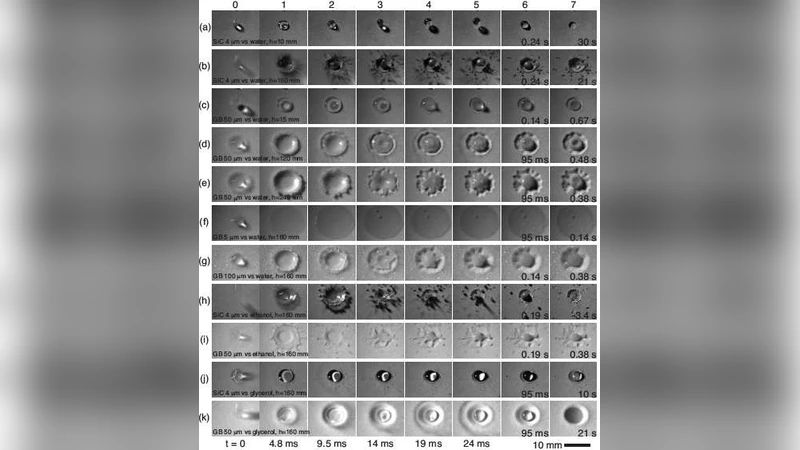
Dynamic observations reveal two distinct crater morphologies: “sink‑type” craters for low impact energies and “ring‑type” craters for higher energies, consistent with earlier work on larger drops. For SiC targets, the crater shape is largely independent of drop size (R₀ ≈ 1.3–2.4 mm) as long as the drop remains in the millimetre regime. Glass‑bead layers exhibit a pronounced fingering instability at the rim when the bead diameter exceeds ≈ 25 µm, producing inner ring structures and, for the largest beads (100 µm), a convex “bump‑type” crater. When the bead size is reduced to 5 µm, the drop does not form a crater; instead it spreads on the surface and rapidly penetrates, a behavior attributed to strong capillary‑bridge cohesion among the hydrophilic beads under laboratory humidity. SiC grains, being more hydrophobic, do not show this deposition even at the smallest grain size.
Time‑scale analysis extracts two characteristic times from the video data: (i) the deformation time t₁, defined as the interval from first contact to maximal flattening, and (ii) the penetration time t₂, the interval from maximal flattening to the moment the drop’s lower surface disappears beneath the granular bed. Both t₁ and t₂ are essentially independent of impact speed, indicating that inertial energy is quickly dissipated and that the subsequent dynamics are governed by material properties rather than the initial kinetic energy. Crucially, t₂ scales with the square root of the liquid’s kinematic viscosity (t₂ ∝ √ν), while t₁ shows only a weak dependence on ν and a modest increase with surface tension γ. This √ν scaling suggests that viscous dissipation within the penetrating liquid dominates the penetration process, analogous to a Poiseuille‑type flow through a porous medium.
Length‑scale analysis focuses on the final crater radius R. The data collapse onto the scaling law previously reported by Katsuragi (Phys. Rev. Lett. 104, 2010):
R ≈ C R₀ (ρ_l v²/γ)^{1/4},
where C is a constant of order unity, ρ_l is liquid density, v is impact speed, and γ is surface tension. Notably, R shows no systematic dependence on liquid viscosity, grain size, or grain material, confirming that the crater radius is set by a balance between inertial pressure and surface tension, independent of the granular substrate’s static strength. The crater depth d correlates linearly with the cross‑sectional area, implying that the granular layer yields plastically under the impact pressure, and that the static shear strength measured by the pillar test is much smaller than the dynamic pressure of the drop.
The authors discuss the role of cohesion in fine, hydrophilic glass beads, where capillary bridges increase the effective shear strength and lead to the observed “deposit” behavior. They also note that the fingering instability is enhanced by surface roughness and larger grain sizes, which promote perturbations at the liquid–granular interface.
In conclusion, the study identifies two governing scalings for liquid‑drop impact on granular media: (1) a viscosity‑controlled time scale t₂ ∝ √ν, and (2) a viscosity‑independent crater‑radius scaling identical to that for non‑cohesive solid projectiles. These findings bridge the gap between solid‑projectile impact studies and fluid‑impact phenomena, offering insight relevant to natural processes such as fossil rain‑drop formation, planetary impacts involving liquid fragments, and industrial applications like ink‑jet printing or rapid spray cooling where liquid droplets interact with particulate substrates.
Comments & Academic Discussion
Loading comments...
Leave a Comment