The role of topology in electrical properties of bacteriorhodopsin and rat olfactory receptor I7
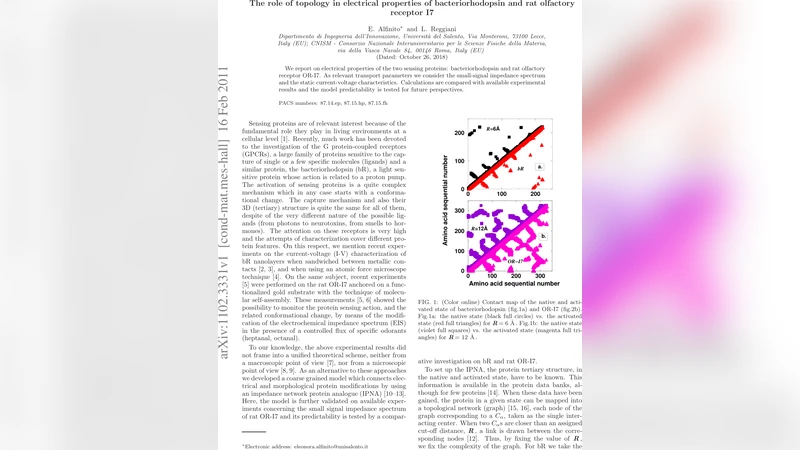
We report on electrical properties of the two sensing proteins: bacteriorhodopsin and rat olfactory receptor OR-I7. As relevant transport parameters we consider the small-signal impedance spectrum and the static current-voltage characteristics. Calculations are compared with available experimental results and the model predictability is tested for future perspectives.
💡 Research Summary
The paper investigates the electrical properties of two sensing proteins—bacteriorhodopsin (bR) and the rat olfactory receptor OR‑I7—by employing a coarse‑grained impedance network model (IPNA) that translates protein topology into an electrical circuit. The authors first obtain the tertiary structures of the proteins in both native and activated states from the Protein Data Bank (PDB) (bR: 2NTU/2NTW; OR‑I7 modeled on bovine rhodopsin). Each Cα atom is treated as a node; a link is drawn between two nodes if their Euclidean distance is less than a chosen cutoff radius R. For bR the optimal R is 6 Å, while for OR‑I7 it is 12 Å, reflecting the different magnitudes of conformational change.
Each link is assigned a complex impedance Zᵢⱼ = ℓᵢⱼ/Aᵢⱼ (ρ⁻¹ + iεᵢⱼε₀ω), where ℓᵢⱼ is the inter‑node distance, Aᵢⱼ a notional cross‑section, ρ the resistivity, εᵢⱼ the relative dielectric constant, and ω the angular frequency. By assembling the full admittance matrix, the overall complex impedance Z(ω) of the protein network is calculated, allowing the generation of Nyquist (real vs. imaginary) and Bode (frequency dependence) plots.
For bR, the Nyquist plot shows an almost semicircular shape; the activated state reduces the static impedance by roughly 10 % compared with the native state when R = 6 Å. This modest change aligns qualitatively with experimental electrochemical impedance spectroscopy (EIS) data reported in the literature. In contrast, OR‑I7 exhibits a much larger effect: with R = 12 Å the static resistance drops by up to 60 % upon activation, matching the experimentally observed impedance decrease when specific odorants (heptanal, octanal) bind to the receptor. Both proteins display increased capacitance and reduced resistance in the activated state, reflecting a more conductive, less resistive network.
To address nonlinear current–voltage (I‑V) behavior, the authors adopt a sequential tunneling mechanism. The tunneling probability between neighboring nodes is approximated by the WKB expression Pᵢⱼ = exp
Comments & Academic Discussion
Loading comments...
Leave a Comment