A Deep Chandra ACIS Study of NGC 4151. I. the X-ray Morphology of the 3 kpc-diameter Circum-nuclear Region and Relation to the Cold Interstellar Medium
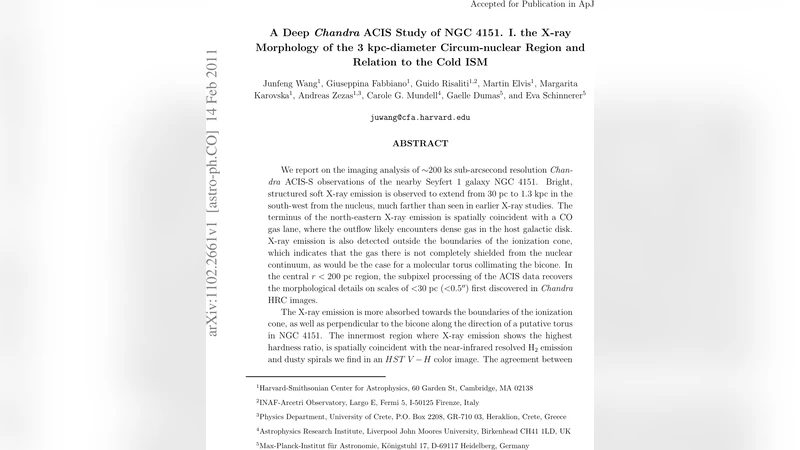
We report on the imaging analysis of 200 ks sub-arcsecond resolution Chandra ACIS-S observations of the nearby Seyfert 1 galaxy NGC 4151. Bright, structured soft X-ray emission is observed to extend from 30 pc to 1.3 kpc in the south-west from the nucleus, much farther than seen in earlier X-ray studies. The terminus of the north-eastern X-ray emission is spatially coincident with a CO gas lane, where the outflow likely encounters dense gas in the host galactic disk. X-ray emission is also detected outside the boundaries of the ionization cone, which indicates that the gas there is not completely shielded from the nuclear continuum, as would be the case for a molecular torus collimating the bicone. In the central r<200 pc region, the subpixel processing of the ACIS data recovers the morphological details on scales of <30~pc (<0.5") first discovered in Chandra HRC images. The X-ray emission is more absorbed towards the boundaries of the ionization cone, as well as perpendicular to the bicone along the direction of a putative torus in NGC 4151. The innermost region where X-ray emission shows the highest hardness ratio, is spatially coincident with the near-infrared resolved H_2 emission and dusty spirals we find in an HST V-H color image. The agreement between the observed H_2 line flux and the value predicted from X-ray-irradiated molecular cloud models supports photo-excitation by X-rays from the active nucleus as the origin of the H_2 line, although contribution from UV fluorescence or collisional excitation cannot be fully ruled out with current data. The discrepancy between the mass of cold molecular gas inferred from recent CO and near-infrared H_2 observations may be explained by the anomalous CO abundance in this X-ray dominated region. The total H_2 mass derived from the X-ray observation agrees with measurement in Storchi-Bergmann et al.
💡 Research Summary
This paper presents a detailed imaging analysis of deep (∼200 ks) Chandra ACIS‑S observations of the nearby Seyfert 1 galaxy NGC 4151, focusing on the morphology of the soft X‑ray emission within the central ∼3 kpc and its relationship to the cold interstellar medium (ISM). By employing sub‑pixel event repositioning and a 0.0625″ pixel scale, the authors achieve an effective resolution better than 0.4″, allowing them to recover structures on scales <30 pc that were previously only seen in HRC data.
The soft X‑ray band (0.3–1 keV) reveals bright, clumpy emission extending from ∼30 pc out to ∼1.3 kpc toward the south‑west (SW). Two distinct knots, labeled “A” at ∼380 pc and “B” at ∼800 pc from the nucleus, are identified for the first time in ACIS images. To the north‑east (NE) the emission reaches ∼1.1 kpc, while the orthogonal NW–SE direction shows a fainter, more compact component limited to ∼200 pc. The authors quantify the impact of photon pile‑up using MARX simulations and the ratio of bad/good ASCA grades, concluding that pile‑up is negligible beyond ∼2″ (∼130 pc) from the nucleus.
Multi‑wavelength comparison is a central part of the study. High‑resolution HST ACS V‑band and NICMOS H‑band images are combined to produce a V–H color map that traces dust extinction and reveals dusty spiral structures within the central 200 pc. The regions of highest X‑ray hardness ratio (1–7 keV / 0.3–1 keV) coincide spatially with these dusty spirals, with the near‑infrared H₂ 2.12 µm line emission, indicating that the same gas is both heavily obscured and strongly irradiated.
The authors compare the X‑ray morphology with CO(1–0) interferometric maps (Dumas et al. 2010). The northeastern terminus of the soft X‑ray emission aligns precisely with a CO gas lane, suggesting that the AGN‑driven outflow encounters dense molecular material in the host galaxy disk. Inside the central 300 pc, CO emission is weak or absent, yet H₂ emission is strong; the authors interpret this as evidence for an X‑ray dominated region (XDR) where CO is destroyed while H₂ survives, consistent with the observed H₂ line flux matching predictions from XDR models.
Spectral fitting of the 0.3–7 keV band shows increased absorbing column densities (N_H ∼10²² cm⁻²) toward the edges of the ionization cone and along the putative torus axis, implying that the gas outside the cone is not completely shielded from the nuclear continuum. This challenges simple torus collimation models and supports a more porous or clumpy obscuring structure.
In summary, the paper delivers several key insights: (1) sub‑pixel ACIS imaging recovers <30 pc X‑ray structures, confirming and extending previous HRC results; (2) soft X‑ray emission extends to kiloparsec scales, interacting with molecular gas lanes and revealing asymmetries likely caused by the inhomogeneous ISM; (3) the spatial coincidence of hard X‑ray, dusty spirals, and H₂ emission supports X‑ray photo‑excitation of molecular gas; (4) the apparent CO deficiency in the innermost region is naturally explained by XDR chemistry; and (5) the observed absorption pattern suggests a leaky torus rather than a perfectly opaque bicone. These findings provide a comprehensive observational framework for understanding AGN feedback on the cold ISM and its role in regulating star formation in the central regions of active galaxies.
Comments & Academic Discussion
Loading comments...
Leave a Comment