X-ray Study of Rekindled Accretion in the Classical Nova V2491 Cygni
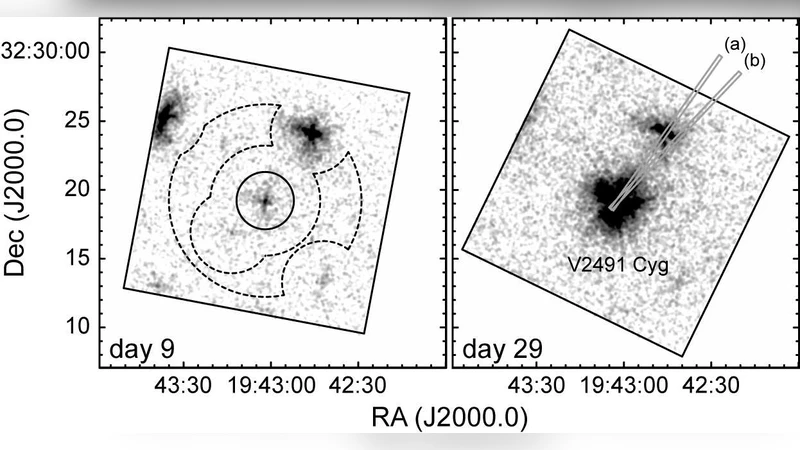
We conducted an X-ray spectroscopic study of the classical nova V2491 Cygni using our target-of-opportunity observation data with the Suzaku and XMM-Newton satellites as well as archived data with the Swift satellite. Medium-resolution (R~10-50) spectra were obtained using the X-ray CCD spectrometers at several post-nova epochs on days 9, 29, 40, 50, and 60-150 in addition to a pre-nova interval between days -322 and -100 all relative to the time when the classical nova was spotted. We found remarkable changes in the time series of the spectra: (a) In the pre-nova phase and on day 9, the 6.7 keV emission line from Fe XXV was significantly detected. (b) On day 29, no such emission line was found. (c) On day 40, the 6.7 keV emission line emerged again. (d) On days 50 and 60-150, three emission lines at 6.4, 6.7, and 7.0 keV respectively from quasi-neutral Fe, Fe XXV, and Fe XXVI were found. Statistically significant changes of the Fe K line intensities were confirmed between day 29 and 50. Based on these phenomena, we conclude that (1) the post-nova evolution can be divided into two different phases, (2) ejecta is responsible for the X-ray emission in the earlier phase, while rekindled accretion is for the later phase, and (3) the accretion process is considered to be reestablished as early as day 50 when the quasi-neutral Fe emission line emerged, which is a common signature of accretion from magnetic cataclysmic variables.
💡 Research Summary
**
This paper presents a comprehensive X‑ray spectroscopic investigation of the classical nova V2491 Cygni, utilizing target‑of‑opportunity observations from Suzaku and XMM‑Newton together with archival Swift data. The authors obtained medium‑resolution (R ≈ 10–50) CCD spectra at several post‑nova epochs (days 9, 29, 40, 50, and 60–150) and also examined a pre‑nova interval (days −322 to −100). Their analysis focuses on the Fe K complex (6–7 keV), which is a powerful diagnostic of high‑temperature plasma and of fluorescence from relatively cold material near the white dwarf (WD).
Key observational results are as follows: (1) In the pre‑nova phase and on day 9, a strong Fe XXV Kα line at 6.7 keV is detected, indicating the presence of hot (∼10⁷ K) plasma. (2) By day 29 the Fe XXV line has vanished, and the spectrum becomes softer, suggesting that the early ejecta have expanded, cooled, and become optically thick to hard X‑rays. (3) The line re‑appears on day 40, implying either reheating of the ejecta or the emergence of a new shock‑heated component. (4) Crucially, on day 50 and later (up to day 150) three distinct Fe K lines are observed simultaneously: neutral Fe I Kα at 6.4 keV, Fe XXV at 6.7 keV, and Fe XXVI at 7.0 keV. The 6.4 keV fluorescence line is a hallmark of hard X‑ray illumination of relatively cold material, most commonly associated with accretion onto magnetic cataclysmic variables (CVs). Its appearance therefore signals that accretion has resumed. The presence of Fe XXVI indicates plasma temperatures of ∼10⁸ K, consistent with the shock‑heated accretion column of an intermediate polar (IP).
Statistical tests confirm that the Fe K line intensities change significantly between day 29 and day 50 (probability < 0.01 %). Based on these temporal trends, the authors propose a two‑phase evolutionary picture for V2491 Cygni:
Phase 1 (≈ 0–40 days) – X‑ray emission is dominated by the nova ejecta. The early hot plasma (Fe XXV) originates from shock heating within the expanding shell; as the ejecta expand and cool, the hard X‑ray component fades.
Phase 2 (≈ ≥ 50 days) – Accretion onto the WD has been re‑established (“rekindled accretion”). The emergence of the neutral Fe I Kα line, together with the high‑ionization Fe XXV and Fe XXVI lines, points to a renewed accretion column that produces hard X‑rays and induces fluorescence on the WD surface.
The authors further note that V2491 Cygni was already an X‑ray source before outburst, a property shared with a few other magnetic novae, suggesting the underlying WD is magnetic. The rapid re‑appearance of the Fe I fluorescence (∼50 days after eruption) is markedly earlier than in previously studied novae (e.g., V2487 Oph, GK Per, CP Pup, V603 Aql), where the line was only seen years after the outburst. This makes V2491 Cygni the first classical nova for which the onset of accretion can be directly traced in the early post‑nova phase via Fe K spectroscopy.
In conclusion, the paper demonstrates that medium‑resolution X‑ray CCD spectroscopy can effectively separate ejecta‑driven and accretion‑driven X‑ray phases in a nova, and that the neutral Fe I Kα line serves as a reliable early indicator of accretion re‑establishment, especially in systems harboring magnetic white dwarfs. The findings have important implications for models of nova evolution, the timescale of accretion recovery, and the role of magnetic fields in shaping post‑nova behavior. Future high‑time‑resolution X‑ray observations, combined with simultaneous optical/UV monitoring, will be essential to refine the physical picture of how accretion resumes after a thermonuclear runaway.
Comments & Academic Discussion
Loading comments...
Leave a Comment