Ologs: a categorical framework for knowledge representation
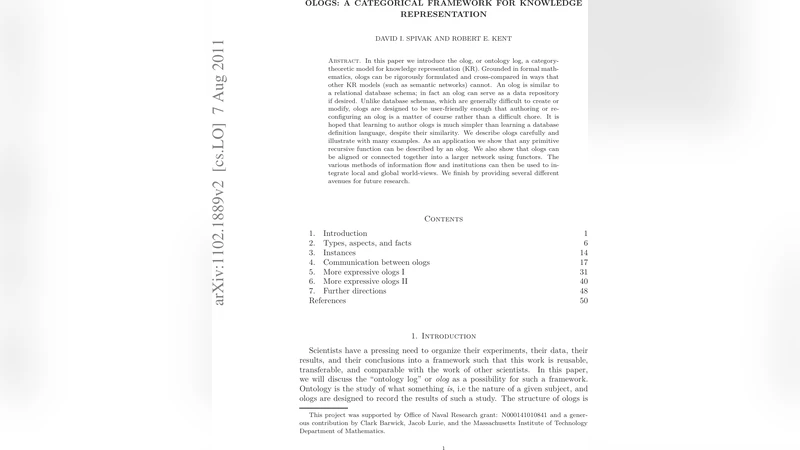
In this paper we introduce the olog, or ontology log, a category-theoretic model for knowledge representation (KR). Grounded in formal mathematics, ologs can be rigorously formulated and cross-compared in ways that other KR models (such as semantic networks) cannot. An olog is similar to a relational database schema; in fact an olog can serve as a data repository if desired. Unlike database schemas, which are generally difficult to create or modify, ologs are designed to be user-friendly enough that authoring or reconfiguring an olog is a matter of course rather than a difficult chore. It is hoped that learning to author ologs is much simpler than learning a database definition language, despite their similarity. We describe ologs carefully and illustrate with many examples. As an application we show that any primitive recursive function can be described by an olog. We also show that ologs can be aligned or connected together into a larger network using functors. The various methods of information flow and institutions can then be used to integrate local and global world-views. We finish by providing several different avenues for future research.
💡 Research Summary
The paper introduces “ologs” (ontology logs), a category‑theoretic framework for knowledge representation that treats concepts as objects, functional relationships as arrows, and factual constraints as commutative diagrams. By labeling each object and arrow with an English phrase, an olog becomes a human‑readable, mathematically precise model that can be directly translated into a relational database schema. Unlike traditional KR formalisms—RDF, OWL, semantic networks, or SQL schemas—ologs combine the descriptive ease of natural language with the rigor of category theory.
Key contributions include: (1) a clear mapping between olog components and database elements (boxes ↔ tables, arrows ↔ foreign keys, instances ↔ rows); (2) the use of functors to align and translate between distinct ologs, enabling modular reuse and precise inter‑ontology communication; (3) the introduction of limits (layouts) and colimits (groupings) to extend basic ologs with expressive constructs such as products, coproducts, and pullbacks, thereby supporting richer modeling patterns; (4) demonstration that any primitive‑recursive function can be encoded as an olog, showing that ologs can capture computational processes; and (5) a formal treatment of ontology integration using the Information Flow and institution frameworks, which provides a principled way to manage constraints across a network of ologs.
The authors contrast ologs with existing KR approaches. RDF triples lack the ability to declare path equivalences, while OWL’s logical constraints differ fundamentally from categorical ones. Semantic networks allow arbitrary relations, not necessarily functional, making them less amenable to categorical reasoning. Ologs, by insisting on functional arrows, inherit the well‑behaved nature of the Set category, allowing safe extensions without breaking existing semantics.
Two illustrative case studies are presented. The first models the factorial function using limits and recursion, proving that the olog formalism can express algorithmic content. The second models pseudo‑metric spaces, a purely mathematical structure, thereby showing that ologs are not limited to empirical domains. Both examples underscore the flexibility of the framework.
The paper also discusses practical aspects: authoring guidelines (“good practice” rules), attaching instance data to an olog (realizing it as a database), and handling discrepancies between world‑views as intentional mismatches rather than errors. The authors argue that such mismatches reflect differing ontological commitments and can be managed through functorial mappings.
Future research directions are outlined: automated extraction of ologs from natural language, scalable storage and versioning of large olog networks, integration with logical inference engines to create hybrid KR systems, and empirical validation across scientific domains such as biology and social sciences.
In summary, the work positions ologs as a mathematically grounded, modular, and extensible alternative to existing KR languages, offering a unified view that bridges human‑centric description and machine‑processable structure.
Comments & Academic Discussion
Loading comments...
Leave a Comment