GRBs in the SWIFT and Fermi era: a new view of the prompt emission
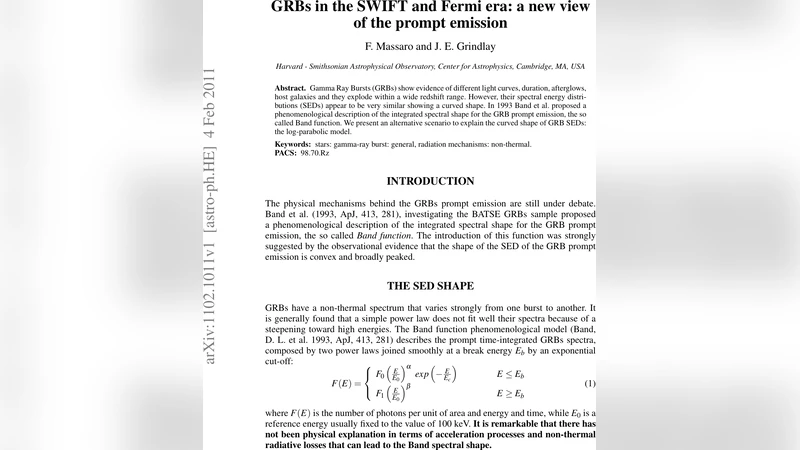
Gamma Ray Bursts (GRBs) show evidence of different light curves, duration, afterglows, host galaxies and they explode within a wide redshift range. However, their spectral energy distributions (SEDs) appear to be very similar showing a curved shape. In 1993 Band et al. proposed a phenomenological description of the integrated spectral shape for the GRB prompt emission, the so called Band function. We present an alternative scenario to explain the curved shape of GRB SEDs: the log-parabolic model.
💡 Research Summary
This paper revisits the spectral description of gamma‑ray burst (GRB) prompt emission, challenging the long‑standing use of the phenomenological Band function. The authors propose a log‑parabolic model, mathematically expressed as F(E)=F₀ (E/E₀)^{‑a‑b log(E/E₀)}, where a is the photon index at a reference energy E₀ (typically 100 keV), b quantifies the curvature, and the peak energy Eₚ and peak flux Sₚ can be derived directly. The log‑parabolic shape corresponds to a log‑normal distribution of particle energies, which naturally arises from a kinetic equation that includes both systematic (e.g., electric fields) and stochastic (e.g., turbulence) acceleration terms together with loss processes such as adiabatic expansion and synchrotron cooling.
Using BATSE and early Fermi‑LAT data, the authors fit both the traditional Band function and the log‑parabolic model to a sample of GRBs, including time‑integrated and time‑resolved spectra. The log‑parabolic fits consistently yield lower reduced χ² values while requiring only three free parameters (b, Eₚ, Sₚ) compared with the four required by the Band function. Importantly, the log‑parabolic model reproduces the observed paucity of high‑energy LAT detections without invoking an ad‑hoc exponential cutoff, which is necessary in the Band framework.
A key observational result is the near‑constancy of the curvature parameter b throughout the rise and decay phases of individual pulses in several long GRBs (e.g., GRB 910927, 941926, 930201, 950818). This stability supports a scenario where adiabatic expansion dominates particle energy losses during pulse decay, while stochastic acceleration maintains the curved electron distribution. Consequently, the spectral curvature does not evolve significantly, in agreement with the predictions of the log‑parabolic kinetic solution.
In summary, the log‑parabolic model offers a more parsimonious and physically motivated description of GRB prompt spectra. It aligns with acceleration theory, explains Fermi‑LAT high‑energy observations without extra parameters, and captures the observed spectral curvature behavior across multiple bursts. The work therefore provides a compelling alternative to the Band function and a solid foundation for future theoretical and observational studies of GRB emission mechanisms.
Comments & Academic Discussion
Loading comments...
Leave a Comment