A small-world of weak ties provides optimal global integration of self-similar modules in functional brain networks
The human brain is organized in functional modules. Such an organization presents a basic conundrum: modules ought to be sufficiently independent to guarantee functional specialization and sufficiently connected to bind multiple processors for efficient information transfer. It is commonly accepted that small-world architecture of short lengths and large local clustering may solve this problem. However, there is intrinsic tension between shortcuts generating small-worlds and the persistence of modularity; a global property unrelated to local clustering. Here, we present a possible solution to this puzzle. We first show that a modified percolation theory can define a set of hierarchically organized modules made of strong links in functional brain networks. These modules are “large-world” self-similar structures and, therefore, are far from being small-world. However, incorporating weaker ties to the network converts it into a small-world preserving an underlying backbone of well-defined modules. Remarkably, weak ties are precisely organized as predicted by theory maximizing information transfer with minimal wiring cost. This trade-off architecture is reminiscent of the “strength of weak ties” crucial concept of social networks. Such a design suggests a natural solution to the paradox of efficient information flow in the highly modular structure of the brain.
💡 Research Summary
The paper investigates how the human brain reconciles the apparent conflict between strong modular organization and the need for efficient global integration. Using phase‑locked BOLD fMRI data from 16 participants performing a dual visual‑auditory task with varying stimulus onset asynchronies, the authors construct functional connectivity matrices based on voxel‑wise phase correlations. By thresholding these matrices at different correlation levels (p) they generate binary networks, but rather than fixing a single threshold, they treat the thresholding process as a percolation problem.
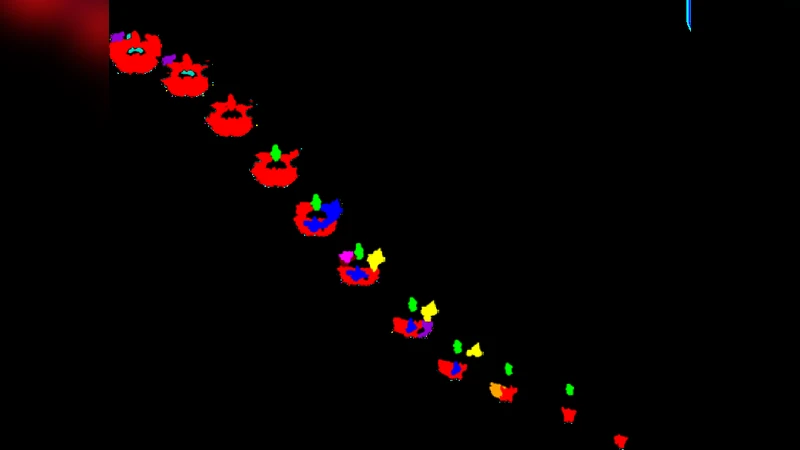
When p is gradually lowered, the size of the largest connected component does not increase smoothly as in classic random percolation; instead it exhibits a series of abrupt jumps. Each jump corresponds to the emergence or merging of a highly correlated cluster, which the authors interpret as a functional module. The first critical point (p_c≈0.979) reveals three large clusters localized to medial occipital, lateral occipital, and anterior cingulate cortices. Further reductions in p lead to hierarchical merging, the appearance of “stubborn” clusters that persist to low p, and eventually the formation of a giant component that still contains distinct sub‑clusters (e.g., thalamic‑striatal and left frontal).
The authors then characterize the internal geometry of these modules. They find power‑law scaling between module mass (number of voxels N_c) and three length measures: maximum topological path length ℓ_max, average shortest‑path distance h_ℓ, and Euclidean diameter r_max. The scaling exponent corresponds to a Hausdorff fractal dimension d_f≈2.1, indicating dense filling of brain volume. To probe self‑similarity across scales, they apply a renormalization‑group (RG) box‑covering algorithm (Maximum Excluded Mass Burning). By covering each module with the minimal number of boxes of side ℓ_B, they obtain N_B ∝ ℓ_B^{-d_B} with d_B≈1.9, confirming fractal organization. Degree distributions within modules follow a power law with exponent γ≈2.1, and under RG transformation node degrees rescale as k’ = s(ℓ_B)·k with s(ℓ_B) ∝ ℓ_B^{d_k}, d_k≈1.5. Modularity metrics also scale with ℓ_B, yielding a high modularity exponent d_M≈1.9.
Crucially, these strong‑link modules behave as “large‑world” structures: they have long average path lengths and would be inefficient for rapid information spread if considered in isolation. The key insight is that the addition of weaker links—edges that fall below the strong‑link threshold—acts as shortcuts that interconnect the modules, converting the overall network into a small‑world while preserving the underlying modular backbone. The spatial arrangement of these weak ties matches theoretical predictions that maximize information transfer while minimizing wiring cost, echoing Granovetter’s “strength of weak ties” principle from sociology.
Thus, the brain appears to employ a dual architecture: robust, self‑similar modules formed by strong functional connections, overlaid with a sparse set of weak connections that provide global integration. This framework resolves the tension between modular specialization and efficient communication, offers a mechanistic explanation for observed small‑world properties in functional brain networks, and suggests that disruptions to weak ties (e.g., in disease, aging, or pharmacological manipulation) could impair global integration despite intact modular structure. The study bridges concepts from percolation theory, fractal network analysis, and social network sociology to provide a comprehensive model of brain functional organization.
Comments & Academic Discussion
Loading comments...
Leave a Comment