Exact dynamics for fully connected nonlinear networks
We investigate the dynamics of the discrete nonlinear Schr\"{o}dinger equation in fully connected networks. For a localized initial condition the exact solution shows the existence of two dynamical transitions as a function of the nonlinearity parame…
Authors: G. P. Tsironis
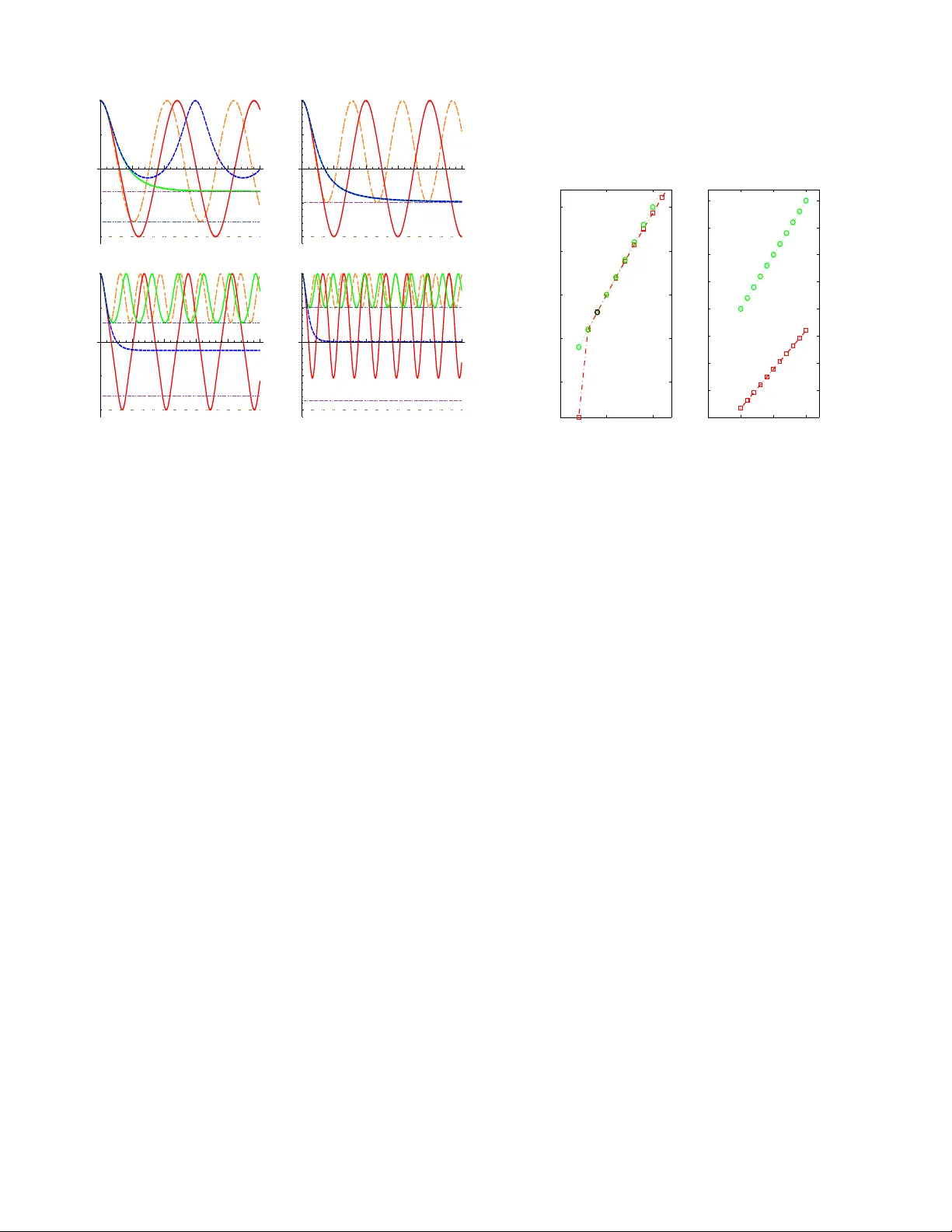
Exact dynamics for fully connected nonlinear networks G. P . Tsiron is Department of Physics, University of Crete and Institute of Electronic Structur e and Laser , FORTH, P .O. Box 220 8, Heraklion 71 003, Cr ete, G r eece. W e in vestigate the dynamics of the discrete nonlinear Schr ¨ odinger equation in fully connec ted netwo rks. For a localized initial condition the exac t solution shows the existen ce of two dynamical transitions as a function of the nonlinearity parameter , a hyperbolic and a trigonometric one. In the latter the netw ork behaves e xactly as the correspondin g linear one b ut with a renormalized frequency . I. INTRODUCTION Nonlinear dynamics in complex networks incorporates competition of propagation, nonlinearity and b ond disorder and may find some applications in co mplex natu ral or man- made materials. For a given rand om n etwork of N sites the limit o f fully coupled lattice wher e each site is con nected to ev ery oth er one with the same streng th plays an important role since, f or ze ro n onlinearity , introdu ces a hig h degree of de- generacy a nd thus localization [1]. It is th erefore interesting to p robe the dynamics in this fully coupled limit when the net- work is nonlinear . W e use the D iscrete Nonlin ear Schr ¨ odinger (DNLS) equ ation for th is study since the latter is a p rototyp i- cal equation with a large number of applications in cond ensed matter physics, optics, Bose-Einstein condensation, etc. [2 – 4]. The DNLS equ ation in the fully coupled or Mean Field (MF) limit is given by : i d ψ n d t = ε n ψ n + V ∑ m 6 = n ψ m − γ | ψ n | 2 ψ n (1) where ψ n ( t ) is a complex amplitude, V d enotes the co nstant overlap integral connectin g any tw o sites, ε n a local site value and γ is a para meter that con trols the stren gth of th e nonlinear term. When t is time, the equ ation d escribes the dyn amics of interacting pa rticles with the nonlin ear ter m rep resenting po - laronic effects or inter action of boson s in an optical lattice. When t is a space variable, th e equatio n describes electric wa ve mo des p ropag ating in fibers t hat include n onlinearity . In the present analysis we take ε n = 0 while the DNLS norm equal to one, viz. ∑ | ψ n | 2 = 1 . For notational simplicity w e rescale tim e to τ = V t and γ to χ = γ / V ; we n ote that for χ > 0 we have the defoc using DNLS equ ation wh ile for χ < 0 we obtain the focusing case. II. REVIEW OF EARLIER LITERA T URE The problem of th e DNL S equation in fully c oupled lat- tices has bee n addressed in the p ast [2, 7 – 10]. Eilbeck et al. [2] analysed th e station ary states of the problem for the general N - site case. M olina and Tsiro nis [7] showed that in the case of N = 3 , i.e. a sy mmetric tr imer, and f or a local- ized initial co ndition, a tran sition occurs for χ = − 6 where the ev olution ceases to be per iodic an d the av eraged pro ba- bility becomes eq ual in all th ree sites. It was also po inted out th at no selftrappin g occ urs fo r po siti ve n onlinear ity val- ues. This dynamical behaviour is analogous, but not identical, to the well known selftrapping transition of the d imer [5, 6]. Andersen and Kenkre [8] so lved an alytically th e symmetr ic trimer case for localized as well as symmetrically delocalized initial cond itions. They wrote exp licitly the time ev olution at selftrating ( χ = − 6), connected it to the stationary states, calculated the averaged occupation probab ility o f the in itially populated site and showed that f or a g iv en value o f the n on- linearity p arameter extreme deloc alization occur s. They also pointed o ut that the nature of selftr apping in the trimer was distinct from that in th e d imer case. Su bsequently , An dersen and Kenkre [9 ] an alysed th e fully connected N -site p roblem using similar methods for localized an d par tially localized in i- tial condition s and showed that a ”migrato ry” transition takes place in some c ases. The latter is related to th e fact that local- ization of the initially non -occup ied sites may occu r for some parameter values. In [9] a g eneral expression in terms o f the W eierstrass elliptic function is given fo r the time ev olu- tion of the oc cupation p robab ility as well as expression s for some special cases. Addition ally the time -av erag ed occupa- tion probab ility is an alysed. Finally , Molin a [10] used a n extension of the metho d of ref. [7] and d etermined explicitly the values o f the n onlinearity param eter at which th ere is a ”transition” for arbitrary values of N . From the pre vious revie w of the existing literature it is clear that th e p roblem of no nlinearity ind uced localization in the fully couple d, MF limit, has been analysed tho rough ly and many of the featu res o f th e solution have been already discov- ered. Howe ver , we b eliev e that a comp lete dynamical p icture has n ot emerged yet. Thus w e will follow the approa ch of ref. [9 ], re-d erive the comp lete dynamical solution and use it to focus on the explicit dyn amics an d not just to the average occupatio n p robab ility . III. NONLINEAR LOCALIZA TION In the pur ely linear case for χ = 0 , Eq. (1) r educes to a lin- ear eig en value problem th at has N − 1 fold d egenerate eigen - values [1]. T his high degree o f d egeneracy forces an initially spatially lo calized state to re main localized executing incom- plete oscillations to the other , initially unoccupied , sites. This linear localization at the in itially excited site in creases with the system size. 2 A. Nonlinear mean field limit For the localized initial con dition we o bserve that if we set initially all pr obability at site on e, the n due to th e symmetry of the lattice, the subsequ ent evolution of all sites except the initially popu lated one will be identical; as a result we can cast the orig inal N -eq uation pr oblem to a simple r one consisting of only two equations, viz. [7 – 10] i ˙ ψ 1 = ( N − 1 ) ψ 2 − χ | ψ 1 | 2 ψ 1 (2) i ˙ ψ 2 = ψ 1 + ( N − 2 ) ψ 2 − χ | ψ 2 | 2 ψ 2 (3) with | ψ 1 | 2 + ( N − 1 ) | ψ 2 | 2 = 1 . T o obtain the set of equa tions 3 we have set ψ 2 = ψ 3 = .. = ψ N at all times. W e proc eed by introd ucing the variable p ( t ) = | ψ 1 | 2 − ( N − 1 ) | ψ 2 | 2 and cast the set of co mplex equations (1) first in to a second or der equation that has the fo rm of Newton’ s law and sub sequently into an eq uiv alent potential prob lem for the localized initial condition p ( 0 ) = 1 [5, 7 – 1 0], viz. ˙ p 2 = U ( p ) ≡ a 0 p 4 + 4 a 1 p 3 + 6 a 2 p 2 + 4 a 3 p + a 4 (4) a 0 = − χ 2 N 2 16 ( N − 1 ) 2 (5) a 1 = − 1 48 ( N − 1 ) 2 [ 3 χ ( N − 2 ) N ( − 2 + χ + 2 N )] (6) (7) a 2 = 1 48 ( N − 1 ) 2 [ 32 χ − 8 χ 2 − 56 χ N + 4 χ 2 N − 8 N 2 + 28 χ N 2 + χ 2 N 2 + 16 N 3 − 4 χ N 3 − 8 N 4 ] (8) a 3 = 1 16 ( N − 1 ) 2 ( N − 2 )( 2 N − 2 + χ )( 8 − 4 χ − 12 N + 3 χ N + 4 N 2 ) (9) a 4 = 1 16 ( N − 1 ) 2 [ 128 − 64 χ + 1 6 χ 2 − 384 N + 144 χ N − 24 χ 2 N + 400 N 2 − 104 χ N 2 + 9 χ 2 N 2 − 160 N 3 + 24 χ N 3 + 16 N 4 (10) (11) W e now form the in variants g 2 , g 3 : g 2 = a 0 a 4 − 4 a 1 a 3 + 3 a 2 2 (12) g 3 = a 0 a 2 a 4 + 2 a 1 a 2 a 3 − a 3 2 − a 0 a 2 3 − a 2 1 a 4 (13) The solution is gi ven in term s of the W eierstrass elliptic func- tion P ( t , g 2 , g 3 ) as follo ws [11 ]: p ( τ ) = 1 − 24 ( N − 1 ) 12 P ( τ , g 2 , g 3 ) + χ 2 + 2 ( N − 2 ) χ + N 2 (14) This solution d epends only o n the non linearity parameter χ and the nu mber of sites N an d presents the exact solu tion of the non linear DNLS pro blem in th e MF lim it for loc alized initial condition and arbitrar y site num ber; it is equiv alent to the so lution in ref. [9] fo r perf ect initial localization on a single site. The W eierstrass function is doubly period ic with periods 2 ω and 2 ω ′ where ω / ω ′ is not r eal. The discriminan t ∆ = g 3 2 − 27 g 2 3 may be expressed as follows ∆ ( N ) = − 1 16 N 2 χ 2 g ( N ) ( χ + 2 N ) (15) g ( N ) = 2 ( N − 2 ) χ 3 + 2 ( N − 2 ) ( 3 N − 8 ) χ 2 + 6 N 3 − 53 N 2 + 112 N − 64 χ + 2 ( N − 1 ) N 3 (16) When the d iscriminant becomes ze ro, the W eierstrass solu - tion chan ges character signalling a ch ange in the phy sical be- haviour o f the system . The quantity ∆ ( N ) h as three r eal roots, denoted h ereafter as χ 0 , χ c and χ ′ c for χ 0 = 0 , g ( χ c ) = 0 and χ ′ c = − 2 N respectively . 3 The root for χ 0 = 0 corr esponds to the linear MF pr ob- lem resulting in g 2 = N 4 / 12, g 3 = N 6 / 216, the W eierstrass function b ecomes a trigonometric functio n, viz. P ( t , g 2 , g 3 ) = − N 2 / 12 + N 2 / 4 sin 2 [( N t / 2 )] and the solution for p ( τ ) is p ( τ ) ≡ p l in ( τ ) = ( N − 2 ) 2 + 4 ( N − 1 ) cos ( N τ ) N 2 (17) a result that agrees with the linear solutions derived in ref. [1]. W e note that in the linear case the system e xecutes oscillations between p = 1 and p l in , M = ( N − 2 ) 2 − 4 ( N − 1 ) / N 2 while p ( τ ) o scillates around < p l in > = ( 1 − 2 / N ) 2 . Only for N = 2 we hav e complete oscillations in the p -rang e 1 , − 1 wh ile for all oth er g eometries the linear system oscillations are incom- plete, viz. ther e is alw ays som e occup ation pr obability at the originally pop ulated site. In th e limit of very large N there is extreme localization at the initially populated site. In o rder to un derstand th e ro le of χ c , χ ′ c in the d ynamical ev olution, it is instructive to address fi rst explicitly the regime for N ≤ 4; althoug h these cases hav e been studied in the p ast, the present expo sition fur nishes ad ditional results and new in- tuition. B. 2 ≤ N ≤ 4 In this ran ge we hav e χ ′ c ≤ χ c with the equ ality holding for N = 4. 1. N=2 In the dime r case we have χ c = 4 an d χ ′ c = − 4; when χ assumes one of these two critical values, the in variants be- come g 2 = 4 / 3 , g 3 = − 8 / 27 , the f requen cies ω = K ( 1 ) = ∞ , ω ′ = i K ′ ( 1 ) = i π / 2 an d the W eierstrass func tion b ecomes a hyperb olic function, v iz. P ( t , 4 / 3 , − 8 / 27 ) = 1 / 3 + 1 / sinh 2 t leading to p ( t ) = sech ( 2 t ) . This situ ation correspon ds to th e well k nown selftrapp ing tran sition fo r a localized initial con- dition wh ere the solution a t the transition is expressed as hy- perbolic secant [ 5]. W e note th at in the d imer case χ c = | χ ′ c | and fo r − χ c < χ < χ c the particle executes co mplete oscilla- tions. 2. N=3 In re f. [7] a tran sition was fou nd occur ring at χ ′ c = − 6, while in ref s. [8, 9] the d ynamical study was perfo rmed. Analysis of the d iscriminant sho ws that in addition to the pre- viously identified ro ot χ ′ c = − 2 N = − 6 there is also the real root of g ( χ c ) = 0 at χ c = − " 1 + 131 6614 − 77 4 √ 43 1 / 3 + 3307 − 38 7 √ 43 1 / 3 3 2 / 3 # (18) or χ c ≈ − 6 . 039 90424 9. For χ = χ ′ c ≡ − 6 the inv ariants ar e g 2 = 3 / 4 , g 3 = − 1 / 8, ω becomes infinite and the W eierstrass fun ction tur ns into a hy perbo lic f unction , viz. P ( t , 3 / 4 , − 1 / 8 ) = 1 / 4 + 3 / 4 h sinh ( p 3 / 4 t ) i − 2 . The time evolution for p ( τ ) be- comes [8] p ( τ ) = 1 3 " 3 − 4 sinh 2 ( p 3 / 4 τ ) 1 + 4 sinh 2 ( p 3 / 4 τ ) # (19) At long times p ( τ ) l im τ → ∞ = − 1 / 3 ≈ − 0 . 333 corr espondin g to equal p robab ility 1 / 3 on all th ree sites an d should be com- pared w ith p l in , M = − 7 / 9 ≈ − 0 . 777 and < p l in > = 1 / 9 ≈ . 111 When χ = χ c both inv a riants are positive and the W eier - strass function turns into a simple trigonom etric function . W e now describe the dyna mics o f the trimer as a functio n of the no nlinearity parameter χ . For χ = 0, p ( τ ) p erforms in- complete oscillation s b etween p ( 0 ) = 1 a nd p l in , M = − 7 / 9. Increasing χ to positive values aug ments gr adually the effect of localizatio n and the par ticle stays almost comp letely at the initial site for large values o f the non linearity pa rameter . For negativ e values of χ , however , the be haviour is mar kedly dif- ferent; upon increasin g χ in absolute value, the par ticle b e- comes m ore d etrapped and per forms oscillation s beyond the p l in , M limit. This behaviour c ontinues as we f urther increase | χ | a nd at χ = − 4 th e p article executes com plete oscillation s to the other sites. Further increase of n onlinearity reduces the amplitude o f the oscillatory motio n while the oscillation pe- riod increases. For χ = χ ′ c there is a transition to a hyp erbolic, non o scillatory b ehaviour; the par ticle collapses from com - plete oscillations to c omplete equipartitio n of pr obability in the three sites (at infinite time s). Th is is a re markable transi- tion since it localizes a gain the particle and all motio n stops asymptotically [7, 8]. As the v alue of | χ | increases f urther, the trapping tenden cy incr eases r apidly and the pa rticle beco mes more trapped in the initial site. As the trimer crosses the value χ c the discrimin ant become s zero again with p ositiv e in variants; this means tha t the time ev olution simplifies to one with trig onometr ic evolution. Al- though this feature is not exceptional in the trimer, it is quite interesting when it ap pears fo r N > 4 ; we will comm ent on this trigono metric tran sition below . The transition at χ ′ c is a self trapping tran sition in the sen se that it forces probab ility e quipartition on all three sites, similar to the correspo nding behaviour in the d imer . It is r emarkab le that n onlinearity first detrap s the p article and af ter r eaching a regime of co mplete oscillatory motion it then for ces th e par- ticle to selftrapping. As a result n onlinear ity first re stores the degeneracy that has be en lifted by the presen ce of more th an two sites and s ubseq uently ac ts in way analogou s to the dimer case, v iz. reache s an equipa rtition state th rough a h yperb olic function transition. 3. N=4 The tetrah edral configu ration obtainned for N = 4 is rath er interesting with χ c = χ ′ c = − 8, g 2 = g 3 = 0 and the W eierstra ss 4 function becom ing a simple rational function P ( t , 0 , 0 ) = 1 / τ 2 leading to the solution p ( τ ) = 1 − 2 τ 2 1 + 4 τ 2 (20) For lo ng times the solution reac hes the value − 1 / 2 wh ile p l in , M = − 1 / 2 an d < p l in > = 1 / 4 . For positive nonlin ear- ities the lo calization tend ency incre ases while for negativ e χ we have first detrappin g, complete oscillations f or χ = − 6 and subsequen t asympo tic equ ipartition at χ = − 8 with the transi- tion being now alge braic as seen in Eq. (20). Further absolute increase o f χ produc es n onlinear lo calization. W e no te that as in the trimer also in the p resent case at χ = χ ′ c we have an asymptotic equipartition o f the probability o n all four sites; in that sence we could use the term ”selftrapping” meaning h ow- ev er the asympto tic an d ir reversible onset of equal probability on all sites. C. N > 4 W e observed from the previous three cases that in the d imer the two roots at χ c and χ ′ c determined two distinct, yet iden- tical in nature, selftrap ping tran sitions. In the trime r χ ′ c was responsible for the hyp erbolic transition, χ c for tr igonom et- ric evolution, while the fact that the two roo ts were eq ual in the te tramer tu rned th e ( unique ) transition to an algebraic one. The (negative) ro ots χ c and χ ′ c ”collide” in the tetramer and we observe that their role changes for N > 4. Specifically , we find that | χ ′ c | > | χ c | , with the algeb raic transition o ccurring at χ c while at χ ′ c we have a specific trigon ometric evolution. For ne gative nonlinearities as we incr ease in absolute value χ we have initially d etrappin g, complete oscillator y motio n followed by subsequent reduction o f the am plitude of the mo- tion that leads to the hype rbolic transition at χ c . This state does no t populate equ ally at long times the sites of the N -mere as in the cases fo r N = 2 , 3 , 4; th e asympto tic pop ulation o f the initially excited site is n ow larger th an that of the other sites. Fur ther increase of | χ | leads to p eriodic motion with in- creasing amp litude reduction . As th e no nlinearity parameter crosses the value χ ′ c = − 2 N the dy namics b ecomes trigono - metric while, at the same time th e amplitud e o f o scillation becomes identical to that of the cor respond ing linea r N - mere. Thus at χ ′ c the n onlinear system beha ves identically to the cor- respond ing linear o ne in what regards the site prob abilities, nevertheless the ev olution is done with different fre quency . Further increase of nonline arity leads to mor e localization. The value o f χ c is determin ed n umerically f rom the solu- tion o f th e cubic equa tion g ( χ c ) = 0; the values obatain ed coinside with those fou nd in ref. [10]. W e observe that as N increases this root separates from the one at − 2 N and asymp- totically r eaches the value − N . Thus in a very large system we expect to have the hyper bolic self traping at non linearity values of ord er − N while at − 2 N the no nlinear system be- haves as the correspon ding linea r one with renor malized fr e- quency . W e also o bserve th at the sy stem r eaches a regime of complete oscillations for χ ′ = − 2 ( N − 1 ) while χ ′ ≤ χ ′ c ≤ χ c | . For N > ∼ 15 the equality for χ ′ does not h old any mo re an d the system begins to e xecute incomplete oscillations reaching a maximu m at χ ′ < ∼ χ c . T hus, while fo r N < 14 the parti- cle fir st reac hes com plete delo calization and at a later stage relaxes hyp erbolicaly , for N > ∼ 15 the two pheno mena occ ur almost f or the same χ -value, first reaching a maximu m in the delocalization and subsequ ently , for infinitesimal chang e in the χ -value, hyperbo lic-type evolution. In this last regime the maximum excursing occurs for χ very clo se to the hyperbo lic transition value χ c . The exact expression f or the ev olutio n at th e trig onome tric transition at χ ′ c = − 2 N for N > 4 is given by: p ( τ ) = 4 − 6 N + N 2 + 2 ( N − 2 ) cos p N ( N − 4 ) τ N h N − 2 − 2 cos p N ( N − 4 ) τ i (21) The oscillation extends f rom p max = 1 to p min = ( N 2 − 8 N + 8 ) / N 2 ; these values are id entical to th e o ne o btainned fo r th e linear MF limit. T hus, in the MF limit o f the DNLS equa- tion there a re two values o f the nonlinear ity parameter, viz. χ = 0 and χ ′ c at which an initially lo calized excitation os- cillates trig onome trically with the same amplitude , but with completely differenent frequ encies. In th e second case, the fi- nite value of no nlinearity is equiv alent to a ” polaron ic” d ress- ing of the excitation leading to a smaller oscillation frequency compare d to the pu rely linear oscillation at χ = 0. The hype rbolic transition a t χ c is g iv en, on th e oth er h and, by p ( τ ) = 1 − 24 ( N − 1 ) 12 c h 1 + 3 sinh 2 [ √ 3 c τ ] i + χ c 2 + 2 ( N − 2 ) χ c + N 2 (22) where c is the value of the d ouble r oot o f the discriminan t of the equation x 3 − g 2 x − g 3 = 0 while the other root is equal 5 1 2 3 4 5 Τ - 1.0 - 0.5 0.5 1.0 p H Τ L 1 2 3 4 5 Τ - 1.0 - 0.5 0.5 1.0 p H Τ L 1 2 3 4 5 Τ - 1.0 - 0.5 0.5 1.0 p H Τ L 1 2 3 4 5 Τ - 1.0 - 0.5 0.5 1.0 p H Τ L H a L H b L H c L H d L FIG. 1 : (Color online) Exact d ynamics for fully connected netwo rks: probability p ( τ ) of Eq. (14) as a function of t he rescaled ti me τ . Each subfigure is for a network with different size and specific nonlinear - ity . In all plots the periodic continuous red line presents the motion for localized initial condition and for the specific N and χ while the dashed orange line t he solution of the corresponding linear network. The continou s green line is the solution at χ = χ ′ c ≡ − 2 N while the dashed blue line the solution at χ = χ c . T he three horizontal lines parallel to the time axis deno te the maximum ex cursion for the cor- responding linear netw ork p l in , M (blue dashed), the equ ipartition line at 1 − 1 / N ( purple) an d the maximum range for the prob ability p ( τ ) at − 1 (dashed with spaces). In (a) N = 3 and χ = − 4. W e note the restauration of complete oscillations to − 1 due to nonlinearity and the trigonometric e volution (blue curv e) t hat in the presen t case is distinct from the purely linear motion (dashed orange curve). (b) N = 4 and χ = − 6. The green and blue curves collapse onto a sin- gle algebraically de caying solution ( χ c = χ ′ c = − 8 that relaxes to the equipartition line, while complete periodic motion to the other sites is also obse rved (red curve reaching − 1). In this case the maximum linear ex cursion also reaches to the equ ipartition line. (c) N = 10 and χ = − 18. The so lutions for the roots at χ c ≃ − 19 . 333 an d χ ′ c = − 20 hav e now changed roles with the former (blue line) designating the hyperbolic t ransition (to non-equipartition- equipartition i s denoted by the dashed purple line) while the latter (green line) f orcing t he network to pure trigonometric evolution with the same amplitude as for the linear ( χ = 0) case. In (d) N = 15 and χ = − 15 we observe similarly the hyperbolic trannsition ( χ c ≃ − 27 . 9772, blue line) to non-equipa rtition as well as the tw o trigono metic e volutions for χ = 0 (dashed orange line) and χ ′ c = − 20 (green line) to − 2 c . The pre sence of fo cusing nonlin earity induces comp lete or partial detrappin g to the MF network f ollowed b y retrapping for larger | χ | . The exact solutio n of the non linear model for arbitrary N shows thus v ery interesting f eatures of detrapping , hyperb olic r elaxation as well as effectiv e linearization of the nonlinear system. As the network size N grows, these interest- ing fearures app ear fo r increa singly larger values o f the non - linearity pa rameter | χ | , a featu re that makes th eir o bservation more d ifficult. The time evolution for various networks is pre - sented in Fig. (1) while the special non linearity v alues χ c and χ ′ c as a f unction of the system size N are portrayed in Fig. (2). 0 5 10 0 5 10 15 20 N − χ c , − χ c ′ 45 50 55 60 80 85 90 95 100 105 110 115 120 N − χ c , − χ c ′ FIG. 2: ( Color on line) Plot of the v alues − χ c (red) and − χ ′ c (green) as a function of the network size for two region s: Left panel, for N < 12 and right panel for 50 < N < 60. The black circle designates the ”collision” of the two branches at N = 4. For larg e- N χ c ∼ − N [10], while χ ′ c = − 2 N for any system size. IV . CONCLUSIONS The analy sis of the MF m odel for th e DNLS equa tion with a lo calized in itial cond ition and arbitrary number o f sites N shows that the system is r ich and h as interesting dyna mical behaviour . In the lin ear ca se ( χ = 0 ) th e pr esence of the long range b onds leads to localization that in creases with N [ 1]. As fo cusing no nlinearity is tu rned on we observe in itially a tendency for detrappin g, i.e. th e particle executes oscillations of larger amplitude that can reach complete or partial ( N > ∼ 15) escape from the initially populated site. The time depen dence of th e system is typical of elliptic function dep enden ce, v iz. period ic oscillato ry motio n that includes an in finite nu mber o f f requenc ies. This time d e- penden ce ch anges for two specific values of the n onlinear- ity p arameter at χ c and χ ′ c respectively . For the fo rmer value the time evolution b ecomes h yperb olic (except in the trimer where th e hy perbo lic e volution occur s at χ ′ c ) an d periodic mo- tion ceases at lon g times. In the we ll studied case o f N = 2, the state fo r this cr itical nolin earity sep arates per iodic d elo- calized fr om loca lized motion and we have selftra pping. For N = 3 , 4, while there is no such separ ation in the hyperb olic transition, there is asymptotic equip artition o f pro bability fo r this value. For N > 4 th e h yperb olic solution at χ c simply rep - resents a n asymp totic state where motion ceases while the in i- tially pop ulated site retains most of the probability , a ten dency that in creases with N . Th us, if by ”selftrapp ing” we mean the separation of delocalized to localized motion then, s trictly 6 speaking, it on ly occur s in the d imer case. On th e oth er han d we may extend the term to include the case where asymptotic equipartitio n o f pro bability takes p lace; in this case the sym- metric trimer and tetramer also qualify , b ut not networks with larger number of sit es. A new feature app ears at χ = χ ′ c ( χ = χ c in the trimer) ; the elliptic f unction evolution beco mes tr igonom etric and the in - finite set o f fr equencies it enco mpasses co llapses to a single one. Addition ally , for N > 4 , the amp litude of the o scillation becomes iden tical to the corr espondin g o ne for χ = 0. Thus the ev olution at χ ′ c is effecti vely linear but with a n ew fre- quency equal to p N ( N − 4 ) (for N > 4) while in the pu rely linear case the frequ ency is N [1]. If we th ink that the nonlin- ear term stems f rom the couplin g with ad ditional degrees of freedom [12] then the evolution becomes mo re slugg ish since the particle is dressed and carries with it the ad ditional degrees of freed om. I t is rema rkable that such a dressing lea ding to frequen cy renorma lization m ay oc cur and still the evolution be trigonometric with the same amplitude as in the purely lin- ear case. In th e large- N limit th e two freq uencies app roach one the other . As the size of the system increases we observe two distinct features, o ne at χ c ∼ − N where time-hy perbo lic b ehaviour takes place w hile at χ ′ c = − 2 N whe re we have an effecti ve linearization of the motion. Both features appear after the ini- tial de traping a nd retr aping h as o ccurred as a f unction o f | χ | . The onset of nonlinea r lo calization is typically associated with discrete breather solutions that are localized in space and time periodic. T he case for χ = χ ′ c found here would then corre- spond to a ”line ar brea ther”, i.e. a lo calized nonlin ear solution with exact trig onom etric e volution. It would b e inte resting to find o ut if a similar situation ca n o ccur in o ther discrete n on- linear systems as well. [1] F . Perakis and G. P . Tsironis, Phys. Lett. A 375 , 676 (2011). [2] J.C. Eilbeck, P . S . Lomdahl and A. C. Scott, Physica D 16 , 318 (1985). [3] B. P . Anderson and M. A. Kase vich, Science 282 , 1686 (1998). [4] F . Lederer , G. I. Stegema n, D. N. Christodoulides , G. Assanto, M. Sege v , Y . Silberberg, Phys, Rep. 46 3 1, (20 08) [5] V . M. Kenkre and D. K. Campbell, P hys. Rev . B 34 , 4959 (1986). [6] G. P . Tsironis and V . M. K enkre, Phys. Lett. A 1 27 , 209 (1 988). [7] M. I. Molina and G. P . Tsironis, Physica (Amsterdam), 65D , 267 (1993). [8] J. D. Andersen and V . M. Kenk re, Phys. Stat. Sol. B 177 , 397 (1993). [9] J. D. Andersen and V . M. Kenk re, P hys. Rev . B 47 , 11134 (1993). [10] M. I. Molina, Mod. Phys. Lett. B 13 , 225 (1999). [11] M. Abramo witz and I. A. Stegun, Handbook of Mathematical Functions , Dover , New Y ork (1965). [12] D. Hennig and G. P . Tsironis, Phys. Rep. 307 , 333 (1999).
Original Paper
Loading high-quality paper...
Comments & Academic Discussion
Loading comments...
Leave a Comment