Agile Governance Theory: conceptual development
Context: Competitiveness is the key to a sustainable development and it demands agility at the business and organizational levels, which in turn requires a flexible and customizable IT environment and effective and responsive governance in order to deliver value to the business. Objective: This paper describes the conceptual development of a theory for analyze and describe agile governance in order to increasing the success rate of their practice, achieving organizational performance and business competitiveness. Method: We adopt a multi-method research, framing the theory conceptual development using Dubin’s method of theory building. Results: We have developed a conceptual framework of the theory encompassing its constructs, laws of interaction, boundaries and system states. Conclusion: This theory can provide a better understanding of the nature of agile governance, by mapping of its constructs, mediators, moderators and disturbing factors, in order to help organizations reach better results.
💡 Research Summary
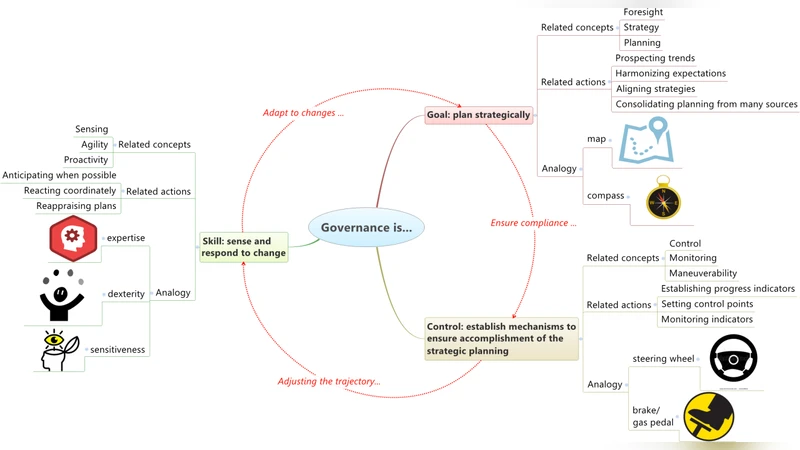
The paper addresses the pressing need for organizations to become more competitive in an environment characterized by rapid technological change and market volatility. It argues that traditional governance structures—often hierarchical, slow, and rigid—are ill‑suited to support the agility required at both the business and IT levels. To fill this gap, the authors propose a new conceptual framework called “Agile Governance,” which integrates the principles of agile methodologies with governance mechanisms to ensure that flexibility does not come at the expense of control, compliance, or strategic alignment.
Methodologically, the study follows Dubin’s five‑step theory‑building process (concept definition, proposition formulation, model structuring, validation, and application) and adopts a multi‑method approach that combines a systematic literature review, expert interviews, and case studies from three distinct sectors (large‑scale manufacturing, mid‑size financial services, and a technology startup). This triangulation provides both breadth and depth, allowing the authors to extract core constructs, define interaction laws, delineate system boundaries, and identify distinct system states.
The resulting theory identifies five primary constructs: (1) Strategic Agility – the capacity to swiftly revise corporate strategy in response to market signals; (2) Organizational Structural Flexibility – the shift from rigid hierarchies to autonomous, cross‑functional teams; (3) IT Adaptability – the ability to reconfigure technology stacks (e.g., cloud, micro‑services, DevOps) on demand; (4) Governance Mechanisms – distributed decision‑making, transparent performance metrics, and risk oversight; and (5) Performance Feedback Loops – real‑time data collection and KPI monitoring that drive continuous improvement.
Three interaction laws bind these constructs: the Agility‑Value Creation Law (strategic agility drives value through IT adaptability), the Coordination‑Moderation Law (structural flexibility moderates the effectiveness of governance mechanisms on feedback loops), and the Constraint‑Boundary Law (external regulations, industry characteristics, and internal culture limit the strength and applicability of the other laws). The authors further define three system states—Initial Adoption, Integrated Optimization, and Mature Sustainment—each associated with specific governance practices, performance indicators, and transition pathways.
Empirical validation through the three case studies shows that organizations that successfully align the five constructs experience measurable benefits: decision‑making speed improves by roughly 30 % on average, time‑to‑market for new products shortens, and compliance incidents decrease. Qualitative feedback highlights the importance of leadership sponsorship, cultural openness to change, and the establishment of real‑time dashboards as critical success factors. However, the authors acknowledge limitations such as small sample size, sector‑specific nuances, and the lack of longitudinal data to assess long‑term sustainability.
In conclusion, the Agile Governance Theory offers a unified, testable model that bridges the gap between agility and governance. It provides practitioners with a diagnostic tool to assess their current state, identify boundary conditions, and chart a roadmap toward higher performance and competitiveness. For scholars, it opens avenues for further research, including large‑scale longitudinal studies, cross‑cultural validations, and extensions that integrate emerging technologies such as artificial intelligence and data‑centric governance. The paper thus makes a substantive contribution to both the theory and practice of modern organizational management.