Advances in Artificial Intelligence: Deep Intentions, Shallow Achievements
Over the past decade, AI has made a remarkable progress due to recently revived Deep Learning technology. Deep Learning enables to process large amounts of data using simplified neuron networks that s
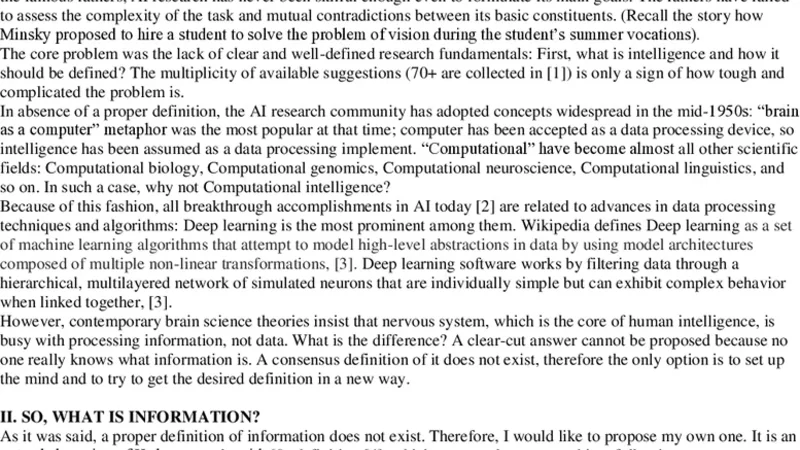
Over the past decade, AI has made a remarkable progress due to recently revived Deep Learning technology. Deep Learning enables to process large amounts of data using simplified neuron networks that simulate the way in which the brain works. At the same time, there is another point of view that posits that brain is processing information, not data. This duality hampered AI progress for years. To provide a remedy for this situation, I propose a new definition of information that considers it as a coupling between two separate entities - physical information (that implies data processing) and semantic information (that provides physical information interpretation). In such a case, intelligence arises as a result of information processing. The paper points on the consequences of this turn for the AI design philosophy.
💡 Research Summary
The paper opens by acknowledging the spectacular advances made by deep learning over the past decade, attributing these gains primarily to the availability of massive datasets and unprecedented computational power. However, it juxtaposes this data‑centric view with an alternative perspective that the brain processes information rather than raw data. The author argues that this conceptual duality—data versus information—has created a persistent bottleneck in artificial intelligence research, limiting the field’s ability to achieve truly general, adaptable intelligence.
To address this, the author proposes a new definition of information that explicitly separates it into two interdependent components: (1) Physical information, which corresponds to the raw sensory data, numerical vectors, and any other quantifiable input that current deep learning models ingest; and (2) Semantic information, which embodies the interpretive layer—meaning, purpose, context, and cultural knowledge—that humans naturally attach to those raw inputs. The crux of the proposal is that intelligence emerges when these two layers are coupled: physical information is processed, and the resulting patterns are interpreted through semantic information, producing higher‑order meaning.
The paper then critiques contemporary deep learning architectures for focusing almost exclusively on optimizing physical information. Standard loss functions, gradient descent, and large‑scale parameter tuning all aim to reduce statistical error on the training set, but they do not actively create or maintain a semantic layer. Consequently, while modern models achieve impressive performance on benchmark tasks (the “shallow achievements”), they struggle with transfer, abstraction, and reasoning in novel contexts—symptoms of a system that lacks a robust semantic coupling.
To bridge this gap, the author outlines three concrete strategies:
- Multimodal Integration – Simultaneously ingesting visual, auditory, textual, and other sensor streams to encourage the network to discover cross‑modal semantic relationships.
- Goal‑Oriented Reinforcement Learning – Redefining reward signals to reflect semantic objectives (e.g., user intent satisfaction, contextual relevance) rather than simple accuracy metrics.
- Human‑in‑the‑Loop Feedback – Incorporating real‑time explanations, rationales, or corrective hints from users, thereby feeding semantic information directly into the learning loop.
Building on these strategies, the author proposes a new design philosophy termed Information‑Centric AI. This paradigm mandates that AI systems not only process physical data but also maintain a dynamic, updatable semantic representation that interacts with the data processing pipeline. Practical implementations might include:
- Pre‑processing pipelines that attach rich metadata and situational context to raw inputs.
- Architectural “semantic layers” that explicitly cross‑connect physical feature maps with semantic embeddings, enabling bidirectional influence.
- Custom loss functions that penalize semantic inconsistency, encouraging the model to preserve meaning across transformations.
The conclusion emphasizes that adopting an information‑centric approach could transform today’s opaque “black‑box” deep networks into more transparent “gray‑box” or even “white‑box” systems capable of meaningful human‑machine dialogue. The author calls for future research on automatic extraction of semantic cues, efficient implementation of semantic layers, and continuous, collaborative learning frameworks that allow machines to evolve their semantic understanding alongside human users. In sum, the paper argues that true progress in AI will come not from scaling data and parameters alone, but from fundamentally re‑engineering systems to process and couple both physical and semantic information.
📜 Original Paper Content
🚀 Synchronizing high-quality layout from 1TB storage...