The Theory of the Interleaving Distance on Multidimensional Persistence Modules
In 2009, Chazal et al. introduced $\epsilon$-interleavings of persistence modules. $\epsilon$-interleavings induce a pseudometric $d_I$ on (isomorphism classes of) persistence modules, the interleaving distance. The definitions of $\epsilon$-interlea…
Authors: Michael Lesnick
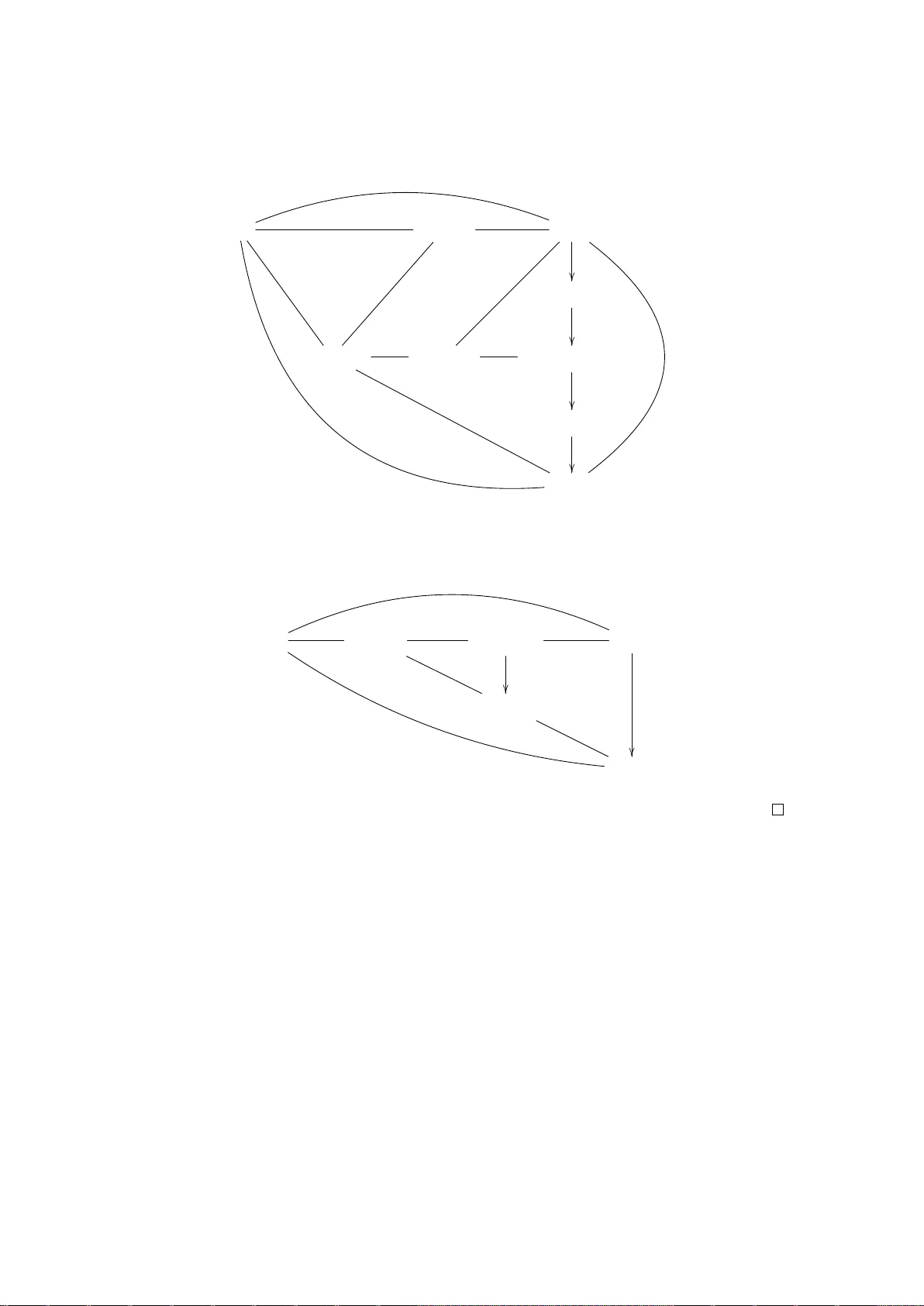
The Theory of the In terlea ving Distance on Multidimensional P ersistence Mo dules Mic hael Lesnic k ∗ Institute for Mathematics and its Applications Abstract In 2009, Chazal et al. in tro duced -interle avings of p ersistence modules. - in terleavings induce a pseudometric d I on (isomorphism classes of ) persistence mo d- ules, the interle aving distanc e . The definitions of -interlea vings and d I generalize readily to multidimensional persistence mo dules. In this pap er, w e develop the theory of m ultidimensional interlea vings, with a view tow ards applications to top o- logical data analysis. W e presen t four main results. First, w e sho w that on 1-D persistence modules, d I is equal to the b ottlenec k distance d B . This result, which first app eared in an earlier preprin t of this pap er, has since app eared in several other places, and is now kno wn as the isometry the or em . Second, we presen t a characterization of the -in terleaving relation on multidi- mensional p ersistence mo dules. This expresses transparen tly the sense in which tw o -in terleav ed mo dules are algebraically similar. Third, using this characterization, w e show that when w e define our p ersistence mo dules o ver a prime field, d I satisfies a universalit y prop ert y . This universalit y result is the cen tral result of the paper. It says that d I satisfies a stabilit y prop ert y generalizing one whic h d B is known to satisfy , and that in addition, if d is any other pseudometric on multidimensional p ersistence mo dules satisfying the same stabilit y prop ert y , then d ≤ d I . W e also show that a v arian t of this universalit y result holds for d B , ov er arbitrary fields. Finally , w e show that d I restricts to a metric on isomorphism classes of finitely presen ted m ultidimensional p ersistence modules. 1 In tro duction 1.1 Bac kground and Motiv ation P ersistent Homology P ersistent homology is a top ological to ol for studying the global, non-linear, geometric features of data. In the last decade and a half, it has b een applied widely [9, 32] and has b een the sub ject of a large b o dy of theoretical work. P ersistent homology pro vides algebraic in v arian ts, called p ersistenc e mo dules , of a v ariety of t yp es of data, including finite metric spaces and R -v alued functions. Let R ∗ mlesnic k@ima.umn.edu. AMS Sub ject Classification 55, 68. Key phrases: multidimensional p ersistence, stabilit y of p ersisten t homology , persistence modules, in terleavings, algebraic stability , isometry theorem. 1 denote the p oset category of real num b ers, and let V ect denote the category of vector spaces ov er some fixed field k . W e define a p ersistence mo dule to b e a functor R → V ect . T o construct a p ersistence mo dule from a data set, we first asso ciate to our data a filtr ation , i.e., a functor F : R → T op that maps eac h element of hom( R ) to an inclusion. F or example, if our data is an R -v alued function γ : T → R , for T a top ological space, w e ma y take F to b e the sublevelset filtr ation S ( γ ), defined by S ( γ ) t = { y ∈ T | γ ( y ) ≤ t } , t ∈ R . Since S ( γ ) s ⊂ S ( γ ) t whenev er s ≤ t , this indeed gives a filtration. Letting H i : T op → V ect denote the i th singular homology functor with co efficien ts in k , w e obtain a persistence mo dule H i F for any i ≥ 0. H i F algebraically enco des geometric information ab out our data. The structure theorem for persistence mo dules of [26] tells us that if M is a p er- sistence mo dule whose v ector spaces are finite dimensional, then M decomposes in an essen tially unique wa y in to simple indecomp osables called interval p ersistenc e mo dules ; see Section 3. The in terv al persistence mo dules are parameterized by the non-empt y in terv als in R . Hence, w e may asso ciate to M a collection of interv als B M whic h indexes the indecomp osables of M . W e call B M the b ar c o de of M . W e usually w ork with the p ersistence modules H i F by wa y of their barco des; w e regard each interv al in B H i F as a top ological feature of our data, and we interpret the length of the interv al as a measure of significance of that feature. The Bottleneck Distance Both theory and applications of p ersisten t homology mak e extensiv e use of pseudometrics on barco des. The b ottlene ck distanc e d B , a readily com- puted [23] and particularly w ell-b eha ved pseudometric on barco des, is the most common c hoice. W e give the definition of d B in Section 3.1. Stabilit y theorems for p ersisten t homology [16, 17, 23] and theorems ab out inferring p ersisten t homology from p oint cloud data [21, 22] are usually formulated using d B . Moreo ver, many applications of p ersisten t homology to shap e comparison and related tasks [4, 8, 14, 24, 44] rely in an essen tial wa y on computations of d B and its v ariants. Via the corresp ondence betw een p ersistence modules and their barco des, w e can regard d B as a pseudometric on p ersistence mo dules. Multidimensional P ersistent Homology . In 2006, the authors of [13] introduced a multidimensional generalization of p ersisten t homology . Whereas ordinary p ersisten t homology maps filtrations to p ersistence mo dules, m ultidimensional p ersisten t homology maps n -dimensional filtr ations to n -dimensional p ersistenc e mo dules , in essentially the same wa y . F or n ≥ 1, define a partial order on R n b y taking ( a 1 , . . . , a n ) ≤ ( b 1 , . . . , b n ) if and only if a i ≤ b i for all i , and let R n denote the asso ciated p oset category . W e define an n - dimensional filtration F to b e a functor R n → T op that maps each elemen t of hom( R n ) to an inclusion, and we define an n -dimensional p ersistence mo dule to be a functor R n → V ect . In Section 2.1, w e giv e an equiv alent definition of an n -D p ersistence mo dule as a graded mo dule ov er a monoid ring. As in the 1-D case, for F an n -dimensional filtration, H i F is an n -dimensional p ersistence mo dule. 2 n -dimensional filtrations, n > 1, arise naturally from data in a n umber of w ays. W e briefly describ e tw o of these wa ys. Example 1.1. As observ ed in [15, 35], an y function γ : T → R n on a top ological space T giv es rise to an n -dimensional sublevelset filtr ation S ( γ ), defined by S ( γ ) a = { y ∈ T | γ ( y ) ≤ a } , a ∈ R n . This generalizes the sublevelset filtration introduced ab ov e in the case n = 1. F requently in top ological data analysis, we hav e several R -v alued functions γ 1 , γ 2 , . . . , γ n : T → R , whic h we can regard as a single function γ : T → R n . F or example, such ensembles of functions arise naturally in shap e and image classification applications [1, 4, 42], [9, Sec- tion 5.2] and in the study of time-v arying data [25]. In these settings, the multidimen- sional p ersisten t homology of S ( γ ) generally enco des muc h more information ab out the ensem ble of functions γ than can b e enco ded using 1-D p ersisten t homology . Example 1.2. As explained in [13], multidimensional filtrations also arise naturally as in v arian ts of metric spaces. In top ological data analysis, we often study a finite metric space P b y considering its Vietoris-Rips filtr ation Rips( P ). This is the 1-dimensional simplicial filtration defined b y taking Rips( P ) t to be the maximal simplical complex with 0-sk eleton P and 1-simplices the edges [ p, q ] with d ( p, q ) ≤ 2 t . While for an y i ≥ 0, H i Rips( P ) is stable to p erturbations of the metric [17], it is highly unstable to the addition and remov al of outliers in P . Relatedly , H i Rips( P ) is insensitiv e to v ariation in the density of p oin ts in P . T o address these issues, [11] and [13] suggested that we consider a c o density function γ : P → R , a function on P whose v alue is lo w at dense p oin ts and high at outliers [13, 45]. γ can b e defined using the metric structure on P alone, using for example a k -nearest neighbors densit y estimate [13]. Giv en γ , w e ma y define a 2-dimensional filtration Rips( γ ) b y taking Rips( γ ) ( a,b ) = Rips( γ − 1 ( −∞ , a ]) b . The 2-D p ersistence mo dules H i Rips( γ ) are more robust to noise and more sensitive to v ariations of density than the 1-D p ersistence mo dules H i Rips( P ). (See also [18], which constructs a different 2-D filtration from p oin t cloud data in w ay that is also robust to noise.) More generally , any function γ : P → R n yields an ( n + 1)-dimensional filtration Rips( γ ), in essen tially the same wa y . There are sev eral other in teresting functions γ whic h w e can define from the metric structure on P alone. F or example, as suggested in [13], w e may tak e γ : P → R to be an e c c entricity function , some measure of cen tralit y of p oin ts in P . Or we ma y take γ : P → R to simply b e the distance to a fixed p oin t p ∈ P . When γ is induced from the metric on P , Rips( γ ) top ologically enco des information ab out the metric; for different choices of γ , Rips( γ ) enco des different kinds of information. 3 The Difficulty of Defining Barco des for Multi-D P ersistence Mo dules While m ultidimensional p ersistence mo dules are far richer in v ariants than their 1-dimensional coun terparts, they also are far more complex. As a consequence, the definition of a barco de do es not extend to multidimensional p ersistence mo dules in any completely satisfactory wa y . A finitely presented n -D p ersistence mo dule M can b e written in an essentially unique w ay as a direct sum of indecomposables; this follows easily from a standard form ulation of the Krull-Sc hmidt theorem [2]. Thu s, in principle, w e can define the barco de B M of M as we do in the 1-D case, as the collection of isomorphism classes of the indecomp osables of M . Ho w ever, it follo ws easily from Gabriel’s theorem in the theory of quiver represen tations [30, 36] that for n > 1, the set of isomorphism classes of finitely presented, indecomp osable, n -D p ersistence mo dules is extremely complicated. Th us, the inv ariant B M will generally b e far to o complicated to b e useful in the w ays that the barco de of a 1-D p ersistence mo dule is t ypically useful. In particular, there seems to b e no naiv e wa y to define a multidimensional generalization of the b ottlenec k distance in terms of suc h generalized barco des B M . Naiv ely , one migh t hope to giv e a differen t definition of the barco de of M , as a collection of nice subsets of R n , muc h as the barco de of a 1-D p ersistence mo dule is defined as a collection of nice subsets of R . Ho wev er, in a sense that can be made precise, there is no go od wa y of form ulating such a definition when n > 1, even if we allo w our inv ariant to b e incomplete. Distances on Multidimensional P ersistence Mo dules . The main goal of this pap er is to show that, in spite of the una v ailabilit y of a fully satisfactory definition of the barco de for m ulti-D persistence modules, the b ottlenec k distance d B do es admit a simple and very w ell-b eha ved generalization to the m ultidimensional setting. This generalization, the interle aving distanc e d I , is defined directly on p ersistence mo dules, in a “barco de-free” wa y . The question of how to b est generalize d B to the setting of multi-D setting is one of basic imp ortance to the theory of multidimensional p ersisten t homology: In order to adapt to the multidimensional setting the many theoretical results for 1-D p ersistence whic h are form ulated using d B , we require a go od multidimensional generalization of d B [41]. A num b er of pap ers ha ve introduced pseudometrics on multidimensional p ersistence mo dules [12, 15, 34, 38], and several of these hav e presen ted stabilit y results for the metrics they introduce [12, 15, 34]. The multi-dimensional matc hing distance of [15] is unique amongst the pseudometrics introduced by these pap ers in that it is a generalization of d B . Ho wev er, in choosing a multidimensional generalization of d B for use in the dev elop- men t of theory or in applications, w e wan t more of our distance than just go od stabilit y prop erties. A stability result of the kind t ypically app earing in the p ersistent homology literature [15, 16, 23, 24] tells us that our distance on p ersistence mo dules is not, in some relativ e sense, to o sensitive. On the other hand, a go od c hoice of distance should also not b e to o insensitive. As an extreme illustration of this, consider the pseudometric on p ersistence mo dules whic h is identically 0; it satisfies lots of strong stability prop erties, y et is clearly to o insensitiv e to b e of an y use. 4 Ideally , then, w e would like to hav e a generalization of d B to m ultidimensional p er- sistence mo dules whic h is not only stable, but also is as sensitive as a stable metric can b e, in a suitable sense. Our universalit y result shows that d I satisfies a prop ert y of this kind, and that it is the unique distance which do es so. The result th us distinguishes d I from the man y p ossible choices of stable distances on multidimensional p ersistence mo dules as a particularly natural choice for use in the developmen t of theory . 1.2 Ov erview of Results W e now give an ov erview of our main results, expanding on the abstract. Where conv e- nien t, w e refer to m ultidimensional p ersistence mo dules simply as “persistence modules.” The Isometry Theorem . Our first main result, Theorem 3.4, sho ws that on 1-D p ersistence mo dules whose v ector spaces are finite dimensional, d I = d B . In view of the algebraic stability theorem of [16], whic h says that d I ≥ d B , it is enough for us to sho w that d I ≤ d B . Adopting the terminology of [7], we call the re sult that d I = d B the isometry the or em . Our pro of of the isometry theorem relies on a recent v ersion of the structure theorem for 1-D p ersistence modules, due to Crawley-Boevey [26]. An earlier version of the presen t pap er [40], written b efore [26] w as av ailable, pro ved the isometry theorem using a weak er version of the structure theorem, due to W ebb [46]. The stronger structure theorem of [26] allo ws for ma jor simplifications b oth in the definition of d B for 1-D p ersistence mo dules indexed b y R and in our pro of that d I = d B . In fact, given the algebraic stability theorem of [16] and the structure theorem of [26], the proof of the isometry theorem b ecomes almost trivial. Other Pro ofs of the Isometry Theorem . Sev eral mon ths after I p osted the first v ersion of this pap er to the arXiv in 2011, t wo pap ers [7, 20] were p osted to the arXiv, eac h of which also prov es a version of the isometry theorem. The v ersion of the result presen ted in [7] is a sp ecial case of our result. The version of the result presented in [20] is a v arian t of our result whic h applies to a more general class of p ersistence mo dules called q-tame p ersistence mo dules. See also [3] for a recen t proof of the isometry theorem in the q-tame setting whic h a voids use of some of the technical mac hinery of [20]. As explained in [20], the structure theorem of [26] do es not fully extend to q-tame p ersistence mo dules. Giv en this, the definition of the barco de in the q-tame setting requires some care; see [19] for a recent inv estigation of this matter. The Characterization of -In terlea ving Relation . Our second main result is The- orem 4.4, a c haracterization of -in terleaving relation on multidimensional p ersistence mo dules; it expresses transparen tly the sense in whic h tw o -interlea v ed p ersistence mo dules are algebraically similar. The result tells us that tw o p ersistence mo dules are -in terleav ed if and only if there exist presen tations for the tw o mo dules that are sim- ilar, in the sense that they differ from one another b y small shifts in the grades of the generators and relations. The result in turn yields a characterization of d I . Our characterization of -in terleav ed pairs of mo dules in fact holds, with essentially the same pro of, for more general types of interlea vings b et ween m ultidimensional p ersis- 5 tence mo dules; see [41] for the more general result and an application of it to top ological inference using Vietoris-Rips complexes. The Univ ersalit y of d I . Our third main result, Corollary 5.6, is our universalit y result for d I . It tells us that for multidimensional p ersistence mo dules ov er a prime field (i.e., Q or Z /p Z for p prime), (i) d I is stable in a sense analogous to that in whic h the b ottlenec k distance is shown to b e stable in [16, 23], (ii) if d is another pseudometric on multidimensional p ersistence mo dules, then d ≤ d I . W e can interpret this result as the statement that d I is the terminal ob ject in a p oset category of stable metrics on multidimensional p ersistence mo dules. This univ ersality result is no vel ev en for 1-D p ersistence. In that case, it offers some mathematical justification, complemen tary to that of [16, 23], for the use of the b ottlenec k distance. In fact, pro vided w e restrict atten tion to 1-D p ersistence mo dules whose v ector spaces are finite dimensional, we ma y disp ense with the assumption that our field of coefficients is prime; our Theorem 5.16 gives an analogue of Corollary 5.6 for this class of mo dules, o ver arbitrary fields. The main ingredien t in the proof of Corollary 5.6 is our characterization result, Theorem 4.4. Using that result, we present a constructive argumen t which shows that when the underlying field is prime, -interlea vings can, in a suitable sense, b e lifted to a category of R n -v alued functions. Given this, our univ ersality result follows readily . After I p osted the first version of this pap er to the arXiv, I learned that for the sp ecial case of 0 th 1-D p ersistent homology , d’Amico et al. [28] had previously established a univ ersalit y result for d B similar to the univ ersality results giv en here. The main univ ersality result of that work, [28, Theorem 32], is a sp ecial case of our Theorem 5.16. The Closure Theorem . Our fourth main result, Theorem 6.1, says that for t wo finitely presen ted multidimensional p ersistence modules M and N , if d I ( M , N ) = , then M and N are -in terleav ed. This is equiv alen t to the statemen t that the set { | M and N are -interlea ved } is closed in R . W e th us call this result the closur e the or em. Considering the case = 0, it follows that d I restricts to a metric on isomorphism classes of finitely presented m ultidimensional p ersistence mo dules. 1.3 Computation of the In terlea ving Distance While it is known that the b ottlenec k distance on 1-D p ersistence mo dules can b e com- puted readily [23], the question of if and how the in terlea ving distance on n -D p ersistence mo dules can b e efficiently computed remains op en for n > 1. An earlier preprint of this pap er and my Ph.D. thesis [41] presen ted partial results on computation of the interlea ving distance, whic h for brevit y’s sake are omitted here: It was shown that given ≥ 0 and presen tations of n -D p ersistence mo dules M and N with a total of m generators and relations, deciding whether M and N are -interlea v ed 6 is equiv alen t to deciding whether a solution exists to a certain system of multiv ariate quadratics with O ( m 2 ) equations and O ( m 2 ) v ariables. F urther, it w as shown that d I ( M , N ) lies in a set S ⊂ [0 , ∞ ) of size O ( m 2 ), determined in a simple wa y from the presen tations of M and N . Hence, performing a binary searc h o v er S , w e can in principle compute d I ( M , N ) by deciding whether M and N are -interlea v ed for O (log m ) v alues of . Ho wev er, the general problem of deciding whether a solution exists to a system of quadratics is NP-complete. W e do not yet understand the complexit y of deciding whether solutions exist to the sp ecific systems of quadratics that arise in our setting. 1.4 Other W ork on Generalized Interlea vings In terleavings and interlea ving distances can also b e defined on multidimensional filtra- tions. My Ph.D. thesis [41] presents results on interlea vings b et ween multidimensional filtrations, some of whic h parallel the results presen ted here. Building on that w ork, Andrew Blumberg and I hav e shown that an analogue of the main universalit y result of the present pap er holds for a homotopy theoretic v arian t of the interlea ving distance on m ultidimensional filtrations [5]. In addition, [41] studies applications of multidimensional in terleavings and in terleav- ing distances to topological inference. In particular [41, Chapter 4], presents m ultidi- mensional analogues of a top ological inference theorem of Chazal, Guibas, Oudot, and Skraba [21], formulated directly on the lev el of filtrations. The inference theorem of [21], whic h we can think of as a loose analogue of the w eak law of large n umbers for p ersisten t homology [41, Section 1.2.2], adapts readily to the m ultidimensional setting, given the language of in terleavings. Since the first v ersion of this pap er w as p osted to the arXiv, sev eral other authors ha ve studied in terleavings and in terleaving distances in v arious generalized p ersistence settings: [27] considers in terleavings on (co)presheav es; [43] and [29] study interlea ving distances on merge trees and Reeb graphs; and [6] in tro duces and studies a general definition of the in terleaving distance on diagrams indexed b y an arbitrary preordered metric space. It would b e interesting to know whether the universalit y result of this pap er adapts to these other settings. 1.5 Organization of the P ap er The pap er is organized as follo ws. Section 2 co vers preliminaries that will be needed for the rest of the paper. In particular, we giv e the mo dule-theoretic definition of a m ultidimensional p ersistence mo dule and define the interlea ving distance. Eac h of Sections 3-6 centers on one of our main results. These sections can largely b e read independently of eac h other, with t wo exceptions: The pro of of our main univer- salit y result in Section 5 dep ends on our characterization of the -interlea ving relation in Section 4, and our treatment of the closure theorem in 6 uses presentations of multi-D p ersistence mo dules, discussed in Section 4.1. The pap er concludes in Section 7 with a discussion of open problems and future directions for researc h. 7 2 Preliminaries 2.1 Multidimensional Persistence Mo dules In Section 1.1, we defined an n -dimensional p ersistence mo dule as a diagram of vector spaces indexed b y R n . In fact, as w e no w explain, w e can interpret this ob ject as a mo dule in the usual algebraic sense. This in terpretation will b e con v enient in Sections 4- 6, when w e w ork with presentations of multidimensional p ersistence mo dules. The Ring P n . F or k a field, let the ring P n b e the analogue of the usual p olynomial ring k [ x 1 , . . . , x n ] in n v ariables, where exp onen ts of the indeterminates in P n are allo w ed to tak e on arbitrary v alues in [0 , ∞ ) rather than only v alues in the non-negativ e in tegers. F or example, if k = Q then 1 + x 2 + x π 1 + 2 5 x 3 1 x √ 2 2 ∈ P 2 . F ormally , P n can b e defined as a monoid ring ov er the monoid ([0 , ∞ ) n , +) [39]. F or a = ( a 1 , . . . , a n ) ∈ [0 , ∞ ) n , we let x a denote the monomial x a 1 1 x a 2 2 · · · x a n n ∈ P n . Mo dule-Theoretic Description of a Multidimensional P ersistence Mo dule . W e define an n -gr ade d mo dule (or n-mo dule , for short) to b e a P n -mo dule M with a direct sum decomp osition as a k -vector space M ' L a ∈ R n M a , such that x b ( M a ) ⊂ M a + b for all a ∈ R n , b ∈ [0 , ∞ ) n . F or a ≤ b ∈ R n , the action of x b − a on M defines a linear map M a → M b , whic h w e denote b y ϕ M ( a, b ) and call a tr ansition map . Note that for a ≤ b ≤ c ∈ R n , the follo wing diagram commutes: M c M a ϕ M ( a,b ) / / ϕ M ( a,c ) 9 9 M b ϕ M ( b,c ) O O W e define a category n - Mo d of n -modules by taking the morphisms in n - Mo d to b e the mo dule homomorphisms f : M → N suc h that f ( M a ) ⊂ N a for all a ∈ R n . W e let f a : M a → N a denote the restriction of the morphism f . Note that for all a ≤ b ∈ R n , the following diagram commutes: M a ϕ M ( a,b ) / / f a M b f b N a ϕ N ( a,b ) / / N b Remark 2.1. Let V ect R n denote the category whose ob jects are n -D p ersistence mo d- ules (functors R n → V ect ), as defined in Section 1.1, and whose morphisms are natural transformations. There is an obvious isomorphism b et ween n - Mo d and V ect R n . Th us w e may iden tify the t wo categories, and work interc hangeably with n -dimensional p er- sistence mo dules and n -mo dules. 8 In terv al n -Mo dules . W e say I ⊂ R n is a (gener alize d) interval if I is non-empty and a, c ∈ I implies b ∈ I whenev er a ≤ b ≤ c . F or I ⊂ R n an in terv al, define the n -mo dule C ( I ) by C ( I ) a = ( k if a ∈ I , 0 otherwise . ϕ C ( I ) ( a, b ) = ( Id k if a, b ∈ I , 0 otherwise . W e refer to the mo dule C ( I ) as an interval n -mo dule. Homogeneit y . Let M b e an n -mo dule. F or a ∈ R n , we refer to any non-zero v ∈ M a as a homo gene ous element of grade a . A homo gene ous submo dule of an n -mo dule is a submo dule generated by a set of homogeneous elements. The quotient of an n -mo dule M by a homogeneous submo dule of M is itself an n -mo dule; the n -graded structure on the quotient is induced by that of M . 2.2 -In terlea vings and the Interlea ving Distance F or ∈ R , let ∈ R n denote the v ector whose comp onen ts are each . Shift F unctors . F or v ∈ R n , we define the v -shift functor ( · )( v ) : n - Mo d → n - Mod as follo ws: F or M an n -mo dule, define the n -mo dule M ( v ) by taking M ( v ) a = M a + v and ϕ M ( v ) ( a, b ) = ϕ M ( a + v , b + v ) for a ≤ b ∈ R n . F or f a morphism in n - Mo d , define f ( v ) by taking f ( v ) a = f a + v . T o keep notation simple, for ∈ R , we write ( · )( ) : n - Mo d → n - Mo d simply as ( · )( ). T ransition Morphisms . F or an n -mo dule M and ∈ [0 , ∞ ), let ϕ M : M → M ( ) , the (diagonal) -tr ansition morphism , b e the morphism whose restriction to M a is the linear map ϕ M ( a, a + ) for all a ∈ R n . -In terleavings . F or ≥ 0, we say that tw o n -mo dules M and N are -interle ave d if there exist morphisms f : M → N ( ) and g : N → M ( ) such that g ( ) ◦ f = ϕ 2 M and f ( ) ◦ g = ϕ 2 N ; w e call f and g -interle aving morphisms. The definition of -interlea ving morphisms was introduced for 1-mo dules in [16]. See also [7] for a rephrasing of the definition using the language of natural transformations; this is giv en for 1-mo dules but extends immediately to n -mo dules. 9 Remark 2.2. It’s easy to sho w that if 0 ≤ 1 ≤ 2 and M and N are 1 -in terleav ed, then M and N are 2 -in terleav ed. Metrics and Pseudometrics . Recall that an extende d pseudometric on X is a func- tion d : X × X → [0 , ∞ ] with the following three prop erties: 1. d ( x, x ) = 0 for all x ∈ X . 2. d ( x, y ) = d ( y, x ) for all x, y ∈ X . 3. d ( x, z ) ≤ d ( x, y ) + d ( y , z ) for all x, y , z ∈ X with d ( x, y ) , d ( y , z ) < ∞ . In this pap er, by a distanc e , we will mean an extended pseudometric. An extende d metric is an extended pseudometric d with the additional prop ert y that d ( x, y ) 6 = 0 whenever x 6 = y . In what follows, we’ll drop the mo difier “extended,” and refer to extended (pseudo)metrics simply as (pseudo)metrics. The Interlea ving Distance on n -mo dules . F or a category C , let ob j C denote the ob jects of C and let [ob j C ] denote the collection of isomorphism classes of ob jects of C . F or M ∈ ob j C , let [ M ] denote the isomorphism class of M . F or d a pseudometric on [ob j C ] and M , N ∈ ob j C , we write d ( M , N ) as shorthand for d ([ M ] , [ N ]). W e define d I : [ob j n - Mo d ] × [ob j n - Mo d ] → [0 , ∞ ], the interle aving distanc e , b y taking d I ( M , N ) = inf { ∈ [0 , ∞ ) | M and N are -in terleav ed } . Note that d I is a pseudometric. Ho wev er, the following example shows that d I is not a metric. Example 2.3. Let M b e the 1-mo dule with M 0 = k and M a = 0 if a 6 = 0. Let N b e the trivial 1-mo dule. Then M and N are not isomorphic, and so are not 0-in terleav ed, but it is easy to c heck that M and N are -in terleav ed for an y > 0. Thus d I ( M , N ) = 0. T o offer some intuition for ho w d I b eha v es, w e consider an additional example. Example 2.4. F or I an interv al, as defined in Section 2.1, define w ( I ), the width of the in terv al I , by w ( I ) = sup { ∈ [0 , ∞ ) | ∃ a ∈ I suc h that a + ∈ I } . If N is the trivial n -mo dule, it is easily chec k ed that d I ( C ( I ) , N ) = w ( I ) 2 . F or example, if n = 2 and I 1 = { ( s, t ) ∈ R 2 | (0 , 0) ≤ ( s, t ) < (2 , 2) } then d I ( C ( I 1 ) , N ) = 1; similarly , if I 2 = { ( x, y ) ∈ R 2 | x ∈ [0 , 2) or y ∈ [0 , 2) } then d I ( C ( I 2 ) , N ) = 1. 3 The Isometry Theorem In this section we present the isometry theorem, our first main result. 10 3.1 Preliminaries for 1-D P ersistence Modules Basics . Informally , a multiset is a set where an elemen t can appear m ultiple times. F or our purposes it will be sufficien t to restrict atten tion to m ultisets where eac h elemen t can app ear at most countably many times. F ormally , then, we ma y define a multiset A with underlying set A to b e a subset of A × N such that if ( s, n ) ∈ A and n 0 ≤ n ∈ N then ( s, n 0 ) ∈ A . Let I denote the set of all (non-empty) in terv als in R . W e define a b ar c o de to b e a m ultiset of interv als in R , i.e., a multiset whose underlying set is a subset of I . W e sa y an n -mo dule M is p ointwise finite dimensional , or simply p.f.d. , if dim( M a ) < ∞ for all a ∈ R n . Structure Theorem F or P oin twise Finite Dimensional 1 -Mo dules . The struc- ture theorem for finitely generated Z -indexed p ersistence mo dules [47] is w ell kno wn. The recen t pap er of William Crawley-Boevey [26] provides the following generalization: Theorem 3.1 (Structure of P ersistence Mo dules [26]) . F or any p.f.d. 1 -mo dule M , ther e exists a unique b ar c o de B M such that M ' ⊕ I ∈B M C ( I ) . As mentioned in Section 1.1, we call B M the b ar c o de of M . -Matc hings and the Bottleneck Distance . T o state the isometry theorem, we first need to define the b ottlenec k distance on p.f.d. 1-mo dules. F or I ⊂ R an interv al and ≥ 0, let the interv al E x ( I ) b e given b y E x ( I ) = { t ∈ R | ∃ s ∈ I with | s − t | ≤ } . F or D a barco de and ≥ 0, define D ⊂ D to b e the mul tiset of in terv als in D whic h con tain a subinterv al of the form [ t, t + ] for some t ∈ R . Note that D 0 = D . Define an -matching b et ween barco des C and D to b e a bijection σ : C 0 ↔ D 0 for some C 0 ⊂ C , D 0 ⊂ D , satisfying the following prop erties: 1. C 2 ⊂ C 0 , 2. D 2 ⊂ D 0 , 3. if σ ( I ) = J then I ⊂ E x ( J ) and J ⊂ E x ( I ). F or barco des C and D , we define the b ottlenec k distance d B b y d B ( C , D ) = inf { ∈ [0 , ∞ ) | ∃ an -matc hing b et ween C and D } . d B induces a pseudometric on p.f.d. 1-mo dules, also denoted d B , giv en by d B ( M , N ) = d B ( B M , B N ). Remark 3.2. Our definition of an -matc hing is sligh tly stronger than the one app earing in [20, Section 4.2], whic h is insensitiv e to whether in terv als are closed or op en on the left and right. Using the stronger definition of -matching allows us to state a sharp form of the isometry theorem for p.f.d. p ersistence modules. How ev er, regardless of whic h definition of -matching one uses, the definition of the b ottlenec k distance one obtains is the same. 11 The Algebraic Stabilit y Theorem . The algebr aic stability the or em , in tro duced in [16] and revisited in [20], considerably generalizes the earlier stability result for R -v alued functions of [23]. In its sharp formulation for p.f.d. 1-mo dules [3], the statemen t of the theorem is as follows: Theorem 3.3 (Algebraic Stability Theorem) . F or M and N p.f.d. 1 -mo dules, an - interle aving morphism f : M → N ( ) induc es an -matching b etwe en B M and B N . In p articular, d B ( M , N ) ≤ d I ( M , N ) . 3.2 The Isometry Theorem W e now come to the isometry theorem, whic h tells us that the conv erse of the algebraic stabilit y theorem also holds. Our exp osition closely follo ws [3, App endix B], which is in turn adapted from an earlier version of this pap er. Theorem 3.4 (The Isometry Theorem) . F or any ≥ 0 , p.f.d. 1 -mo dules M and N ar e -interle ave d if and only if ther e exists an -matching b etwe en B M and B N . In p articular, d I ( M , N ) = d B ( M , N ) Our pro of of Theorem 3.4 relies on the following easy lemma, whose pro of we leav e to the reader: Lemma 3.5. L et ≥ 0 . (i) If I , J ar e intervals such that I ⊂ E x ( J ) and J ⊂ E x ( I ) , then C ( I ) and C ( J ) ar e -interle ave d. (ii) If I is an interval which do es not c ontain the subinterval [ t, t + 2 ] for any t ∈ R , then C ( I ) and the trivial mo dule ar e -interle ave d. Pr o of of The or em 3.4. In view of the algebraic stability theorem, it suffices to sho w that an -matching b etw een B M and B N induces an -in terleaving b et w een M and N . W e ma y assume without loss of generality that M = M I ∈B M C ( I ) , N = M I ∈B N C ( I ) . F or D M ⊂ B M and D N ⊂ B N , let σ : D M → D N b e an -matching b et ween B M and B N . Let M • = M I ∈D M C ( I ) , M ◦ = M I ∈D c M C ( I ) , N • = M I ∈D N C ( I ) , N ◦ = M I ∈D c N C ( I ) , where D c M and D c N denote the complements of D M and D N in B M and B N , resp ectiv ely . Clearly , M = M • ⊕ M ◦ and N = N • ⊕ N ◦ . By Lemma 3.5 (i), for each pair ( I , J ) ∈ D M × D N with σ ( I ) = J , w e may choose a pair of -interlea ving morphisms f I : C ( I ) → C ( J )( ) , g J : C ( J ) → C ( I )( ) . 12 These morphisms induce a pair of -in terleaving morphisms f • : M • → N • ( ) , g • : N • → M • ( ) . Define a morphism f : M → N by taking the restriction of f to M • to b e equal to f • and taking the restriction of f to M ◦ to b e the trivial morphism. Symmetrically , define a morphism g : N → M by taking the restriction of g to N • to b e equal to g • and taking the restriction of g to N ◦ to b e the trivial morphism. By Lemma 3.5 (ii), ϕ 2 M ( M ◦ ) = ϕ 2 N ( N ◦ ) = 0 . F rom this fact and the fact that f • and g • are -interlea ving morphisms, it follows that f and g are -in terleaving morphisms as w ell. 4 Characterization of the -Interlea ving Relation W e now presen t our c haracterization of the -in terleaving relation on n -mo dules; as noted in the in tro duction, this result expresses transparen tly the sense in which t wo -in terleav ed n -modules are algebraically similar. This c haracterization induces in an ob vious w ay a corresp onding characterization of d I . It is also the most imp ortan t step in our pro of of our main universalit y result Corollary 5.6. As noted earlier, our charac- terization of the -interlea ving relation holds, with essentially the same pro of, for more general types of interlea vings b et ween n -mo dules [41]. The intuitiv e idea of our characterization theorem is simple: informally , the theorem tells us that tw o n -mo dules M and N are -in terleav ed if and only if there exist presen- tations for M and N whic h differ from one another b y -shifts of the grades of generators and relations. 4.1 F ree n -Mo dules and Presen tations W e b egin our accoun t of the c haracterization theorem b y in tro ducing free n -modules and presentations of n -mo dules. n -Graded Sets . Define an n -gr ade d set to b e a pair W = ( W, gr W ) for some set W and function gr W : W → R n . W e’ll often abuse notation sligh tly and write W to mean the set W . Also, when W is clear from context we’ll write gr W simply as gr. F ormally , we ma y regard W as the set of pairs { ( w , gr( w )) | w ∈ W } . W e’ll sometimes make use of this representation. F or ≥ 0 let W ( ) b e the n -graded set ( W, gr 0 ), where gr 0 ( w ) = gr W ( w ) − . The disjoin t union W 1 q W 2 of n -graded sets W 1 W 2 is defined in the ob vious w ay . Clearly , w e may regard the set of homogeneous elements of an n -mo dule M as an n -graded set, so gr( y ) is well defined for y ∈ M homogeneous. 13 F ree n -Mo dules . As we no w explain, the usual notion of a free mo dule extends to the setting of n -mo dules. W e regard the ring P n of Section 2.1 as an n -mo dule by taking ( P n ) a to b e the 1-D v ector space spanned b y the monomial x a , for each a ∈ R n . Then, in our notion for shifts of p ersistence mo dules of Section 2.2, for v ∈ R n , P n ( − v ) denotes a cop y of the ring P n , shifted so that the multiplicativ e iden tity of the ring is homogeneous of grade v . F or W an n -graded set, let fr[ W ] = ⊕ w ∈W P n ( − gr( w )). W e iden tify W with a homogeneous set of generators for fr[ W ] by identifying w ∈ W with the multiplicativ e iden tity of the corresp onding summand P n ( − gr( w )). A fr e e n -mo dule F is an n -mo dule such that F ' fr[ W ] for some n -graded set W . Equiv alently , w e can define a free n -mo dule as an n -mo dule whic h satisfies a certain univ ersal prop ert y; see [13] for the definition in the case of free multi-graded k [ x 1 , . . . , x n ]- mo dules. The definition in our case is analogous. F or Y a homogeneous subset of a free n -mo dule F , let hY i denote the submo dule of F generated by Y . Presen tations of n -Mo dules . A pr esentation of an n -mo dule M is a pair ( W , Y ) where W is an n -graded set and Y ⊂ fr[ W ] is a set of homogeneous elements suc h that M ' fr[ W ] / hY i . W e denote the presentation ( W , Y ) as hW |Y i , and write M ' hW |Y i . F or n -graded sets W 1 , W 2 and homogeneous sets Y 1 , Y 2 ⊂ fr[ W 1 q W 2 ], we’ll let hW 1 , W 2 |Y 1 , Y 2 i denote hW 1 q W 2 |Y 1 ∪ Y 2 i . Clearly , a presentation exists for any n -mo dule. If M is an n -mo dule such that there exists a presen tation hW |Y i ' M with W and Y finite, then we say that M is finitely pr esente d . F ree Cov ers and Lifts . Define a fr e e c over of an n -mo dule M to b e a surjective morphism ρ M : F M → M , for F M a free n -mo dule. F or ρ M : F M → M , ρ N : F N → N free co v ers and f : M → N a morphism, define a lift of f to b e a morphism ˜ f : F M → F N suc h that the follo wing diagram commutes: F M ˜ f / / ρ M F N ρ N M f / / N Lemma 4.1 (Existence and Uniqueness (up to Homotopy) of Lifts) . F or any morphism f : M → N of n -mo dules and fr e e c overs ρ M : F M → M , ρ N : F N → N , ther e exists a lift ˜ f : F M → F N of f . If ˜ f 0 : F M → F N is another lift of f , then im( ˜ f − ˜ f 0 ) ⊂ k er ρ N . Pr o of. This is just a sp ecialization of the standard result on the existence and homotopy uniqueness of free resolutions [33, Theorem A3.13] to the 0 th mo dules in free resolutions for M and N . The pro of is straightforw ard. Characterization Theorem Preliminiares . T o prepare for the statement of our c haracterization theorem, we mak e some basic observ ations and establish notation con- cerning shifts of n -graded sets and free n -mo dules. 14 Remark 4.2. (i) F or an y n -graded set W and ∈ R , fr[ W ( )] is canonically isomorphic to fr[ W ]( ). Th us w e may identify fr[ W ( − )]( ) with fr[ W ]( − )( ) = fr[ W ]. (ii) F or ≥ 0, the morphism ϕ fr[ W ( − )] : fr[ W ( − )] → fr[ W ] is injective, and so gives an identification of fr[ W ( − )] with a submo dule of fr[ W ]. (iii) More generally , noting that for n -graded sets W 1 , W 2 , fr[ W 1 , W 2 ] = fr[ W 1 ] ⊕ fr[ W 2 ] , w e see that the morphism Id fr[ W 1 ] 0 0 ϕ fr[ W ( − )] : fr[ W 1 ] ⊕ fr[ W 2 ( − )] → fr[ W 1 ] ⊕ fr[ W 2 ] giv es an identification of fr[ W 1 , W 2 ( − )] with a submo dule of fr[ W 1 , W 2 ]. Symmetrically , we obtain an iden tification of fr[ W 1 ( − ) , W 2 ] with a submo dule of fr[ W 1 , W 2 ]. F or M an n -mo dule, Y ⊂ M homogeneous, and ∈ R , let Y ( ) ⊂ M ( ) denote the image of Y under the bijection b etw een M and M ( ) induced by the identification of eac h summand M ( ) a with M a + ~ . Remark 4.3. By Remark 4.2 (i), for ≥ 0 and Y 1 ⊂ fr[ W 1 , W 2 ( − )] homogeneous, we ma y regard Y 1 ( − ) as a subset of fr[ W 1 ( − ) , W 2 ( − 2 )]. By Remark 4.2 (iii) then, we ma y iden tify Y 1 ( − ) with a homogeneous subset of fr[ W 1 ( − ) , W 2 ]. Symmetrically , for Y 2 ⊂ fr[ W 1 ( − ) , W 2 ] homogeneous, w e may identify Y 2 ( − ) with a homogeneous subset of fr[ W 1 , W 2 ( − )]. 4.2 The Characterization Theorem W e no w come to the main result of this section, our c haracterization of -in terlea ved pairs of m ultidimensional p ersistence mo dules. Theorem 4.4 (Characterization Theorem) . n -mo dules M and N ar e -interle ave d if and only if ther e exist n -gr ade d sets W 1 , W 2 and homo gene ous sets Y 1 ⊂ fr[ W 1 , W 2 ( − )] , Y 2 ⊂ fr[ W 1 ( − ) , W 2 ] such that M ' hW 1 , W 2 ( − ) |Y 1 , Y 2 ( − ) i , N ' hW 1 ( − ) , W 2 |Y 1 ( − ) , Y 2 i . If M and N ar e finitely pr esente d, W 1 , W 2 , Y 1 , Y 2 c an b e taken to b e finite. Remark 4.5. F or M and N -interlea v ed n -mo dules, our pro of of the characterization theorem in fact furnishes an explicit construction of presentations of M and N as in the statemen t of the theorem. 15 Pr o of of the char acterization the or em. It’s easy to see that if there exist n -graded sets W 1 , W 2 and sets Y 1 , Y 2 as in the statement of the theorem, then M and N are - in terleav ed. T o prov e the conv erse, we lift to free co vers of M and N a construction presented in the pro of of [16, Lemma 4.6]. [16, Lemma 4.6] was stated only for 1-mo dules, but the result and its pro of generalize immediately to n -mo dules. T o keep notation simple, throughout the pro of we’ll write the -shift f ( ) of a mor- phism f of n -mo dules simply as f . Let f : M → N ( ), g : N → M ( ) b e -in terleaving morphisms. Up on generalizing to n -mo dules, the pro of of [16, Lemma 4.6] yields the following result as a sp ecial case: Lemma 4.6. L et κ 1 : M ( − 2 ) → M ⊕ N ( − ) b e given by κ 1 ( y ) = ( ϕ 2 M ( − 2 ) ( y ) , − f ( y )) . L et κ 2 : N ( − ) → M ⊕ N ( − ) b e given by κ 2 ( y ) = ( − g ( y ) , y ) . L et R ⊂ M ⊕ N ( − ) b e the submo dule gener ate d by im κ 1 ∪ im κ 2 . Then M ' ( M ⊕ N ( − )) /R . F or con venience’s sak e, we reprov e Lemma 4.6 here. Pr o of. Let ι : M → M ⊕ N ( − ) denote the inclusion, and let ζ : M ⊕ N ( − ) → M ⊕ N ( − ) /R denote the quotien t. W e’ll sho w that ζ ◦ ι is an isomorphism. F or an y ( y , z ) ∈ M ⊕ N ( − ), ( − g ( z ) , z ) ∈ R , so ζ ◦ ι ◦ g ( z ) = (0 , z ) + R . Therefore ζ ◦ ι ( g ( z ) + y ) = ( y , z ) + R. Hence ζ ◦ ι is surjective. ζ ◦ ι is injectiv e iff ι ( M ) ∩ R = 0. It’s clear that M ∩ im κ 2 = 0. Thus to show that ζ ◦ ι is injective it’s enough to sho w that im κ 1 ⊂ im κ 2 . If y ∈ M ( − 2 ), then since ϕ 2 M ( − 2 ) ( y ) = g ◦ f ( y ), κ 1 ( y ) = ( ϕ 2 M ( − 2 ) ( y ) , − f ( y )) = ( g ◦ f ( y ) , − f ( y )) = κ 2 ◦ f ( − y ) . Th us im κ 1 ⊂ im κ 2 and so ζ ◦ ι is injective. W e conclude that ζ ◦ ι is an isomorphism. No w let hW M |Y M i b e a presentation for M and let hW N |Y N i b e a presentation for N . Without loss of generalit y we may assume that M = fr[ W M ] / hY M i and N = fr[ W N ] / hY N i . Let ρ M : fr[ W M ] → M , ρ N : fr[ W N ] → N denote the quotient maps. ρ M and ρ N are free co vers for M and N . 16 Let ˜ f : fr[ W M ] → fr[ W N ( )] b e a lift of f and let ˜ g : fr[ W N ] → fr[ W M ( )] b e a lift of g . Let Y M ,N = { y − ˜ f ( y ) } y ∈W M ( − ) , Y N ,M = { y − ˜ g ( y ) } y ∈W N ( − ) . Note that Y M ,N is a homogeneous subset of fr[ W M ( − ) , W N ] and Y N ,M is a homogeneous subset of fr[ W M , W N ( − )]. Let P M = hW M , W N ( − ) |Y M , Y N ,M , Y N ( − ) , Y M ,N ( − ) i P N = hW M ( − ) , W N |Y M ( − ) , Y N ,M ( − ) , Y N , Y M ,N i . By Remark 4.3, w e can regard Y M ,N ( − ) as a homogeneous subset of fr[ W M , W N ( − )], so P M is well defined. Symmetrically , P N is well defined. W e claim that P M is a presen tation for M and P N is a presen tation for N . W e’ll pro ve that P M is a presentation for M ; the pro of that P N is a presentation for N is iden tical. Let F = fr[ W M , W N ( − )] , K = hY M , Y N ,M , Y N ( − ) , Y M ,N ( − ) i K 0 = hY M , Y N ( − ) i . Let ρ : F → F /K 0 denote the quotien t map. Clearly , w e ma y identify F /K 0 with M ⊕ N ( − ) and ρ with the map ρ M 0 0 ρ N : fr[ W 1 ] ⊕ fr[ W 2 ( − )] → M ⊕ N ( − ) . W e’ll c heck that ρ maps hY M ,N ( − ) i surjectiv ely to im κ 1 and hY N ,M i surjectiv ely to im κ 2 , so that under the identification of F /K 0 with M ⊕ N ( − ), K /K 0 = R . Giv en this, it follows that P M is a presen tation for M b y Lemma 4.6 and the third isomorphism theorem for mo dules [31]. W e first chec k that h ρ ( Y M ,N ( − )) i = im κ 1 . Viewing Y M ,N ( − ) as a subset of fr[ W M , W N ( − )], Y M ,N ( − ) = { ϕ 2 fr[ W M ( − 2 )] ( y ) − ˜ f ( y ) } y ∈W M ( − 2 ) . ϕ 2 fr[ W M ( − 2 )] is a lift of ϕ 2 M ( − 2 ) and ˜ f is a lift of f , so for any y ∈ W M ( − 2 ), ρ ( ϕ 2 fr[ W M ( − 2 )] ( y ) − ˜ f ( y )) = ( ϕ 2 M ( − 2 ) ◦ ρ M ( y ) , − f ◦ ρ M ( y )) = κ 1 ◦ ρ M ( y ) . Th us ρ ( Y M ,N ( − )) ⊂ im κ 1 . Since W M generates fr[ W M ] and ρ M is surjective, we hav e that ρ hY M ,N ( − ) i = im κ 1 . The c heck that ρ hY N ,M i = im κ 2 is similar to the abov e, but simpler. Y N ,M = { y − ˜ g ( y ) } y ∈W N ( − ) . ˜ g is a lift of g so for any y ∈ W N ( − ), ρ ( y − ˜ g ( y )) = ( − g ◦ ρ N ( y ) , ρ N ( y )) = κ 2 ◦ ρ N ( y ) . 17 Th us ρ ( Y N ,M ) ⊂ im κ 2 . Since W N generates fr[ W N ] and ρ N is surjective, we hav e that ρ hY N ,M i = im κ 2 . This completes the verification that P M is a presen tation for M . No w, taking W 1 = W M , W 2 = W N , Y 1 = Y M ∪ Y N ,M , Y 2 = Y N ∪ Y M ,N giv es the first statemen t of Theorem 4.4. If M and N are finitely presen ted then W M , W N , Y M , Y N , Y M ,N , and Y N ,M can all b e taken to b e finite; the second statement of Theorem 4.4 follows. Example 4.7. W e now present an explicit example of the compatible presentations of -in terleav ed n -mo dules constructed in the proof of the characterization theorem 4.4. Let M and N b e 1-mo dules given by M = h ( a, 0) | x 3 a i , N = h ( b, 1) | x 2 b i . M and N are 1-in terleav ed: Let ˜ f : fr[( a, 0)] → fr[( b, 0)] be the morphism which sends a to b and let ˜ g : fr[( b, 1)] → fr[( a, − 1)] b e the morphism which sends b to x 2 a . ˜ f and ˜ g descend to 1-interlea ving morphisms f : M → N (1), g : N → M (1), so that ˜ f is a lift of f and ˜ g is a lift of g . Let W 1 = { ( a, 0) } , W 2 = { ( b, 1) } , and define Y 1 , Y 2 ⊂ fr[ W 1 , W 2 ] by Y 1 = { x 3 a, xb − x 2 a } , Y 2 = { x 2 b, xa − b } . The construction in the pro of of the characterization theorem gives us that M ' hW 1 , W 2 ( − ) |Y 1 , Y 2 ( − ) i , N ' hW 1 ( − ) , W 2 |Y 1 ( − ) , Y 2 i . Noting that fr[ W 1 , W 2 ( − )] and fr[ W 1 ( − ) , W 2 ] are canonically isomorphic to the free submo dules h a, xb i and h xa, b i of fr[( a, 0) , ( b, 1)], we thus hav e that M ' h a, xb i / h x 3 a, xb − x 2 a, x 3 b, x 2 a − xb i , N ' h xa, b i / h x 4 a, x 2 b − x 3 a, x 2 b, xa − b i . Equiv alently , but more intrinsically , we may write M ' h ( a, 0) , ( b, 2) | x 3 a, b − x 2 a, x 2 b, x 2 a − b i N ' h ( a, 1) , ( b, 1) | x 3 a, x 2 b − x 2 a, x 2 b, a − b i . 5 Univ ersalit y of the In terlea ving and Bottleneck Distances This section presen ts our universalit y results for d I and d B . W e also consider the stabilit y prop erties of d I . 18 A Category of R n -v alued functions . F or n ≥ 1, let n - F un b e the category defined as follows: 1. Ob jects of n - F un are functions γ : X → R n , for X any top ological space. 2. F or functions γ X : X → R n and γ Y : Y → R n , hom( γ X , γ Y ) is the set of con tin uous functions f : X → Y suc h that γ X ( p ) ≥ γ Y ◦ f ( p ) for all p ∈ X . Multidimensional Filtrations . Recall that in Section 1.1, w e defined an n -dimensional filtration to b e a functor F : R n → T op that maps each element of hom( R n ) to inclu- sion. Let n - Filt denote the category whose ob jects are n -dimensional filtrations and whose morphisms are natural transformations. The Sublev elset Filtration F unctor . In Example 1.1, w e defined the n -dimensional sublev elset filtration S ( γ ) of any function γ : T → R n with T a top ological space. This giv es a map S : ob j n - F un → ob j n - Filt . In fact, defining the action of S on morphisms in the obvious wa y , we obtain a functor S : n - F un → n - Filt . Multidimensional P ersisten t Homology . As in Section 1.1, for i ≥ 0 let H i denote the i th singular homology functor with co efficien ts in the field k . H i induces a functor H i : n - Filt → n - Mo d , the i th p ersistent homolo gy functor . When no confusion is likely , we’ll often write the comp osition H i S : n - F un → n - Mo d simply as H i . 5.1 Stabilit y of the Interlea ving Distance A Metric on [ob j n -F un ]. F or γ : X → R n a function, let k γ k ∞ = ( sup p ∈ X k γ ( p ) k ∞ if X 6 = ∅ , 0 if X = ∅ . Giv en γ X : X → R n , γ Y : Y → R n , we let d ∞ ( γ X , γ Y ) = inf h ∈H k γ X − γ Y ◦ h k ∞ , where H is the set of homeomorphisms from X to Y . d ∞ descends to a metric on [ob j n - F un ], which we also write as d ∞ . Note that d ∞ ( γ X , γ Y ) = ∞ if X and Y are not homeomorphic. When n = 1, d S is known as the natur al pseudo-distanc e ; it features prominen tly in the work of Patrizio F rosini and his coauthors on p ersisten t homology—see [28], for example. 19 Remark 5.1. It is interesting to note that d ∞ can b e defined equiv alently as an inter- lea ving distance. T o define an interlea ving distance on [ob j n - F un ], we need to give a suitable definition of -interlea vings in the category n - F un . T o do this, for each ≥ 0 w e ha ve to sp ecify an -shift functor ( · )( ) : n - F un → n - F un and a transition morphism ϕ γ : γ → γ ( ) for every γ ∈ ob j n - F un . F or γ : X → R n in ob j n - F un , we let γ ( ) = γ 0 , where γ 0 : X → R n is given by γ 0 ( x ) = γ ( x ) − ; for f a morphism in n - F un , we let f ( ) = f ; and we let ϕ γ = Id X . It’s easy to chec k that the interlea ving distance induced by these c hoices is equal to d ∞ . Stabilit y of the Bottlenec k Distance . Here is the fundamental stability result for sublev elset p ersisten t homology . Theorem 5.2 (Stabilit y of d B [16, 23]) . F or i ≥ 0 , top olo gic al sp ac es X , Y , and functions γ X : X → R , γ Y : Y → R such that H i ( γ X ) and H i ( γ Y ) ar e p.f.d., we have d B ( H i ( γ X ) , H i ( γ Y )) ≤ d ∞ ( γ X , γ Y ) . As shown in [16], this result is an immediate corollary of the algebraic stabilit y theorem 3.3. Stabilit y of the Interlea ving Distance . W e now m ak e the easy observ ation that d I is stable with resp ect to multidimensional sublev elset p ersistent homology; in view of the isometry theorem (Theorem 3.4) this generalizes Theorem 5.2. In fact, d I is stable with resp ect to m ultidimensional p ersisten t homology in sev eral other senses as well; see [41] for further (easy) stability results. F or i ≥ 0, we say a pseudometric d on [ob j n - Mo d ] is i -stable if for an y top ological spaces X , Y and functions γ X : X → R n , γ Y : Y → R n , w e ha ve d ( H i ( γ X ) , H i ( γ Y )) ≤ d ∞ ( γ X , γ Y ) . W e sa y a pseudometric on [ob j n - Mo d ] is stable if it is i -stable for all i ≥ 0. Theorem 5.3. d I is stable. Pr o of. If d ∞ ( γ X , γ Y ) = , then for an y δ > , there exists a homeomorphism h : X → Y suc h that for a ∈ R n , S ( γ X ) a ⊂ S ( γ Y ◦ h ) a + ~ δ and S ( γ Y ◦ h ) a ⊂ S ( γ X ) a + ~ δ . The images of these inclusions under the i th singular homology functor define δ -in terlea ving morphisms b et w een H i ( γ X ) and H i ( γ Y ◦ h ). γ Y ◦ h and γ Y are isomorphic ob jects of n - F un , so H i ( γ Y ◦ h ) and H i ( γ Y ) are isomorphic, i.e., 0-interlea v ed. Thus H i ( γ X ) and H i ( γ Y ) are δ -in terleav ed. It follows that d I ( H i ( γ X ) , H i ( γ Y )) ≤ , as needed. 20 5.2 Univ ersalit y of the Interlea ving Distance W e no w are ready to formulate and prov e our main universalit y results. Definitions of Univ ersality . F or i ≥ 0, we say that a pseudometric d on [ob j n - Mo d ] is i -universal if d is i -stable and for any other i -stable metric d 0 on [ob j n - Mo d ], d 0 ( M , N ) ≤ d ( M , N ) for all M , N ∈ im H i S . W e say a pseudometric d on [ob j n - Mo d ] is universal if d is stable and for any other stable metric d 0 on [ob j n - Mo d ], d 0 ( M , N ) ≤ d ( M , N ) for all M , N suc h that there exists i ≥ 0 with M , N ∈ im H i S . Recall that k is the field of co efficien ts with resp ect to whic h we ha ve defined n - Mod and H i . When k is a prime field, our definitions can b e simplified: Lemma 5.4. In the c ase that our field of c o efficients k is prime, (i) for i ≥ 1 , a pseudometric d on [ob j n - Mo d ] is i -universal if and only if d is i -stable and for any other i -stable metric d 0 on [ob j n - Mo d ] , d 0 ≤ d , (ii) a pseudometric d on [ob j n - Mo d ] is universal if and only if d is stable and for any other stable metric d 0 on [ob j n - Mo d ] , d 0 ≤ d . Pr o of. Prop osition 5.8 b elo w implies that when k is a prime field, H i is essentially surjectiv e for i ≥ 1. Giv en this, the result is immediate. The Main Univ ersality Result . Theorem 5.5. If k is a prime field and i ≥ 1 , then d I is i -universal. W e giv e the pro of of Theorem 5.5 b elo w. Corollary 5.6. If k is a prime field then d I is universal. Pr o of of Cor ol lary 5.6. Theorem 5.3 sho ws that d I is stable. Let d b e another stable metric. Then d is in particular 1-stable, so by Theorem 5.5, d ≤ d I . In Section 5.4, w e also present an analogue of Theorems 5.5 for p.f.d. 1-modules whic h holds for arbitrary fields k and i ≥ 0. I susp ect that Theorem 5.5 strengthens as follows: Conjecture 5.7. F or any field k and i ≥ 0 , d I is i -universal. Lifts of Interlea vings to F unctions . The key step in the pro of of Theorem 5.5 is the pro of of the following prop osition. Prop osition 5.8 (Existence of Geometric Lifts of Interlea vings) . L et k b e a prime field and let M and N b e -interle ave d n -mo dules. Then for any i ≥ 1 , ther e exists a CW- c omplex X and c ontinuous functions γ M , γ N : X → R n such that M ' H i ( γ M ) , N ' H i ( γ N ) , d ∞ ( γ M , γ N ) = . The prop osition tells us that in terleavings on n -mo dules lift to interlea vings on ob- jects of n - F un , in the sense of Remark 5.1. Section 5.3 b elo w is dev oted to the pro of of Prop osition 5.8. 21 Pr o of of The or em 5.5. W e no w deduce Theorem 5.5 from Prop osition 5.8. Let M and N b e n -mo dules suc h that d I ( M , N ) = . F or an y δ > 0, M and N are ( + δ )-in terleav ed. By Proposition 5.8, for i ≥ 1 there exists a topological space X and γ M : X → R n , γ N : X → R n suc h that M ' H i ( γ M ), N ' H i ( γ N ), and d ∞ ( γ M , γ N ) = + δ . Thus if d is an y i -stable metric on [ob j n - Mo d ], d ( M , N ) ≤ + δ. Since this holds for all δ > 0, w e ha ve d ( M , N ) ≤ = d I ( M , N ). Note that Conjecture 5.7 w ould follow from the follo wing conjectural extension of Prop osition 5.8. Conjecture 5.9. L et k b e any field and let M and N b e -interle ave d n -mo dules in im H i S . Then for any i ≥ 0 , ther e exists a CW-c omplex X and c ontinuous functions γ M , γ N : X → R n such that M ' H i ( γ M ) , N ' H i ( γ N ) , d ∞ ( γ M , γ N ) ≤ . 5.3 Pro of of Prop osition 5.8. P art 1: Constructing the CW-complex . It is clear that Prop osition 5.8 is true if M and N are b oth trivial n -mo dules, so we may assume without loss of generalit y that either M or N is not trivial. Theorem 4.4 gives us n -graded sets W 1 , W 2 and homogeneous sets Y 1 , Y 2 ⊂ fr[ W 1 , W 2 ] suc h that Y 1 ∈ fr[ W 1 , W 2 ( − )], Y 2 ∈ fr[ W 1 ( − ) , W 2 ], and M ' hW 1 , W 2 ( − ) |Y 1 , Y 2 ( − ) i , N ' hW 1 ( − ) , W 2 |Y 1 ( − ) , Y 2 i . Giv en such W 1 , W 2 , Y 1 , Y 2 , we no w construct the CW-complex X app earing in the statemen t of Prop osition 5.8. Let W = W 1 q W 2 and Y = Y 1 ∪ Y 2 . Let X 0 b e the standard CW-complex structure on R . That is, for each z ∈ Z , we take z to b e a 0-cell in X 0 and w e take the in terv al ( z , z + 1) to b e a 1-cell in X 0 . No w fix i ≥ 1. F or Z a CW-complex, let cells( Z ) the collection of cells of Z . W e define X so that 1. X 0 is a sub complex of X . 2. X has an i -cell e i w for each w ∈ W . 3. X has an ( i + 1)-cell e i +1 y for each y ∈ Y . 4. cells( X ) = cells( X 0 ) q { e i w } w ∈W q { e i +1 y } y ∈Y . F or a = ( a 1 , . . . , a n ) ∈ R n , let b a c = max { z ∈ Z | z ≤ a j for 1 ≤ j ≤ n } . F or all w ∈ W , let the attaching map of e i w b e the constant map to the 0-cell b gr( w ) c ∈ X 0 . This defines the i -skeleton X i of X . X i is th us a copy of the real line with a copy S i w of the i -dimensional sphere attac hed for each w ∈ W . Clearly , the map q : X i → ∨ w ∈W S i w 22 whic h collapses X 0 to a p oin t is a homotopy equiv alence, so the map q ∗ : π i ( X i ) → π i ( ∨ w ∈W S i w ) is an isomorphism. By [37, Examples 4.26 and 1.21], for i > 1 (i=1), π i ( ∨ w ∈W S i w ) is free ab elian (free) with generators the homotopy classes of the inclusions j w : S i w → ∨ w ∈W S i w . The image of this set of generators under q − 1 ∗ is th us a generating set for π i ( X i ). W e let g w ∈ π i ( X i ) denote the generator q − 1 ∗ [ j w ]. T o complete the construction of X , it remains only to sp ecify the attac hing map σ y : S i → X i of each cell e i +1 y . Here w e need to treat the cases k = Q and k = Z /p Z separately . W e first consider the case k = Q . Recall that we iden tify W with a set of homogeneous generators for fr[ W ], and that b y definition, Y ⊂ fr[ W ]. F or eac h y ∈ Y , there exists a unique c hoice of finite set W y ⊂ W and non-zero rational n umber c 0 ( y , w ) for each w ∈ W y , such that gr( w ) ≤ gr( y ) and y = X w ∈W y c 0 ( y , w ) x gr( y ) − gr( w ) w . Since W y is finite, there exists z ∈ Z , z 6 = 0, such that for each w ∈ W y , c 0 ( y , w ) z ∈ Z . F or eac h w ∈ W y , we let c ( w , y ) = c 0 ( w , y ) z . Analogously , in the case that k = Z /p Z , for eac h y ∈ Y there exists a unique c hoice of finite set W y ⊂ W and non-zero in teger c ( y , w ) for eac h w ∈ W y , suc h that gr( w ) ≤ gr( y ) and y = X w ∈W y [ c ( y , w )] x gr( y ) − gr( w ) w , where [ c ( y , w )] ∈ Z /p Z denotes the equiv alence class of c ( y , w ) mo d p . Ha ving defined the integers c ( y , w ) differently in the tw o cases, the rest of the pro of of Prop osition 5.8 is the same for b oth cases. W e define the attaching map σ y : S i → X i of the cell e i +1 y to b e any map suc h that 1. im σ y ⊂ X 0 S w ∈W y e i w , 2. regarding X 0 as a cop y of the real line, w e hav e that for each r ∈ im σ y ∩ X 0 , r ≤ max w ∈W y b gr( w ) c , 3. σ y is in the unbased homotopy class containing the based homotop y class Y w ∈W y g c ( y ,w ) w ∈ π i ( X i ) . It is easy to c heck that such a map σ y : S i → X i exists. Remark 5.10. In the sp ecial case that the grades of elements of W are b ounded b elo w in the partial order on R n (for example, when W is finite), it suffices to w ork with a simpler definition of X , where X i is taken to b e a wedge sum of i -spheres. How ev er, in the general case, this simpler construction of X does not suffice. 23 Example 5.11. W e illustrate the construction of the CW-complex X ab o v e with a simple example. Supp ose that n = 2, i = 1, and W = { ( a, (1 / 2 , 1)) , ( b, (3 , 2)) , ( c, (5 , 5)) } , Y = { x 1 x 2 a, c − x 2 1 x 3 2 b } . W e obtain X 1 b y attaching three 1-spheres S 1 a , S 1 b , and S 1 c to X 0 at 0, 2, and 5, resp ec- tiv ely . W e obtain X from X 1 b y attac hing a disk along S 1 a and a second disk along · ( S 1 b ) − 1 · − 1 · S 1 c , where : [0 , 1] → X 0 = R is the linear path from 2 to 5, and we interpret S 1 b , S 1 c as closed paths in X 1 with endp oin ts in X 0 . The resulting space X is a copy of X 0 with a disk attached to 0 ∈ X 0 and a cylinder attached to [2 , 5] ⊂ X 0 , as in Figure 1. Figure 1: The CW complexes X 1 ⊂ X constructed in Example 5.11. F or T a CW-complex and l ≥ 0, let C l ( T ) denote the l th cellular chain vector space of T , and let ∂ T l : C l ( T ) → C l − 1 ( T ) denote the l th cellular b oundary map. (See [37] for details on cellular homology .) Recall that the l -cells in T form a basis for C l ( T ). Lemma 5.12. F or y ∈ Y , ∂ X i +1 ( e i +1 y ) = X w ∈W y c ( y , w ) e i w , wher e we interpr et the e quation mo d p if k = Z /p Z . Pr o of. F or e an i -cell in X , let q e : X → S i denote the map which collapses the comple- men t of e to a p oin t. W e first note that b y the cellular b oundary form ula [37], ∂ X i +1 ( e i +1 y ) = X e an i -cell in X d e e where d e is the degree of the map q e ◦ σ y : S i → S i , and only finitely man y of the co efficien ts d e are non-zero. As ab o ve, we in terpret the equation mo d p if k = Z /p Z . 24 If i = 1 and e is a 1-cell in X 0 , then d e = 0. T o see this, note that q e factors through the map X 1 → X 0 whic h, for eac h w ∈ W , collapses the 1-cell e 1 w on to its p oin t of in tersection with X 0 . Since X 0 is contractible, q e is nullhomotopic, so q e ◦ σ y is n ullhomotopic as well. Therefore d e = 0. F or i ≥ 1, if e is an i -cell in X with im σ y ∩ e = ∅ , then again we hav e d e = 0. Since σ y ⊂ X 0 S w ∈W y e i w , we thus ha ve that ∂ X i +1 ( e i +1 y ) = X w ∈W y d w e i w , where we hav e written d e i w simply as d w . It remains to chec k that for each w ∈ W y , d w = c ( y , w ). Let q w = q e i w , and let ¯ q w : ∨ v ∈W S i v → S i b e the map which collapses ∨ v ∈W −{ w } S i v to a p oin t. W e hav e a comm utative diagram: X i q / / q w ( ( ∨ v ∈W S i v ¯ q w S i σ y lies in the unbased homotopy class containing the homotopy class Y w ∈W y g c ( y ,w ) w ∈ π i ( X i ) , so b y the wa y we’v e defined the generators g w , w e ha ve that q ◦ σ y ' j , where j = Q w ∈W y j c ( y ,w ) w . By the commutativit y of the ab o ve diagram, then, we ha ve q w ◦ σ y ' ¯ q w ◦ j ' (Id S i ) c ( y ,w ) . By [37, Corollary 4.25], (Id S i ) c ( y ,w ) is a map of degree c ( y , w ), so since the degree of a map is a homotopy inv ariant, we ha ve that d w = c ( y , w ), as desired. P art 2: Defining γ M and γ N . Having defined the CW-complex X , we next define γ M , γ N : X → R n . Let ˜ X = X 0 q w ∈W D i w q y ∈Y D i +1 y , where D i w and D i +1 y denote copies of the i-dimensional and (i+1)-dimensional closed unit disk, resp ectiv ely . X is the quotient of ˜ X under the equiv alence relation generated b y the attac hing maps of the i -cells and ( i + 1)-cells of X − X 0 . Let ρ : ˜ X → X denote the quotient map. An y con tin uous function ˜ X → R n whic h is constan t on fib ers of ρ descends to a con tinuous function X → R n . T o define γ M , γ N , w e define functions ˜ γ M , ˜ γ N : ˜ X → R n whic h are constant on fib ers of ρ . W e then tak e γ M , γ N to b e the resp ectiv e induced functions on X . W e’ll tak e b oth ˜ γ M and ˜ γ N to hav e the prop ert y that for each disk in ˜ X − X 0 , the restriction of the function to any r adial line se gment (i.e., a line segment from the origin 25 of the disk to the b oundary of the disk) is linear. T o specify ˜ γ M and ˜ γ N , then, it is enough to sp ecify the v alues of eac h function on X 0 and on the origin O D of each disk D in ˜ X − X 0 . W e define ˜ γ M and ˜ γ N as follows: ˜ γ M ( t ) = ˜ γ N ( t ) = t for t ∈ X 0 = R , ˜ γ M ( O D v ) = ( gr( v ) for v ∈ W 1 ∪ Y 1 gr( v ) + for v ∈ W 2 ∪ Y 2 , ˜ γ N ( O D v ) = ( gr( v ) + for v ∈ W 1 ∪ Y 1 gr( v ) for v ∈ W 2 ∪ Y 2 . Lemma 5.13. d ∞ ( γ M , γ N ) = . Pr o of. Assume that for a disk D of ˜ X − X 0 , k ˜ γ M ( p ) − ˜ γ N ( p ) k ∞ ≤ for all p ∈ ∂ D , and that k ˜ γ M ( O D ) − ˜ γ N ( O D ) k ∞ = . W e’ll show that then k ˜ γ M ( p ) − ˜ γ N ( p ) k ∞ ≤ for all p ∈ D . Applying this result once gives that d ∞ ( γ M ◦ ι, γ N ◦ ι ) = , where ι : X i → X is the inclusion. Applying the result a second time establishes the lemma. T o show that k ˜ γ M ( p ) − ˜ γ N ( p ) k ∞ ≤ for an y p ∈ D , write p = tO D + (1 − t ) b for some b ∈ ∂ D and 0 ≤ t ≤ 1. Since the restrictions of ˜ γ M and ˜ γ N to any radial line segmen t from O D to ∂ D are linear, we hav e that ˜ γ M ( p ) = t ˜ γ M ( O D ) + (1 − t ) ˜ γ M ( b ) , ˜ γ N ( p ) = t ˜ γ N ( O D ) + (1 − t ) ˜ γ N ( b ) . Th us k ˜ γ M ( p ) − ˜ γ N ( p ) k ∞ ≤ t k ˜ γ M ( O D ) − ˜ γ N ( O D ) k ∞ + (1 − t ) k ˜ γ M ( b ) − ˜ γ N ( b ) k ∞ ≤ t + (1 − t ) = as needed. P art 3: V erifying that M ' H i ( γ M ) and N ' H i ( γ N ). W e’ll now sho w that M ' H i ( γ M ); the argumen t that N ' H i ( γ N ) is essen tially the same. Lemma 5.14. F or any disk D in ˜ X − X 0 and p ∈ D , ˜ γ M ( p ) ≤ ˜ γ M ( O D ) . Pr o of. Since we hav e defined ˜ γ M to b e linear along the radial line segments of disks in ˜ X − X 0 , it suffices to pro ve the result for p ∈ ∂ D . F or D = D w an i -dimensional disk, ˜ γ M ( p ) = # » b gr( w ) c ≤ gr( w ) ≤ ˜ γ M ( O D w ) , so the result holds. F or D = D y an ( i + 1)-dimensional disk, let u ∈ R n b e given by u = sup ( { gr( w ) | w ∈ W y ∩ W 1 } ∪ { gr( w ) + | w ∈ W y ∩ W 2 } ) . 26 It follows from prop erties 1 and 2 in our definition of σ y that ˜ γ M ( p ) ≤ u . T o finish the pro of of the lemma, we show that u ≤ ˜ γ M ( O D y ). If y ∈ Y 1 , then since y ∈ fr[ W 1 , W 2 ( − )], we hav e that gr( w ) ≤ gr( y ) for all w ∈ W y ∩ W 1 , and gr( w ) + ≤ gr( y ) for all w ∈ W y ∩ W 2 . Thus u ≤ gr( y ) = ˜ γ M ( O D y ) . If y ∈ Y 2 , then since y ∈ fr[ W 1 ( − ) , W 2 ], we hav e that gr( w ) ≤ gr( w ) + ≤ gr( y ) ≤ gr( y ) + for all w ∈ W 1 ∩ W y , and gr( w ) + ≤ gr( y ) + for all w ∈ W 2 ∩ W y . Thus u ≤ gr( y ) + = ˜ γ M ( O D y ) . Since either y ∈ Y 1 or y ∈ Y 2 , we therefore hav e that u ≤ γ M ( O D y ), as desired. F or a ∈ R n , let F a denote the sub complex of X con taining only those cells e of X en tirely con tained in S ( γ M ) a . Lemma 5.15. F a is a deformation r etr act of S ( γ M ) a . Pr o of. There exists a pair of deformation retractions S ( γ M ) a → F a ∪ ( S ( γ M ) a ∩ X i ) → F a ; this follows easily from Lemma 5.14 and the fact that ˜ γ M is linear along the radial line segmen ts of disks in ˜ X − X 0 . Clearly , the comp osition of the t wo maps is a deformation retraction S ( γ M ) a → F a . {F a } a ∈ R n defines an n -dimensional cellular filtration F , and the inclusions F a → S ( γ M ) a define a morphism χ : F → S ( γ M ) of n -dimensional filtrations. By Lemma 5.15, H i ( χ ) a : H i F a → H i ( γ M ) a is an isomorphism for all a ∈ R , so H i ( χ ) : H i F → H i ( γ M ) is an isomorphism of n -mo dules. Th us, to pro ve that M ' H i ( γ M ), it’s enough to chec k that M ' H i F . This is a straightforw ard application of cellular homology , as w e now explain. Let M 0 b e the n -mo dule with M 0 a = fr[ W 1 , W 2 ( − )] a / hY 1 , Y 2 ( ) i a and with ϕ M 0 ( a, a 0 ) the map induced by the inclusion fr[ W 1 , W 2 ( − )] a → fr[ W 1 , W 2 ( − )] a 0 . M 0 is canonically isomorphic to fr[ W 1 , W 2 ( − )] / hY 1 , Y 2 ( − ) i , so since M ' hW 1 , W 2 ( − ) |Y 1 , Y 2 ( − ) i , M is isomorphic to M 0 . T o show that M ' H i F , then, it’s enough to define isomorphisms α a : H i F a → M 0 a for all a ∈ R n , such that the following diagram commutes whenev er a ≤ b : H i F a ϕ H i F ( a,b ) / / α a ' H i F b α b ' M 0 a ϕ M ( a,b ) / / M 0 b (1) 27 Define W a ⊂ W and Y a ⊂ Y b y W a = { w ∈ W 1 | gr( w ) ≤ a } ∪ { w ∈ W 2 | gr( w ) + ≤ a } . Y a = { y ∈ Y 1 | gr( y ) ≤ a } ∪ { y ∈ Y 2 | gr( y ) + ≤ a } . Let E = { e i w | w ∈ W a } . It follo ws from Lemma 5.14 that E is exactly the set of i -cells in F a whic h do not lie in X 0 . The i -cells of F a form a basis for C i ( F a ), so E is a linearly indep endent set in C i ( F a ). In fact, it’s easy to chec k that E is a basis for ker ∂ a i , where we hav e written ∂ F a i simply as ∂ a i . Let V = { x a − gr( w ) w | w ∈ W a } . V is a basis for fr[ W 1 , W 2 ( − )] a . W e hav e a bijection E → V sending e i w to x a − gr( w ) w . Since E and V are bases for ker ∂ a i and fr[ W 1 , W 2 ( − )] a , resp ectiv ely , this bijection extends linearly to an isomorphism ˜ α a : k er ∂ a i → fr[ W 1 , W 2 ( − )] a . W e next show that ˜ α a (im ∂ a i +1 ) = hY 1 , Y 2 ( − ) i a . By Lemma 5.14, { e i +1 y | y ∈ Y a } is the set of ( i + 1)-cells in F a , hence is a basis for C i +1 ( F a ). Thus, by Lemma 5.12, im ∂ a i +1 = span X w ∈W y c ( y , w ) e i w | y ∈ Y a . On the other hand, w e ha ve that hY 1 , Y 2 ( − ) i a = span X w ∈W y c ( y , w ) x a − gr( w ) w | y ∈ Y a . It follows that ˜ α a (im ∂ a i ) = hY 1 , Y 2 ( − ) i a , as desired. Hence, since the singular and cellular homology of CW-complexes are naturally iso- morphic, ˜ α a descends to an isomorphism α a : H i F a → M 0 a . It remains to chec k that for this definition of the maps α a , the diagram (1) ab o v e comm utes. F or a ≤ b ∈ R n , w e ha ve a commutativ e diagram of the following form, where the horizon tal arrows denote the inclusions: k er ∂ a i ˜ α a / / k er ∂ b i ˜ α b fr[ W 1 , W 2 ( − )] a / / fr[ W 1 , W 2 ( − )] b It now follows by taking quotients that the diagram (1) comm utes. This completes the pro of of Prop osition 5.8. 5.4 Univ ersalit y of the Bottleneck Distance W e no w present a universalit y result for d B analogous to our univ ersality result The- orem 5.5 for d I . It is most con v enient to form ulate this result in terms of reduced homology . W e let ˜ H i : n - Filt → n - Mo d denote the i th reduced p ersisten t homology functor, defined in the ob vious w ay . Let f1- Mo d denote the full sub category of 1- Mo d whose ob jects are p.f.d. p ersis- tence mo dules. F or i ≥ 0, w e say a pseudometric on [ob j f1- Mo d ] is i -stable if for any top ological spaces X , Y and functions γ X : X → R , γ Y : Y → R 28 suc h that ˜ H i ( γ X ) and ˜ H i ( γ Y ) are p.f.d., we hav e d ( ˜ H i ( γ X ) , ˜ H i ( γ Y )) ≤ d ∞ ( γ X , γ Y ) . F or i ≥ 0, w e sa y a pseudometric d on [ob j f1- Mo d ] is i -universal if d is i -stable and for any other pseudometric d 0 on [ob j f1- Mo d ], d 0 ≤ d . Theorem 5.16. F or any field k and i ≥ 0 , d B is i -universal. Pr o of. Using Prop osition 5.17 below in place of Proposition 5.8, the pro of of Theorem 5.5 carries ov er to giv e the result. Note that whereas Theorem 5.5 holds for prime fields k and i ≥ 1, Theorem 5.16 holds for arbitrary fields k and i ≥ 0. Prop osition 5.17 (Existence of Geometric Lifts of In terleavings for p.f.d. 1-Mo dules) . L et k b e any field, and let M and N b e p.f.d. 1 -mo dules with d B ( M , N ) = . Then for any i ≥ 0 and δ > 0 , ther e exists a CW-c omplex X and c ontinuous functions γ M , γ N : X → R such that M ' ˜ H i ( γ M ) , N ' ˜ H i ( γ N ) , d ∞ ( γ M , γ N ) ≤ + δ. Pr o of. An easy constructiv e pro of, similar on a high level to our pro of of Prop osition 5.8, follo ws from the definition of d B and the structure theorem for 1-D persistence mo d- ules, Theorem 3.1. W e leav e the details to the reader. Remark 5.18. In the sp ecial case that i = 0, our Theorem 5.16 generalizes the univer- salit y result of [28]. 6 The Closure Theorem This section is devoted to the pro of our fourth and last main result: Theorem 6.1 (The Closure Theorem) . If M and N ar e finitely pr esente d n -mo dules and d I ( M , N ) = , then M and N ar e -interle ave d. Corollary 6.2. d I r estricts to a metric on isomorphism classes of finitely pr esente d n -mo dules. Remark 6.3. In the sp ecial case n = 1, the closure theorem follo ws easily from the Isometry Theorem 3.2 and the observ ation that a finitely presen ted 1-D p ersistence mo dule has a finite barco de with all interv als of the form [ s, t ), s < t ∈ R ∪ {∞} . W e prepare for the pro of of the closure theorem with a few definitions and lemmas. F or M an y finitely presen ted n -module, let U M ⊂ R n b e the set of grades of the generators and relations in some fixed, arbitrarily chosen, finite presentation for M ; let U i M ⊂ R be the set of i th co ordinates of the elements of U M ; and let ¯ U i M = U i M ∪ {−∞} . The pro of of the following result is straightforw ard: Lemma 6.4. F or any a ≤ b ∈ R n such that ( a i , b i ] ∩ U i M = ∅ for al l i , ϕ M ( a, b ) is an isomorphism. 29 Let fl M : R n → Π n i =1 ¯ U i M b e defined b y fl M ( a 1 , . . . , a n ) = ( a 0 1 , . . . , a 0 n ), where a 0 i is the largest elemen t of U i M suc h that a 0 i ≤ a i , if suc h an element exists, and a 0 i = −∞ otherwise. Lemma 6.5. F or any a ∈ R n with fl M ( a ) ∈ R n , ϕ M (fl M ( a ) , a ) is an isomorphism. Pr o of. This is an immediate consequence of Lemma 6.4. Lemma 6.6. F or any finitely pr esente d n -mo dule M and a ∈ R n , ther e exists t ∈ (0 , ∞ ) such that ϕ M ( a, a + s ) is an isomorphism for al l 0 ≤ s ≤ t . Pr o of. This to o is an immediate consequence of Lemma 6.4. F or the remainder of this section, we will write a + t simply as a + t for any a ∈ R n and t ∈ R . Pr o of of The or em 6.1. Let M and N b e finitely presen ted n -mo dules with d I ( M , N ) = . By Lemma 6.6 and the finiteness of U M and U N , there exists δ > 0 suc h that for all a ∈ U M , ϕ N ( a + , a + + δ ) and ϕ M ( a + 2 , a + 2 + 2 δ ) are isomorphisms, and for all a ∈ U N , ϕ M ( a + , a + + δ ) and ϕ N ( a + 2 , a + 2 + 2 δ ) are isomorphisms. By Remark 2.2, since d I ( M , N ) = , M and N are ( + δ )-interlea v ed. Theorem 6.1 then follows from the following lemma. Lemma 6.7. L et M and N b e finitely pr esente d n -mo dules and supp ose ther e exist ≥ 0 and δ > 0 such that 1. M and N ar e ( + δ ) -interle ave d, 2. for al l a ∈ U M , ϕ N ( a + , a + + δ ) and ϕ M ( a + 2 , a + 2 + 2 δ ) ar e isomorphisms, 3. for al l a ∈ U N , ϕ M ( a + , a + + δ ) and ϕ N ( a + 2 , a + 2 + 2 δ ) ar e isomorphisms. Then M and N ar e -interle ave d. Pr o of. Let f : M → N ( + δ ) and g : N → M ( + δ ) b e interlea ving morphisms. W e define -interlea ving morphisms ˜ f : M → N ( ) ˜ g : N → M ( ) b y sp ecifying ˜ f a : M a → N a + and ˜ g a : N a → M a + for each a ∈ R n . First, for a ∈ U M define ˜ f a = ϕ − 1 N ( a + , a + + δ ) ◦ f a . Then for arbitrary a ∈ R n suc h that fl M ( a ) ∈ R n define ˜ f a = ϕ N (fl M ( a ) + , a + ) ◦ ˜ f fl M ( a ) ◦ ϕ − 1 M (fl M ( a ) , a ) . (Note that ϕ − 1 M (fl M ( a ) , a ) is well defined b y Lemma 6.5.) Finally , for a ∈ R n suc h that fl M ( a ) 6∈ R n , define ˜ f a = 0. (If fl M ( a ) 6∈ R n then M a = 0, so this last part of the definition is reasonable.) 30 Symmetrically , for a ∈ U N define ˜ g a = ϕ − 1 M ( a + , a + + δ ) ◦ g a , and for arbitrary a ∈ R n suc h that fl N ( a ) ∈ R n define ˜ g a = ϕ M (fl N ( a ) + , a + ) ◦ ˜ g fl N ( a ) ◦ ϕ − 1 N (fl N ( a ) , a ) . F or a ∈ R n s.t. fl N ( a ) 6∈ R n , define ˜ g a = 0. W e need to chec k that ˜ f , ˜ g as thus defined are in fact morphisms. W e p erform the c heck for ˜ f ; the chec k for ˜ g is the same. F or a ≤ b ∈ R n suc h that fl M ( a ) 6∈ R n , then since M a = 0, it’s clear that ˜ f b ◦ ϕ M ( a, b ) = 0 = ϕ N ( a + , b + ) ◦ ˜ f a . F or a ≤ b ∈ R n suc h that fl M ( a ) ∈ R n , the equalit y ˜ f b ◦ ϕ M ( a, b ) = ϕ N ( a + , b + ) ◦ ˜ f a is immediate from the commutativit y of the follo wing diagram; in this diagram and those that follow, unlab eled edges represent transition maps, and edges lab eled ‘ ' ’ represent the inv erses of transition maps whic h are inv ertible by assumption. M a / / ˜ f a ' M b ˜ f b ' M fl M ( a ) / / f fl M ( a ) M fl M ( b ) f fl M ( b ) N fl M ( a )+ + δ / / ' N fl M ( b )+ + δ ' N fl M ( a )+ / / N fl M ( b )+ N a + / / N b + T o finish the pro of of the lemma, we need to chec k that ˜ g ( ) ◦ ˜ f = ϕ 2 M and ˜ f ( ) ◦ ˜ g = ϕ 2 N . W e p erform the first chec k; the second chec k is the same. F or a ∈ R n , if fl M ( a ) 6∈ R n then since M a = 0, ˜ g a + ◦ ˜ f a = 0 = ϕ M ( a, a + 2 ) . The verification that this also holds for a with fl M ( a ) ∈ R n is a large diagram chase, whic h w e break up in to t w o smaller diagram c hases: W e first verify the result for a ∈ U M . W e’ll then use this sp ecial case to v erify the result for arbitrary a ∈ R n with fl M ( a ) ∈ R n . 31 F or a ∈ U M w e obtain the result from the commutativit y of the following diagram: M a f a / / ˜ f a ) ) 0 0 N a + + δ g a + + δ ' / / N a + g a + ˜ g a + { { ' N fl N ( a + ) g fl N ( a + ) M a +2 +2 δ ' ' ' M a +2 + δ o o M fl N ( a + )+ + δ o o ' M fl N ( a + )+ M a +2 Then, for arbitrary a ∈ R n with fl M ( a ) ∈ R n , we hav e, using that ˜ g is a morphism, that the follo wing diagram commutes: M a ˜ f a ( ( - - ' / / M fl M ( a ) ˜ f fl M ( a ) / / ' ' N fl M ( a )+ / / ˜ g fl M ( a )+ N a + ˜ g a + M fl M ( a )+2 ' ' M a +2 This gives that ˜ g a + ◦ ˜ f a = ϕ M ( a, a + 2 ), as we wan ted. 7 Discussion Computation . The results of this pap er establish that d I is, in several senses, a very w ell behav ed generalization of d B to the multidimensional setting. Insofar as d I is in fact a go o d choice of distance on multidimensional p ersistence mo dules, the question of if and ho w it can b e computed or approximated is interesting and p otentially significan t from the standp oin t of applications. As noted in the in tro duction, this question re- mains op en. One p oten tial application of interlea ving distance computations is to shap e matc hing, where distances b et w een m ultidimensional p ersistence mo dules hav e already b een applied [4]. I also imagine that in statistical settings, computation of d I could b e useful in resampling metho ds for computing confidence regions for estimates of multi-D p ersisten t homology . 32 Questions Related to Universalit y . Our in vestigation of the universalit y prop erties of d I raises several questions: 1. Our universalit y result Theorem 5.5 demonstrates that d I is i -universal, as defined in Section 5.2, when k is a prime field and i ≥ 1. W e ha ve hypothesized (Con- jecture 5.7) that in fact d I is i -univ ersal for arbitrary k and i ≥ 0. Can we prov e this? 2. Our definition of univ ersality is induced b y a particular c hoice of definition of the stabilit y of a pseudometric on [ob j n - Mo d ], given in Section 5.1. By v arying our definition of stabilit y , w e obtain different definitions of universalit y , and thus are led to a n umber of interesting questions about the univ ersalit y of pseudometrics analogous to those considered in this pap er. T o giv e one example, say a pseudo- metric d on [ob j 1- Mo d ] is GH-stable if for eac h i ≥ 0 and pair of finite metric spaces X , Y , d ( H i Rips( X ) , H i Rips( Y )) ≤ d GH ( X , Y ) , where d GH denotes the Gromov-Hausdorff distance. Say a pseudometric d is GH- universal if it is GH-stable and for ev ery GH-stable pseudometric d 0 , d 0 ( M , N ) ≤ d ( M , N ) for all 1-mo dules M , N such that ∃ i ≥ 0 with M , N ∈ im H i Rips( · ). It w as sho wn in [17] that d I is GH-stable. Is it true that d I is GH-universal? 3. Can we obtain results analogous to our universalit y result Theorem 5.5 for more general t yp es of p ersisten t homology mo dules? F or instance, can we prov e a result analogous to Theorem 5.5 for levelset zig-zag p ersistence [10]? 4. A question related to question 3: is there a w ay of algebraically reform ulating the bottleneck distance for zig-zag persistence mo dules as an analogue of d I in suc h wa y that the definition generalizes to a larger classes of commutativ e quiver represen tations [30]? Ac kno wledgments The first v ersion of this pap er w as written while I was a graduate student. Discussions with my Ph.D. adviser Gunnar Carlsson catalyzed the researc h presented here in sev eral w ays. In addition, Gunnar served as a patient and helpful sounding b oard for the ideas of this pap er. I thank him for his supp ort and guidance. Thanks to Henry Adams, P eter Bub enik, P atrizio F rosini, Peter Landw eb er, Dmitriy Morozo v, and the anonymous referees for useful corrections and helpful feedback on this w ork. P arts of the exp osition in Sections 1.1 and 3 b enefited from edits done jointly with Ulric h Bauer on closely related material in [3]. The main result of William Cra wley-Bo evey’s pap er [26] plays an imp ortan t role in the present v ersion of this work. I thank Bill for writing his pap er and b oth Bill and Vin de Silv a for enligh tening discussions ab out structure theorems for R -graded p ersistence mo dules. Thanks to Stanford Universit y , the T ec hnion, the Institute for Adv anced Study , and the Institute for Mathematics and its Applications for their supp ort hospitalit y during the writing and revision of this pap er. This work was supp orted by ONR gran t N00014- 09-1-0783 and NSF gran t DMS-1128155. Any opinions, findings, and conclusions or 33 recommendations expressed in this material are those of the author and do not necessarily reflect the views of the National Science F oundation. References [1] Aaron Adco c k, Daniel Rubin, and Gunnar Carlsson. Classification of hepatic lesions using the matching metric. Computer Vision and Image Understanding , 121:36–42, 2014. [2] Mic hael F Atiy ah. On the krull-schmidt theorem with application to sheav es. Bul- letin de la So ci´ et´ e Math ´ ematique de F r anc e , 84:307–317, 1956. [3] U. Bauer and M. Lesnic k. Induced matc hings of barco des and the algebraic stabilit y of persistence. In Pr o c e e dings of the 2014 Annual Symp osium on Computational Ge ometry , page 355. ACM, 2014. Extended v ersion to app ear in Discr ete and Computational Ge ometry . [4] S. Biasotti, A. Cerri, P . F rosini, D. Giorgi, and C. Landi. Multidimensional size functions for shap e comparison. Journal of Mathematic al Imaging and Vision , 32(2):161–179, 2008. [5] A. Blumberg and M. Lesnick. Universalit y of the homotopy in terleaving distance. In pr ep ar ation , 2015. [6] P . Bub enik, V. de Silv a, and J. Scott. Metrics for generalized p ersistence mo dules. arXiv pr eprint arXiv:1312.3829 , 2013. [7] P . Bub enik and J. Scott. Categorification of p ersisten t homology . Discr ete & Com- putational Ge ometry , 51(3):600–627, 2014. [8] E. Carlsson, G. Carlsson, V. de Silv a, and S. F ortune. An algebraic top ological metho d for feature identification. International Journal of Computational Ge ometry and Applic ations , 16(4):291–314, 2006. [9] G. Carlsson. T op ological pattern recognition for p oin t cloud data. A cta Numeric a , 23:289–368, May 2014. [10] G. Carlsson, V. de Silv a, and D. Morozo v. Zigzag p ersisten t homology and real- v alued functions. In Pr o c e e dings of the 25th annual symp osium on Computational ge ometry , pages 247–256. A CM, 2009. [11] G. Carlsson, T. Ishkhanov, V. de Silv a, and A. Zomoro dian. On the lo cal b eha vior of spaces of natural images. International Journal of Computer Vision , 76(1):1–12, 2008. [12] G. Carlsson and F. M´ emoli. Multiparameter hierarchical clustering metho ds. Clas- sific ation as a T o ol for R ese ar ch , pages 63–70, 2010. [13] G. Carlsson and A. Zomoro dian. The theory of multidimensional p ersistence. Dis- cr ete and Computational Ge ometry , 42(1):71–93, 2009. [14] G. Carlsson, A. Zomoro dian, A. Collins, and L. Guibas. Persistence barco des for shap es. In Pr o c e e dings of the 2004 Eur o gr aphics/A CM SIGGRAPH symp osium on Ge ometry pr o c essing , pages 124–135. A CM, 2004. 34 [15] Andrea Cerri, Barbara Di F abio, Massimo F erri, P atrizio F rosini, and Claudia Landi. Betti n umbers in multidimensional p ersisten t homology are stable functions. Mathematic al Metho ds in the Applie d Scienc es , 36(12):1543–1557, 2013. [16] F. Chazal, D. Cohen-Steiner, M. Glisse, L.J. Guibas, and S.Y. Oudot. Proxim- it y of p ersistence mo dules and their diagrams. In Pr o c e e dings of the 25th annual symp osium on Computational ge ometry , pages 237–246. ACM, 2009. [17] F. Chazal, D. Cohen-Steiner, L.J. Guibas, F. M ´ emoli, and S.Y. Oudot. Gromo v- Hausdorff stable signatures for shap es using p ersistence. In Pr o c e e dings of the Sym- p osium on Ge ometry Pr o c essing , pages 1393–1403. Eurographics Asso ciation, 2009. [18] F. Chazal, D. Cohen-Steiner, and Q. M´ erigot. Geometric inference for probabilit y measures. F oundations of Computational Mathematics , pages 1–19, 2011. [19] F. Chazal, W. Crawley-Boevey , and V. de Silv a. The observ able structure of p er- sistence mo dules. arXiv pr eprint arXiv:1405.5644 , 2014. [20] F. Chazal, V. de Silv a, M. Glisse, and S. Oudot. The structure and stabilit y of p ersistence mo dules. arXiv pr eprint arXiv:1207.3674 , 2012. [21] F. Chazal, L. Guibas, S. Oudot, and P . Skraba. P ersistence-based clustering in riemannian manifolds. Journal of the ACM (JACM) , 60(6):41, 2013. [22] F. Chazal, L.J. Guibas, S.Y. Oudot, and P . Skraba. Analysis of scalar fields ov er p oin t cloud data. In Pr o c e e dings of the twentieth A nnual ACM-SIAM Symp osium on Discr ete Algorithms , pages 1021–1030. So ciet y for Industrial and Applied Math- ematics, 2009. [23] D. Cohen-Steiner, H. Edelsbrunner, and J. Harer. Stability of persistence diagrams. Discr ete and Computational Ge ometry , 37(1):103–120, 2007. [24] D. Cohen-Steiner, H. Edelsbrunner, J. Harer, and Y. Mileyko. Lipschitz functions ha ve L p -stable p ersistence. F oundations of Computational Mathematics , 10(2):127– 139, 2010. [25] D. Cohen-Steiner, H. Edelsbrunner, and D. Morozov. Vines and vineyards by up dat- ing p ersistence in linear time. In Pr o c e e dings of the twenty-se c ond annual symp osium on Computational ge ometry , pages 119–126. A CM, 2006. [26] W. Crawley-Boe v ey . Decomp osition of p oin twise finite-dimensional p ersistence mo dules. arXiv pr eprint arXiv:1210.0819 , 2012. [27] J. Curry . Shea v es, coshea ves and applications. Ph.D. Dissertation, University of Pennsylvania , 2014. [28] M. d’Amico, P . F rosini, and C. Landi. Natural pseudo-distance and optimal match - ing b etw een reduced size functions. A cta applic andae mathematic ae , 109(2):527–554, 2010. [29] Vin de Silv a, Elizab eth Munch, and Amit Patel. Categorified reeb graphs. arXiv pr eprint arXiv:1501.04147 , 2015. [30] H. Derksen and J. W eyman. Quiver represen tations. Notic es of the AMS , 52(2):200– 206, 2005. [31] D.S. Dummit and R.M. F o ote. A bstr act algebr a . Wiley , 1999. 35 [32] H. Edelsbrunner and J. Harer. Computational top olo gy: an intr o duction . American Mathematical So ciet y , 2010. [33] D. Eisen bud. Commutative algebr a with a view towar d algebr aic ge ometry . Springer, 1995. [34] P . F rosini. Stable comparison of multidimensional p ersisten t homology groups with torsion. A cta Applic andae Mathematic ae , pages 1–12, 2010. [35] P . F rosini and M. Mulazzani. Size homotopy groups for computation of natural size distances. Bul letin of the Belgian Mathematic al So ciety Simon Stevin , 6(3):455–464, 1999. [36] P eter Gabriel. Unzerlegbare darstellungen i. Manuscripta Mathematic a , 6(1):71– 103, 1972. [37] A. Hatc her. A lgebr aic top olo gy . Cam bridge Univ ersity Press, 2002. [38] T. Ishkhanov. A top ological metho d for shape comparison. In Computer Vision and Pattern R e c o gnition Workshops, 2008. CVPR W’08. IEEE Computer So ciety Confer enc e on , pages 1–4. IEEE, 2008. [39] S. Lang. Algebra, revised third edition. Gr aduate T exts in Mathematics , 2002. [40] M. Lesnick. The optimalit y of the interlea ving distance on multidimensional p er- sistence mo dules. Arxiv pr eprint arXiv:1106.5305v2 , 2011. [41] M. Lesnick. Multidimensional interlea vings and applications to top ological infer- ence. Ph.D. Dissertation, Stanfor d University , 2012. [42] C. Li, M. Ovsjaniko v, and F. Chazal. Persistence-based structural recognition. In Pr o c e e dings of the IEEE Confer enc e on Computer Vision and Pattern R e c o gnition , pages 1995–2002, 2013. [43] D. Morozo v, K. Beketa y ev, and G. W eb er. In terleaving distance b et ween merge trees. Discr ete and Computational Ge ometry , 49:22–45, 2013. [44] A. V erri, C. Uras, P . F rosini, and M. F erri. On the use of size functions for shap e analysis. Biolo gic al Cyb ernetics , 70(2):99–107, 1993. [45] L. W asserman. A l l of statistics: a c oncise c ourse in statistic al infer enc e . Springer V erlag, 2004. [46] Cary W ebb. Decomp osition of graded mo dules. Pr o c e e dings of the Americ an Math- ematic al So ciety , 94(4):565–571, 1985. [47] A. Zomoro dian and G. Carlsson. Computing persistent homology. Discr ete and Computational Ge ometry , 33(2):249–274, 2005. 36
Original Paper
Loading high-quality paper...
Comments & Academic Discussion
Loading comments...
Leave a Comment