We investigate the production of gamma-rays in the inner regions of SS 433 and in its interaction between its jets and the W50 nebula. We estimate the VHE emission that can be generated within the jets at distances above 1e+13 cm from the compact object. We also apply a theoretical model of the jet/medium interaction to SS 433/W50. We compare the predicted fluxes to observations of SS 433 at TeV energies, and derive new constraints of the physical properties of this system.
Deep Dive into Gamma-rays from SS~433 and its interaction with the W50 nebula.
We investigate the production of gamma-rays in the inner regions of SS 433 and in its interaction between its jets and the W50 nebula. We estimate the VHE emission that can be generated within the jets at distances above 1e+13 cm from the compact object. We also apply a theoretical model of the jet/medium interaction to SS 433/W50. We compare the predicted fluxes to observations of SS 433 at TeV energies, and derive new constraints of the physical properties of this system.
Relativistic jets from a stellar compact object were discovered for the first time in the microquasar SS 433 1,2 . The system is composed of a 9 M ⊙ black hole orbiting a 30 M ⊙ A3-7 supergiant star with orbital radius ∼ 79 R ⊙ 3,4 and period P orb ∼ 13.1 d. Located at a distance of 5.5 ± 0.2 kpc 5 , the system shows relativistic jets with a velocity of 0.26c 6 . The jets precess with a period P pre ∼ 162 d in cones of half opening angle θ ≈ 21 • and are inclined by i ≈ 78 • with respect to the observer line of sight. 6 . SS 433 is the only X-ray binary system in which hadrons have been found in the jet. Clouds of plasma with baryonic content are observed at large distances, suggesting that atomic reheating is working at z jet 10 17 cm from the compact object. Furthermore, a continuous regime of supercritical accretion onto the black hole is accomplished in SS 433. This could explain the large kinetic power thought to be transported by the jets, L k ∼ 10 39 erg s -1 (see, e.g. Ref. 8).
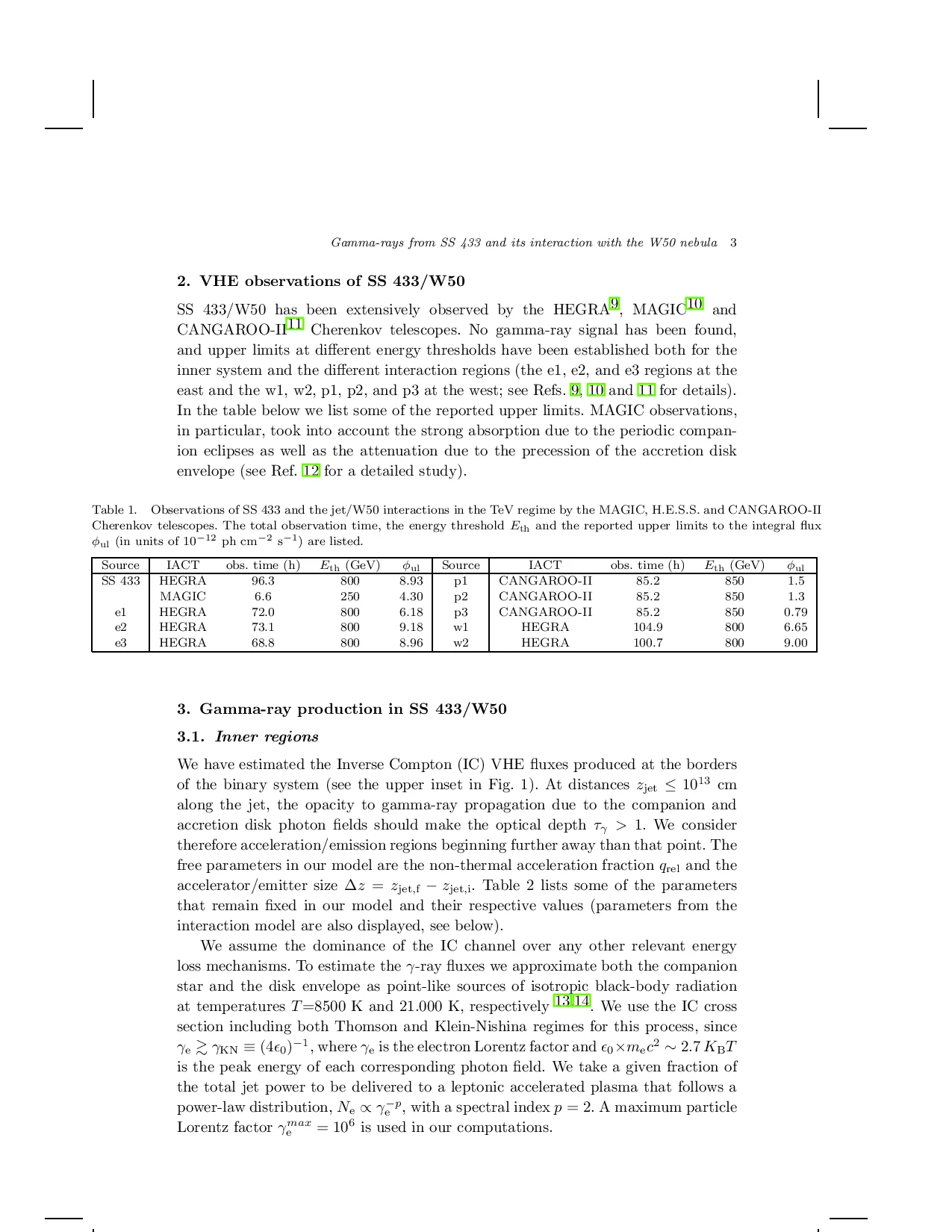
SS 433/W50 has been extensively observed by the HEGRA 9 , MAGIC 10 and CANGAROO-II 11 Cherenkov telescopes. No gamma-ray signal has been found, and upper limits at different energy thresholds have been established both for the inner system and the different interaction regions (the e1, e2, and e3 regions at the east and the w1, w2, p1, p2, and p3 at the west; see Refs. 9, 10 and 11 for details).
In the table below we list some of the reported upper limits. MAGIC observations, in particular, took into account the strong absorption due to the periodic companion eclipses as well as the attenuation due to the precession of the accretion disk envelope (see Ref. 12 for a detailed study). 3. Gamma-ray production in SS 433/W50
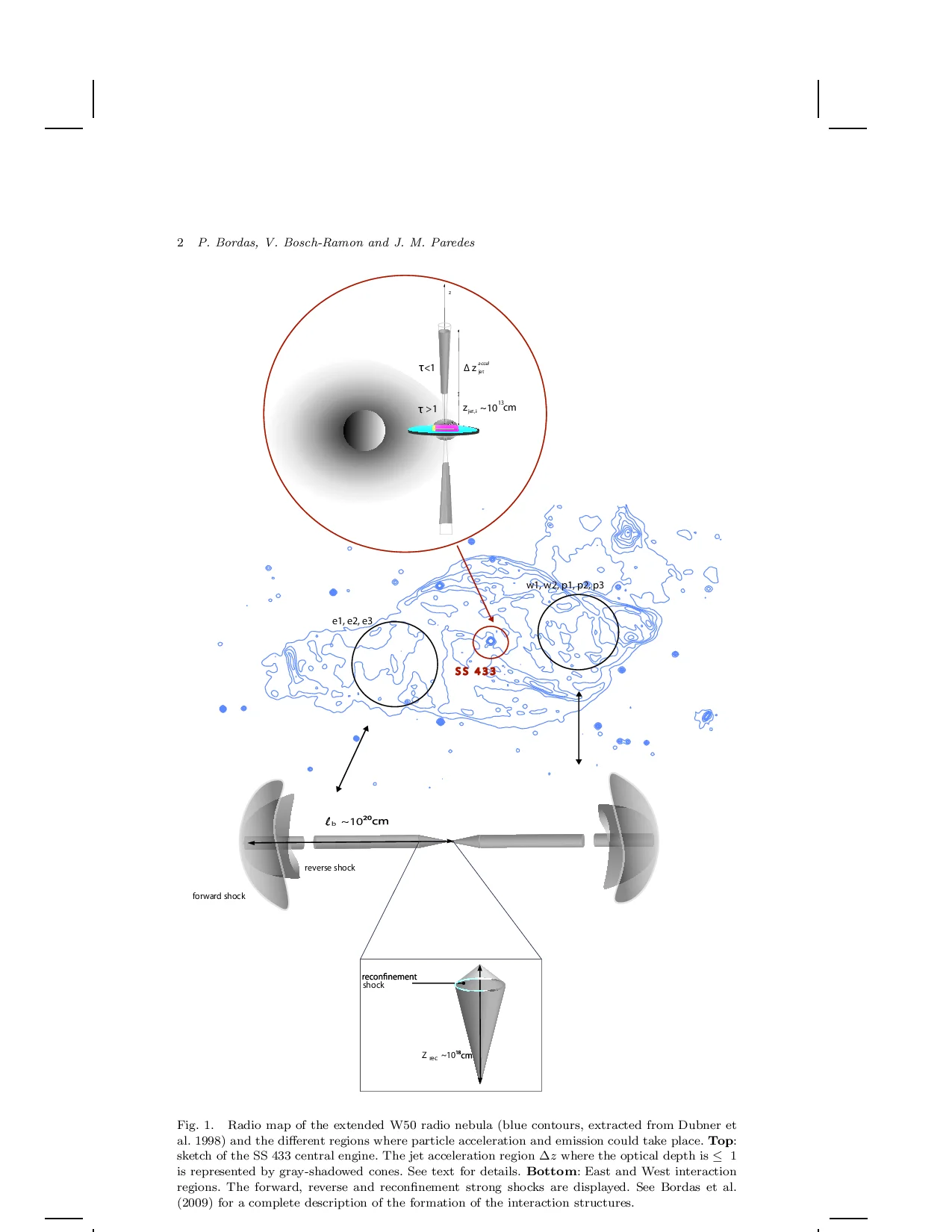
We have estimated the Inverse Compton (IC) VHE fluxes produced at the borders of the binary system (see the upper inset in Fig. 1). At distances z jet ≤ 10 13 cm along the jet, the opacity to gamma-ray propagation due to the companion and accretion disk photon fields should make the optical depth τ γ > 1. We consider therefore acceleration/emission regions beginning further away than that point. The free parameters in our model are the non-thermal acceleration fraction q rel and the accelerator/emitter size ∆z = z jet,f -z jet,i . Table 2 lists some of the parameters that remain fixed in our model and their respective values (parameters from the interaction model are also displayed, see below). We assume the dominance of the IC channel over any other relevant energy loss mechanisms. To estimate the γ-ray fluxes we approximate both the companion star and the disk envelope as point-like sources of isotropic black-body radiation at temperatures T =8500 K and 21.000 K, respectively 13,14 . We use the IC cross section including both Thomson and Klein-Nishina regimes for this process, since γ e γ KN ≡ (4ǫ 0 ) -1 , where γ e is the electron Lorentz factor and ǫ 0 ×m e c 2 ∼ 2.7 K B T is the peak energy of each corresponding photon field. We take a given fraction of the total jet power to be delivered to a leptonic accelerated plasma that follows a power-law distribution, N e ∝ γ -p e , with a spectral index p = 2. A maximum particle Lorentz factor γ max e = 10 6 is used in our computations. Shell relativistic bremsstrahlung Synchrotron emission (shell + cocoon + reconfinement) IC emission (shell + cocoon + reconfinement) Fig. 3. SED of the interaction regions obtained for the parameters listed in Table 2. The sum of the contributions from the shell region, the cocoon and the reconfinement region is displayed. Relativistic bremsstrahlung is important only in the shell region, due to the low particle densities in the jet and cocoon. The contribution of only one jet impacting on the nebula is showed.
slightly lower than the upper limits for the different interaction regions listed in Table 2.
We explored the γ-ray emission produced by relativistic electrons both in the inner jet regions and in the jet/W50 interaction regions. The gamma-ray fluxes obtained for the central regions depend linearly on q rel and the acceleration region within the jet, which are nonetheless poorly constrained under a theoretical point of view. A value of q rel far larger than ∼ 10 -6 for ∆z accel jet starting at z jet,i ∼ 10 13 cm is ruled out within our flux estimations and the reported upper limits, while q rel ≥ 10 -5 is not allowed provided that the acceleration region ∆z accel jet starts at z jet,i ≥ 10 14 cm. Acceleration processes could be much less efficient than expected, though it seems unlikely since acceleration is actually required to explain the non-thermal emission at lower energies. In addition to the IC process, relativistic bremsstrahlung and SSC could be important at the very inner regions near the jet base, where magnetic fields and ion densities are the highest. However, the opacity in these zones should make their contribution at VHE difficult to observe.
No γ-ray signal has been found from the SS 433/W50 interacti
…(Full text truncated)…
This content is AI-processed based on ArXiv data.