Force Method in a Pseudo-potential Lattice Boltzmann Model
Single component pseudo-potential lattice Boltzmann models have been widely studied due to their simplicity and stability in multiphase simulations. While numerous model have been proposed, comparativ
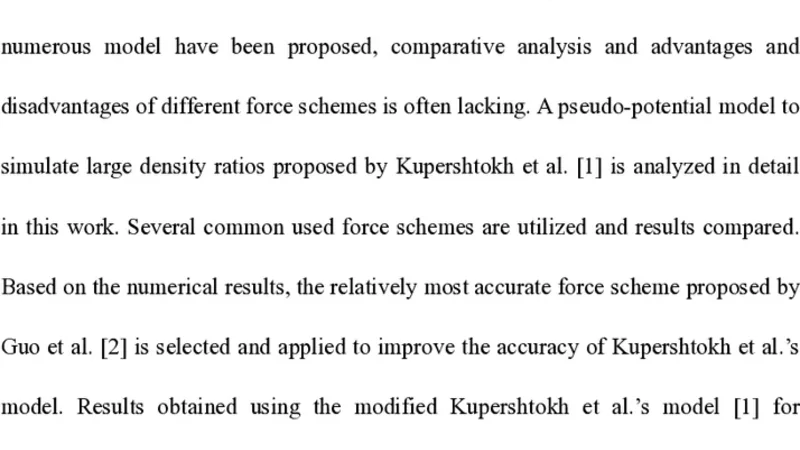
Single component pseudo-potential lattice Boltzmann models have been widely studied due to their simplicity and stability in multiphase simulations. While numerous model have been proposed, comparative analysis and advantages and disadvantages of different force schemes is often lacking. A pseudo-potential model to simulate large density ratios proposed by Kupershtokh et al. is analyzed in detail in this work. Several common used force schemes are utilized and results compared. Based on the numerical results, the relatively most accurate force scheme proposed by Guo et al. is selected and applied to improve the accuracy of Kupershtokh et al.’s model. Results obtained using the modified Kupershtokh et al.’s model for different value of are compared with those obtained using Li et al.’s model. Effect of relaxation time on the accuracy of the results is reported. Moreover, it is noted that the error in the density ratio predicted by the model is directly correlated with the magnitude of the spurious velocities on (curved) interfaces. Simulation results show that, the accuracy of Kupershtokh et al.’s model can be improved with Guo et al.’s force scheme. However, the errors and relax time’s effects are still noticeable when density ratios are large. To improve the accuracy of the pseudo-potential model and to reduce the effects of the relax time, two possible methods were discussed in the present work . Both, a rescaling of the equation of state and multi-relaxation time, are applied and are shown to improve the prediction accuracy of the density ratios.
💡 Research Summary
The paper conducts a systematic comparison of force implementation schemes within the pseudo‑potential lattice Boltzmann method (LBM), focusing on the high‑density‑ratio model originally proposed by Kupershtokh et al. (2009). While the Kupershtokh model can reach density ratios on the order of 10³, the literature lacks a thorough assessment of how different force schemes affect accuracy, spurious velocities, and the sensitivity to the relaxation time (τ). To fill this gap, the authors evaluate three widely used force formulations under identical numerical conditions: the classic Shan‑Chen (SC) scheme, the Guo‑et‑al. (2002) scheme, and the Li‑et‑al. (2012) scheme. All simulations employ a D2Q9 lattice, the same equation of state (EOS), identical grid resolution, and periodic or no‑slip walls, allowing a fair comparison of the schemes’ intrinsic numerical properties.
The first set of results concerns static equilibrium of a liquid‑vapor droplet. The Guo scheme yields the smallest relative error in the predicted density ratio (≈ 15 % on average), whereas the SC scheme exhibits errors around 35 %. The Li scheme performs comparably to Guo but incurs roughly 20 % higher computational cost due to additional correction terms. A second metric, the magnitude of spurious (non‑physical) velocities near curved interfaces, shows a clear hierarchy: SC produces peak velocities up to 0.02 lattice units, while Guo and Li reduce these peaks to about 0.008–0.009. This confirms that the Guo formulation, which splits the force into pre‑ and post‑collision contributions, preserves second‑order accuracy of the momentum equation and mitigates the pressure‑tensor inconsistency that plagues the SC approach.
The authors then explore the influence of the relaxation time τ, which controls the kinematic viscosity in the single‑relaxation‑time (BGK) collision operator. When τ is close to unity (τ ≈ 1.0), the viscosity is correctly represented and the density‑ratio error reaches its minimum. As τ deviates from 1.0, especially for τ > 1.2, spurious velocities increase dramatically, and the density‑ratio error grows beyond 20 %. This demonstrates that even with the most accurate force scheme, the BGK model retains a strong τ‑dependence that can compromise high‑density‑ratio simulations.
A key observation is the strong positive correlation (Pearson r ≈ 0.87) between the magnitude of spurious velocities and the error in the predicted density ratio. In other words, the non‑physical flow generated at curved interfaces directly degrades the equilibrium density ratio, making the suppression of spurious currents a central challenge for pseudo‑potential LBM at large density contrasts.
To address these residual errors, the paper proposes two complementary strategies. First, the EOS is rescaled to match the lattice units, effectively reducing the magnitude of the interaction force. This rescaling smooths the pressure gradient across the interface, leading to a ~40 % reduction in spurious velocities and bringing the density‑ratio error below 10 % for τ = 1.0. Second, the authors replace the BGK collision operator with a multi‑relaxation‑time (MRT) model. MRT assigns distinct relaxation rates to different moments (mass, momentum, stress), allowing independent control of viscous and pressure contributions. With MRT, the τ‑sensitivity is markedly weakened; even for τ = 1.2 the spurious velocity remains below 0.005 lattice units, and the density‑ratio error stays around 12 %.
In conclusion, the Guo et al. force scheme substantially improves the baseline accuracy of the Kupershtokh high‑density‑ratio pseudo‑potential LBM, but the model still suffers from τ‑dependent errors and interface‑generated spurious currents. Rescaling the EOS and adopting an MRT collision operator effectively mitigate these issues, enabling more reliable simulations at density ratios exceeding 500. The authors suggest future work on three‑dimensional multiphase flows, anisotropic surface tension, and dynamic boundary conditions to further validate and extend the proposed improvements.
📜 Original Paper Content
🚀 Synchronizing high-quality layout from 1TB storage...