Boundary Element and Finite Element Coupling for Aeroacoustics Simulations
We consider the scattering of acoustic perturbations in a presence of a flow. We suppose that the space can be split into a zone where the flow is uniform and a zone where the flow is potential. In the first zone, we apply a Prandtl-Glauert transformation to recover the Helmholtz equation. The well-known setting of boundary element method for the Helmholtz equation is available. In the second zone, the flow quantities are space dependent, we have to consider a local resolution, namely the finite element method. Herein, we carry out the coupling of these two methods and present various applications and validation test cases. The source term is given through the decomposition of an incident acoustic field on a section of the computational domain’s boundary.
💡 Research Summary
This paper presents a novel hybrid numerical methodology for simulating the propagation and scattering of aeroacoustic noise generated by aircraft engines, specifically targeting the complex flow conditions present during take-off and landing phases. The core challenge addressed is the accurate modeling of sound waves traversing regions with distinct flow characteristics: a near-field region with non-uniform, potential flow around the engine, and a far-field region with uniform flow.
The proposed solution cleverly decomposes the physical domain into two subdomains and applies a tailored numerical method to each. For the exterior far-field region (Ωe) with uniform flow, the Prandtl-Glauert transformation is employed. This coordinate transformation stretches space along the flow direction, effectively reducing the convected Helmholtz equation (which governs sound propagation in a moving medium) to a classical Helmholtz equation with a modified wavenumber. This allows the application of the Boundary Element Method (BEM), a technique perfectly suited for exterior infinite-domain problems as it only requires discretization of the boundary surface and inherently satisfies the Sommerfeld radiation condition.
For the interior near-field region (Ωi) with spatially varying potential flow, the Finite Element Method (FEM) is used. FEM provides the necessary flexibility to handle complex geometries and inhomogeneous material properties (like local speed of sound and flow velocity) inherent to the engine nacelle and its vicinity.
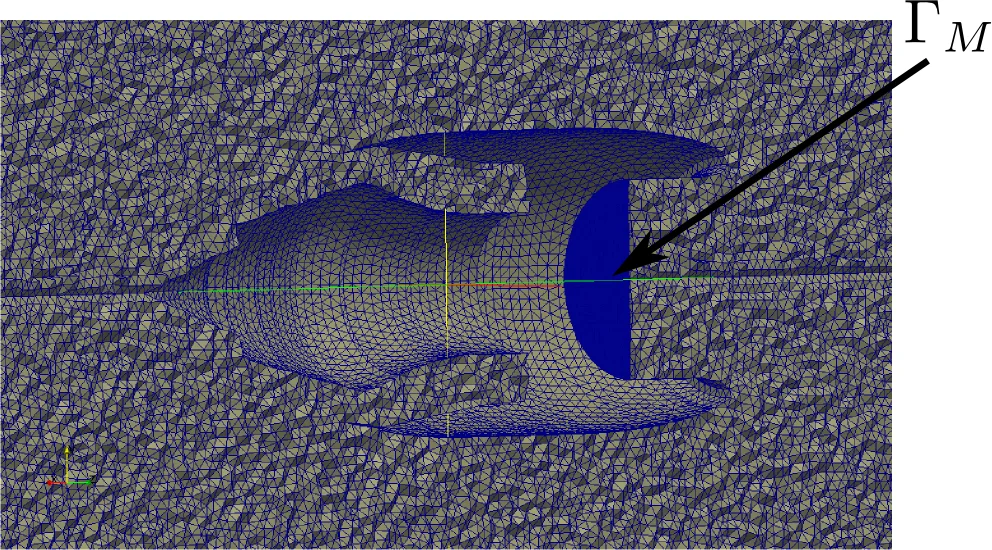
The innovation lies in the rigorous coupling of these two disparate methods at a defined interface (Γ∞). The coupling is achieved by enforcing continuity of the acoustic potential and its normal flux across this interface. Mathematically, the influence of the exterior BEM domain is incorporated into the interior FEM problem via a Dirichlet-to-Neumann (DtN) operator (Λ∞). This operator, derived from the BEM solution, maps the potential value on the interface (Dirichlet data) to the corresponding normal flux (Neumann data), which then acts as a boundary condition for the FEM formulation. A similar DtN operator (ΛM) is used to model acoustic sources defined as modal decompositions on the engine duct surfaces.
The paper details the derivation of the weak formulation for the coupled problem and its discretization into a linear system. The method integrates seamlessly with existing BEM solvers (like ACTIPOLE used at Airbus) for the Helmholtz equation, requiring only the implementation of the transformed interior FEM region and the coupling interface conditions. This hybrid approach effectively combines the computational efficiency of BEM for large exterior domains with the modeling flexibility of FEM for complex near-field physics. It enables integrated aeroacoustic simulations from the engine duct (with non-uniform flow) to the far-field (with uniform flow), overcoming limitations of previous methods that assumed uniform flow everywhere. The framework represents a significant step towards high-fidelity, industrially applicable tools for predicting aircraft engine noise radiation.
Comments & Academic Discussion
Loading comments...
Leave a Comment