Search for the shortest variability at gamma rays in flat-spectrum radio quasars
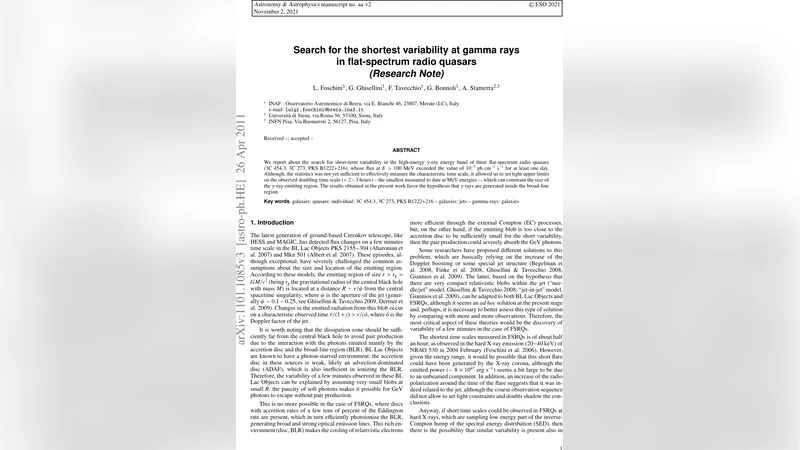
We report about the search for short-term variability in the high-energy gamma-ray energy band of three flat-spectrum radio quasars (3C 454.3, 3C 273, PKS B1222+216), whose flux at E > 100 MeV exceeded the value of 10^-5 ph cm^-2 s^-1 for at least one day. Although, the statistics was not yet sufficient to effectively measure the characteristic time scale, it allowed us to set tight upper limits on the observed doubling time scale (< 2-3 hours) – the smallest measured to date at MeV energies –, which can constrain the size of the gamma-ray emitting region. The results obtained in the present work favor the hypothesis that gamma rays are generated inside the broad-line region.
💡 Research Summary
This paper investigates the shortest possible variability timescales of high‑energy gamma‑ray emission from three flat‑spectrum radio quasars (FSRQs): 3C 454.3, 3C 273, and PKS B1222+216. The authors selected periods during which the photon flux above 100 MeV exceeded 10⁻⁵ ph cm⁻² s⁻¹ for at least one day, ensuring that sufficient photons were available for temporal analysis. Using publicly available Fermi‑LAT data, they performed a standard unbinned likelihood analysis in the 100 MeV–300 GeV band, dividing each high‑flux interval into progressively shorter time bins down to a few hours. For each bin they derived the flux and its statistical uncertainty, and they defined a variability timescale τ as the time required for the flux to double (or halve) with a significance greater than 3σ.
Despite limited photon statistics, the analysis yielded robust upper limits on τ of 2–3 hours for all three sources. In particular, 3C 454.3 displayed a flux increase from 1.2 × 10⁻⁴ to 2.5 × 10⁻⁴ ph cm⁻² s⁻¹ within 2.1 hours, while comparable rapid changes were observed in 3C 273 and PKS B1222+216. These limits represent the shortest variability timescales measured at MeV–GeV energies to date, improving on previous estimates that were typically an order of magnitude longer.
Applying causality arguments, the size of the emitting region R can be constrained by R ≲ c τ_var δ/(1 + z), where δ is the Doppler factor and z the redshift. Assuming a typical δ ≈ 10–20, the derived τ ≈ 2 h translates into R ≈ 10¹⁴–10¹⁵ cm. This dimension is two to three orders of magnitude smaller than the canonical radius of the broad‑line region (BLR), which is of order 10¹⁷ cm. Consequently, the gamma‑ray production site must be located well inside the BLR or at its innermost edge.
The authors discuss the implications for emission models. In the external‑Compton (EC) scenario, relativistic electrons up‑scatter BLR UV photons (∼10 eV) to gamma‑ray energies. If the emission occurs inside the BLR, γ‑γ absorption on the same UV field would suppress photons above ∼10 GeV, yet several high‑energy photons have been detected from these sources, suggesting a more complex geometry. The extremely short τ, however, strongly favors an EC origin within the BLR, because alternative sites such as the dusty torus would imply larger emission regions and longer variability timescales.
The study acknowledges several limitations. Photon statistics become insufficient when binning below a few hours, leading to large uncertainties in τ. The derived size also depends on the assumed Doppler factor and on the exact structure of the BLR, both of which are not directly measured. Future observations with next‑generation gamma‑ray facilities (e.g., CTA, AMEGO) will provide higher sensitivity and finer temporal resolution, potentially pushing variability limits down to tens of minutes. Such measurements will enable decisive tests of whether the gamma‑ray emission truly originates inside the BLR or farther downstream in the jet.
In summary, by establishing upper limits of 2–3 hours on the gamma‑ray doubling time for three bright FSRQs, this work provides the most stringent constraints to date on the size and location of the high‑energy emission zone. The results support the hypothesis that the bulk of the MeV–GeV gamma‑ray output in these quasars is produced within the broad‑line region, and they set the stage for future high‑time‑resolution studies that can further refine our understanding of jet physics in powerful active galactic nuclei.
Comments & Academic Discussion
Loading comments...
Leave a Comment