Two theory-driven models of electron ionization cross sections, the Binary-Encounter-Bethe model and the Deutsch-M\"ark model, have been design and implemented; they are intended to extend the simulation capabilities of the Geant4 toolkit. The resulting values, along with the cross sections included in the EEDL data library, have been compared to an extensive set of experimental data, covering more than 50 elements over the whole periodic table.
Deep Dive into Ionisation Models for Nano-Scale Simulation.
Two theory-driven models of electron ionization cross sections, the Binary-Encounter-Bethe model and the Deutsch-M"ark model, have been design and implemented; they are intended to extend the simulation capabilities of the Geant4 toolkit. The resulting values, along with the cross sections included in the EEDL data library, have been compared to an extensive set of experimental data, covering more than 50 elements over the whole periodic table.
variety of experimental applications require the capability of simulating electron interactions over a wide rangefrom the nano-scale to the macroscopic one: some experimental examples are the ongoing R&D (research and development) for nanotechnology-based particle detectors, plasma physics, radiation effects on semiconductor devices, biological effects of radiation etc.
General-purpose tools for electron transport are available and well established in all Monte Carlo codes based on condensed and mixed transport schemes, whereas in the lower energy end track structure codes provide simulation capabilities limited to a single, or a small number of target materials.
New developments are presented here, which intend to endow a large scale Monte Carlo system for the first time with the capability of simulating electron impact ionisation down to the scale of a few tens of electronvolts for any target element. The models are suitable for use with Geant4 [1] [2].
Two theory-driven models of electron ionisation cross sections, the Binary-Encounter-Bethe [3] and the Deutsch-Märk [4] one, have been implemented; they are applicable to any target elements. The resulting values have been compared to an extensive set of experimental data, covering more than 50 elements over the whole periodic table.
The Binary-Encounter-Dipole (BED) [3] cases where some components of the BED cross section model would be difficult to calculate or to measure experimentally.
The BEB model involves three atomic parameters for each subshell of the target atom: the electron binding energy, the average kinetic energy and the electron occupation number of the subshell. This model does not contain any empirical or adjustable parameter.
The Deutsch-Märk (DM) model has its origin in a classical binary encounter approximation derived by Thomson [5] and its improved form of Gryzinski [6]. Its formulation involves some parameters (weighting factors), which derive from fits to experimental data; values of these parameters are reported in the original authors’ publications concerning the model.
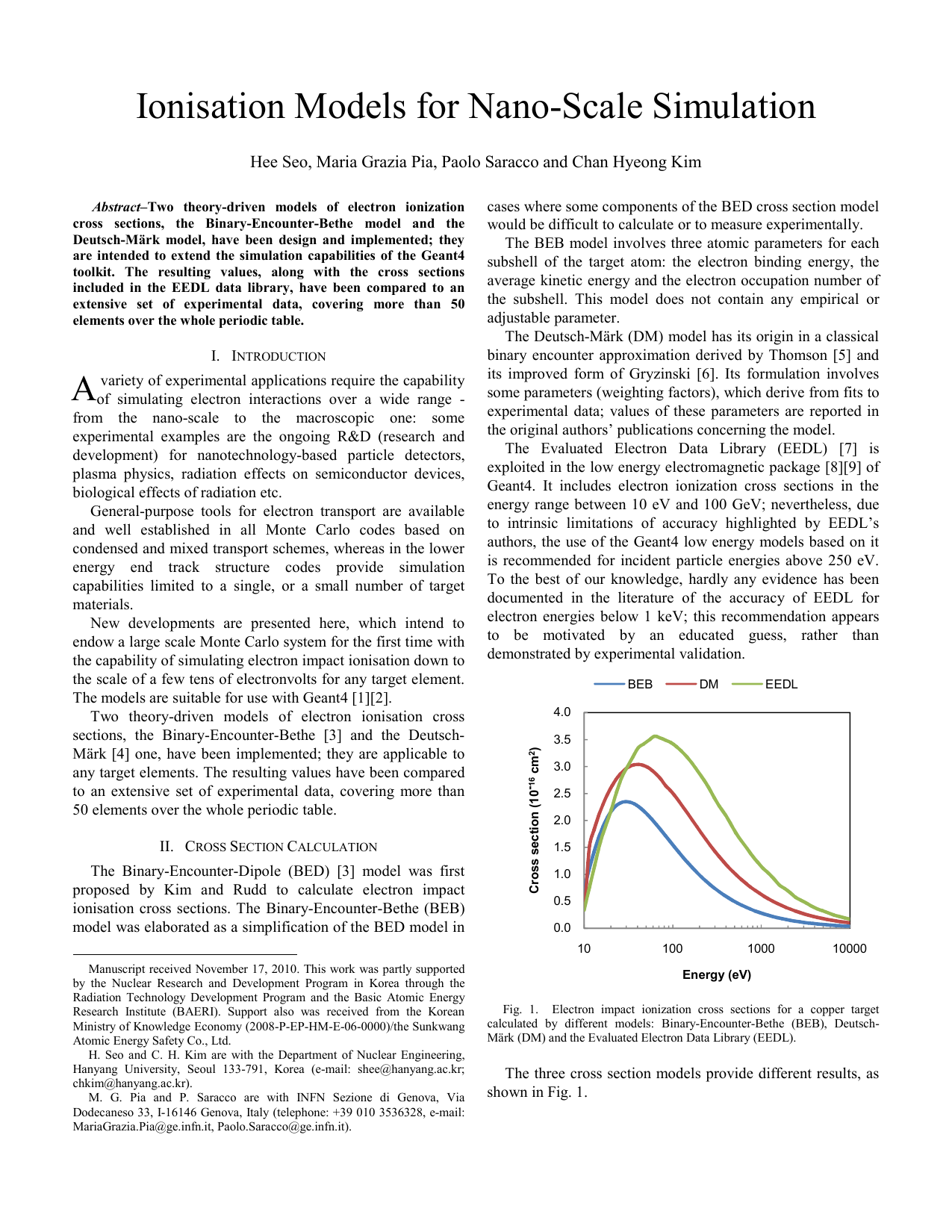
The Evaluated Electron Data Library (EEDL) [7] is exploited in the low energy electromagnetic package [8][9] of Geant4. It includes electron ionization cross sections in the energy range between 10 eV and 100 GeV; nevertheless, due to intrinsic limitations of accuracy highlighted by EEDL’s authors, the use of the Geant4 low energy models based on it is recommended for incident particle energies above 250 eV. To the best of our knowledge, hardly any evidence has been documented in the literature of the accuracy of EEDL for electron energies below 1 keV; this recommendation appears to be motivated by an educated guess, rather than demonstrated by experimental validation. The software adopts a policy-based class design, which has also been exploited in recent developments [10] [11] for photon interactions. The adoption of this design approach contributes to the ongoing investigation about the use of generic programming techniques in the physics domain of Monte Carlo simulation; feedback about its use in modeling charged particle interactions is helpful in the current R&D phase.
The policy relevant to this context is associated with a CrossSection function, whose arguments characterize the involved incident particle and target.
The software implementation is based on the most recent documented analytical formulations and associated parameters of the BEB and DM models, which could be retrieved in the literature at the time of writing this paper.
The formulation of both models involves some atomic parameters. Their values were taken from the same sources documented by the original authors, whenever possible; otherwise, in the cases were the original parameters were not at reach, values tabulated in the Evaluated Atomic Data Library (EADL) [12] or available from the NIST web site were used.
The implemented models allow the calculation of ionization cross sections for any element.
Verification tests were performed to check whether the cross section values calculated by the software were consistent with those calculated by the original authors of the models, which are documented in the literature.
In most cases the software implementation reproduces the original values consistently; in a few cases some discrepancies were observed, which could be tracked to different values of model parameters in the software implementation and in the original calculations. An example of these verifications is shown in Fig. 2 and Fig. 3.
As a result of the verification process, the software implementation was acknowledged to render the original cross section values with adequate precision. Further details of the verification process will be available in a dedicated paper after this conference.
The validation process involved the comparison with experimental data. A survey in the literature identified more than one hundred sets of experimental data concerning electron ioniza
…(Full text truncated)…
This content is AI-processed based on ArXiv data.