Quantum Diffusive Dynamics of Macromolecular Transitions
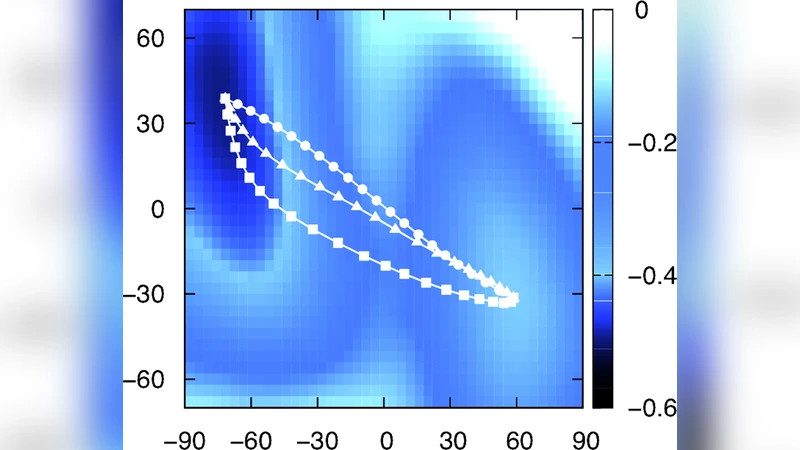
We study the role of quantum fluctuations of atomic nuclei in the real-time dynamics of non-equilibrium macro-molecular transitions. To this goal we introduce an extension of the Dominant Reaction Pathways (DRP) formalism, in which the quantum corrections to the classical overdamped Langevin dynamics are rigorously taken into account to order h^2 . We first illustrate our approach in simple cases, and compare with the results of the instanton theory. Then we apply our method to study the C7_eq to C7_ax transition of alanine dipeptide. We find that the inclusion of quantum fluctuations can significantly modify the reaction mechanism for peptides. For example, the energy difference which is overcome along the most probable pathway is reduced by as much as 50%.
💡 Research Summary
In this work the authors develop a novel extension of the Dominant Reaction Pathways (DRP) formalism that explicitly incorporates quantum fluctuations of atomic nuclei up to order ℏ², targeting the overdamped (high‑friction) regime typical of many biomolecular processes. Starting from the quantum Smoluchowski equation (QSE), they derive a multi‑dimensional Fokker‑Planck‑type equation for the diagonal part of the reduced density matrix, which includes two quantum correction functions L₁(X) and L₂(X) that depend on the Laplacian and gradient squared of the potential energy surface. The stationary solution of the QSE reproduces a semi‑classical Boltzmann weight with an effective potential U_Q = U + β∑λ_i∇²_iU – (β²/2)∑λ_i|∇_iU|², where λ_i = βℏ²/(12m_i).
From the QSE they obtain an equivalent quantum Langevin equation (QLE) with multiplicative noise and a “quantum force” Q_i that, in the Ito interpretation, reads Q_i = (1/β)∇_iL₂ – L₁∇_iU. Near minima of the potential the quantum correction simply rescales the effective temperature (enhanced diffusion), whereas near saddle points it reduces diffusion, mimicking a lower temperature. This asymmetry explains why quantum effects can dramatically alter transition pathways even when they have modest impact on equilibrium thermodynamic averages.
The core of the paper is the path‑integral representation of the propagator for the QSE, leading to an effective action S
Comments & Academic Discussion
Loading comments...
Leave a Comment