Radio Band Observations of Blazar Variability
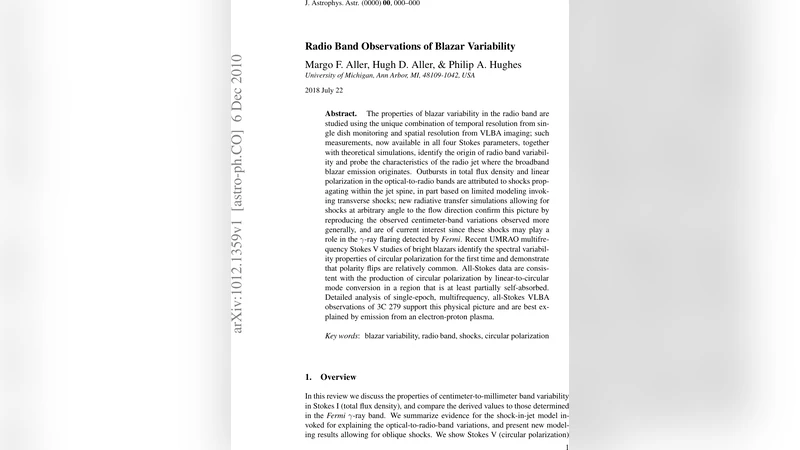
The properties of blazar variability in the radio band are studied using the unique combination of temporal resolution from single dish monitoring and spatial resolution from VLBA imaging; such measurements, now available in all four Stokes parameters, together with theoretical simulations, identify the origin of radio band variability and probe the characteristics of the radio jet where the broadband blazar emission originates. Outbursts in total flux density and linear polarization in the optical-to-radio bands are attributed to shocks propagating within the jet spine, in part based on limited modeling invoking transverse shocks; new radiative transfer simulations allowing for shocks at arbitrary angle to the flow direction confirm this picture by reproducing the observed centimeter-band variations observed more generally, and are of current interest since these shocks may play a role in the gamma-ray flaring detected by Fermi. Recent UMRAO multifrequency Stokes V studies of bright blazars identify the spectral variability properties of circular polarization for the first time and demonstrate that polarity flips are relatively common. All-Stokes data are consistent with the production of circular polarization by linear-to-circular mode conversion in a region that is at least partially self-absorbed. Detailed analysis of single-epoch, multifrequency, all-Stokes VLBA observations of 3C 279 support this physical picture and are best explained by emission from an electron-proton plasma.
💡 Research Summary
The paper presents a comprehensive investigation of blazar variability in the radio band by exploiting the complementary strengths of single‑dish monitoring (temporal resolution) and Very Long Baseline Array (VLBA) imaging (spatial resolution). Using the University of Michigan Radio Astronomy Observatory (UMRAO) data, the authors obtained multi‑frequency, full‑Stokes (I, Q, U, V) measurements at 4.8, 8, and 14.5 GHz over many years. These data reveal that outbursts in total flux density are frequently accompanied by rapid swings in linear polarization angle, indicating a coherent physical process that simultaneously affects both intensity and magnetic‑field orientation.
To locate the emission region, the team performed VLBA imaging of several bright blazars (e.g., 3C 279, OJ 287, 3C 454.3) at 15, 22, and 43 GHz. The high‑resolution maps resolve the core and downstream jet components, showing that linear polarization is strongest in the core while circular polarization (Stokes V) is detectable mainly in the immediate vicinity of the core. Notably, 3C 279 exhibits polarity flips of Stokes V, a phenomenon that had not been systematically documented before.
The central theoretical contribution is a set of radiative‑transfer simulations that extend earlier “transverse‑shock” models. The new framework allows shocks to propagate at arbitrary angles relative to the jet flow, incorporates realistic magnetic‑field configurations (ordered versus turbulent components), and treats an electron‑proton plasma with a power‑law energy distribution. Simulations demonstrate that oblique shocks compress the magnetic field and harden the electron spectrum, reproducing the observed simultaneous increases in total flux and abrupt rotations of the linear polarization angle. After the shock passes, a partially self‑absorbed region forms where linear‑to‑circular mode conversion becomes efficient, generating the observed circular polarization and its occasional sign reversals.
The authors argue that the circular polarization is not produced by intrinsic synchrotron emission from a pure electron‑positron plasma; instead, it arises from linear‑to‑circular conversion in a region that is at least partially self‑absorbed and contains an electron‑proton component. This interpretation is reinforced by the VLBA epoch of 3C 279, where the core’s high optical depth and low linear polarization degree are consistent with the conversion scenario.
Importantly, the paper links radio‑band variability to high‑energy gamma‑ray flares detected by the Fermi Large Area Telescope. The timing of radio outbursts and polarization events often coincides with gamma‑ray spikes, suggesting that the same shocks responsible for the radio signatures also accelerate particles to energies sufficient for gamma‑ray production. Thus, the study provides a unified picture in which shocks of arbitrary orientation travel down the jet spine, modulate the magnetic field, drive both linear and circular polarization changes, and potentially trigger gamma‑ray flares.
In summary, the work (1) confirms that radio variability in blazars is dominated by shock propagation within the jet, (2) shows that shock angle and magnetic‑field geometry dictate the detailed polarization behavior, (3) demonstrates that circular polarization originates from linear‑to‑circular conversion in a partially self‑absorbed, electron‑proton plasma, and (4) highlights the relevance of these radio processes to the production of gamma‑ray flares. The combination of long‑term full‑Stokes monitoring, high‑resolution VLBA imaging, and sophisticated radiative‑transfer modeling sets a new benchmark for multi‑wavelength studies of relativistic jets.
Comments & Academic Discussion
Loading comments...
Leave a Comment