Radio and X-ray variability in the Seyfert galaxy NGC 4051
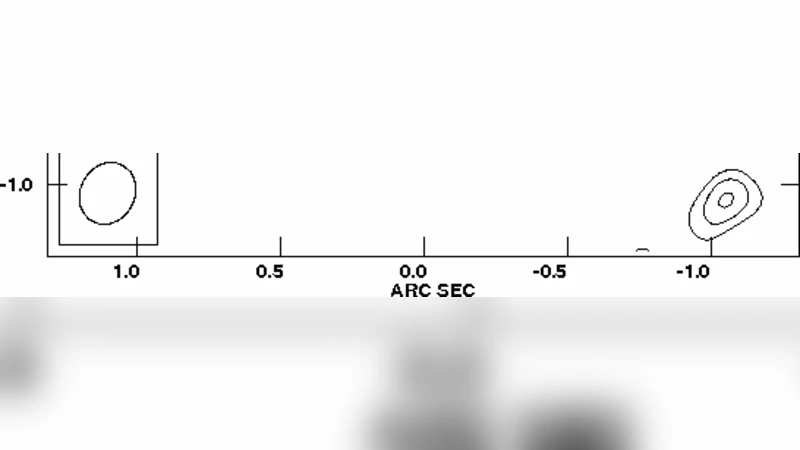
We present intensive quasi-simultaneous X-ray and radio monitoring of the narrow line Seyfert 1 galaxy NGC 4051, over a 16 month period in 2000-2001. Observations were made with the Rossi Timing X-ray Explorer (RXTE) and the Very Large Array (VLA) at 8.4 and 4.8 GHz. In the X-ray band NGC 4051 behaves much like a Galactic black hole binary (GBH) system in a soft-state'. In such systems, there has so far been no firm evidence for an active, radio-emitting jet like those found in hard state’ GBHs. VLBI observations of NGC 4051 show three co-linear compact components. This structure resembles the core and outer hot spots seen in powerful, jet-dominated, extragalactic radio sources and suggests the existence of a weak jet. Radio monitoring of the core of NGC 4051 is complicated by the presence of surrounding extended emission and by the changing array configurations of the VLA. Only in the A configuration is the core reasonably resolved. We have carefully removed the contaminations of the core by extended emission in the various arrays. The resulting lightcurve shows no sign of large amplitude variability (i.e. factor 50 %) over the 16 month period. Within the most sensitive configuration (A array) we see marginal evidence for radio core variability of ~25% (~0.12 mJy at 8.4GHz) on a 2-week timescale, correlated with X-ray variations. Even if the radio variations in NGC 4051 are real, the percentage variability is much less than in the X-ray band. Within the B configuration observations, where sensitivity is reduced, there is no sign of correlated X-ray/radio variability. The lack of radio variability in NGC 4051, which we commonly see in `hard state’ GBHs, may be explained by orientation effects. Another possibility is that the radio emission arises from the X-ray corona, although the linear structure of the compact radio components here is hard to explain.
💡 Research Summary
The paper presents an intensive, quasi‑simultaneous monitoring campaign of the narrow‑line Seyfert 1 galaxy NGC 4051, carried out over a 16‑month interval from 2000 to 2001 using the Rossi X‑ray Timing Explorer (RXTE) for X‑ray observations and the Very Large Array (VLA) for radio observations at 8.4 GHz and 4.8 GHz. The primary goal was to investigate whether the X‑ray variability, which in this source closely resembles that of Galactic black‑hole binaries (GBHBs) in a soft‑state, is accompanied by correlated radio variability that would indicate the presence of an active jet.
X‑ray results: The RXTE light curve shows strong, rapid variability on timescales of days to weeks, with flux changes of order 30–50 % and a power‑density spectrum characteristic of soft‑state GBHBs (a steep, low‑frequency dominated slope). Spectral analysis confirms a soft continuum with little hard X‑ray contribution, consistent with a disk‑corona system rather than a jet‑dominated emission.
Radio results: The VLA observations were taken in all four standard configurations (A, B, C, D), which differ markedly in angular resolution and sensitivity to extended emission. NGC 4051 is embedded in low‑surface‑brightness radio emission extending over ∼1 kpc, which contaminates the compact core flux in the more compact configurations. The authors therefore modeled and subtracted the extended component in each dataset, achieving a reliable core measurement only in the A‑array data where the beam is ∼0.3 arcsec. The mean core flux density at 8.4 GHz is ≈0.48 mJy.
Variability analysis: Over the full 16‑month span the core shows at most a 50 % change, far smaller than the X‑ray amplitude. In the highest‑resolution A‑array data, a modest ∼25 % fluctuation (≈0.12 mJy) is detected on a ∼2‑week timescale, and this modest radio excursion appears to be loosely synchronized with contemporaneous X‑ray peaks. In the B‑array data, where the sensitivity to the core is reduced and the extended emission contributes more strongly, no statistically significant radio variability is found, and consequently no clear X‑ray/radio correlation emerges.
VLBI context: Earlier Very Long Baseline Interferometry (VLBI) imaging of NGC 4051 revealed three collinear compact components: a central core and two symmetric outer hotspots separated by ∼10 mas. This morphology resembles the core‑hotspot structure of classical, jet‑dominated radio galaxies, suggesting that a weak, possibly non‑relativistic jet may be present in NGC 4051 despite its soft‑state X‑ray behavior.
Interpretation: The authors discuss two main scenarios. (1) The radio emission originates from a faint jet whose orientation is close to the plane of the sky, reducing Doppler boosting and leading to low observed variability. In this case the modest radio changes could be the result of small fluctuations in jet power that are heavily damped before reaching the radio‑emitting region. (2) The radio photons are produced directly in the X‑ray corona, perhaps via synchrotron radiation from non‑thermal electrons. This would naturally explain the low variability amplitude, but it is difficult to reconcile with the linear VLBI structure, which is more readily interpreted as a jet.
The lack of strong, rapid radio variability—common in hard‑state GBHBs where compact, flat‑spectrum jets dominate—contrasts sharply with the pronounced X‑ray variability of NGC 4051. The authors suggest that orientation effects, a suppressed jet, or a corona‑dominated radio source could account for this discrepancy. They emphasize that future observations with higher angular resolution, broader frequency coverage, and simultaneous polarization measurements are essential to disentangle jet and corona contributions and to test whether the weak jet hypothesis holds for soft‑state AGN such as NGC 4051.
Comments & Academic Discussion
Loading comments...
Leave a Comment