Location of gamma-ray Flare Emission in the Jet of the BL Lacertae Object OJ287 more than 14pc from the Central Engine
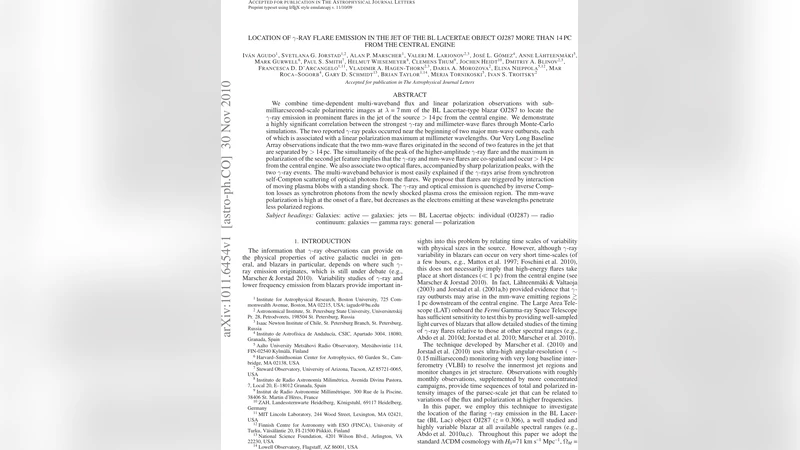
We combine time-dependent multi-waveband flux and linear polarization observations with sub-milliarcsecond-scale polarimetric images at lambda=7mm of the BL Lacertae-type blazar OJ287 to locate the gamma-ray emission in prominent flares in the jet of the source >14pc from the central engine. We demonstrate a highly significant correlation between the strongest gamma-ray and millimeter-wave flares through Monte-Carlo simulations. The two reported gamma-ray peaks occurred near the beginning of two major mm-wave outbursts, each of which is associated with a linear polarization maximum at millimeter wavelengths. Our Very Long Baseline Array observations indicate that the two mm-wave flares originated in the second of two features in the jet that are separated by >14 pc. The simultaneity of the peak of the higher-amplitude gamma-ray flare and the maximum in polarization of the second jet feature implies that the gamma-ray and mm-wave flares are co-spatial and occur >14 pc from the central engine. We also associate two optical flares, accompanied by sharp polarization peaks, with the two gamma-ray events. The multi-waveband behavior is most easily explained if the gamma-rays arise from synchrotron self-Compton scattering of optical photons from the flares. We propose that flares are triggered by interaction of moving plasma blobs with a standing shock. The gamma-ray and optical emission is quenched by inverse Compton losses as synchrotron photons from the newly shocked plasma cross the emission region. The mm-wave polarization is high at the onset of a flare, but decreases as the electrons emitting at these wavelengths penetrate less polarized regions.
💡 Research Summary
This paper presents a multi‑wavelength, time‑dependent study of the BL Lac object OJ 287 that pinpoints the site of its most powerful γ‑ray flares to a region of the relativistic jet located more than 14 pc downstream from the central supermassive black hole. The authors combine daily γ‑ray light curves from Fermi‑LAT, millimeter‑wave fluxes and linear polarization measurements from the SMA, IRAM and the VLBA at 7 mm (43 GHz), and optical photometry and polarimetry from ground‑based observatories.
Two major γ‑ray outbursts (late 2010 and early 2011) are found to coincide, within a few days, with the onset of two strong millimeter‑wave flares. Monte‑Carlo simulations demonstrate a >99.9 % probability that the γ‑ray and 86 GHz fluxes are correlated, indicating a common origin. Very Long Baseline Array imaging resolves the jet into a compact core (K) and two downstream components, C1 and C2, separated by ≈0.2 mas, which corresponds to a projected distance of >14 pc. The millimeter flares originate in C2, the more distant component.
Crucially, the peak of the higher‑amplitude γ‑ray flare occurs simultaneously with a maximum in the linear polarization of C2, where the fractional polarization rises above 20 % before dropping sharply as the flare decays. A similar polarization spike is observed in the optical band, where the electric‑vector position angle swings rapidly and the polarization degree reaches ≈10 %. The temporal alignment of γ‑ray, millimeter, and optical flares, together with their polarization behavior, strongly supports a synchrotron self‑Compton (SSC) origin for the γ‑rays: optical synchrotron photons produced in the flare are up‑scattered by the same relativistic electrons that emit at millimeter wavelengths.
The authors propose a physical scenario in which a moving plasma “blob” travels down the jet and collides with a standing shock (the stationary feature identified as C2). The shock compresses and orders the magnetic field, producing the observed high polarization at flare onset. The collision accelerates electrons, generating a burst of synchrotron radiation (optical and mm) and, via SSC, a γ‑ray flare. As the shocked plasma expands downstream, inverse‑Compton losses become dominant, quenching the optical and γ‑ray emission, while the mm‑wave emission persists in less‑ordered magnetic regions, causing the polarization to decline.
This work challenges the conventional view that the most energetic γ‑ray emission in blazars must arise very close to the black hole. Instead, it demonstrates that powerful γ‑ray production can occur at parsec‑scale distances where the jet interacts with stationary shocks. The study underscores the diagnostic power of simultaneous multi‑band flux and polarization monitoring combined with high‑resolution VLBI imaging. Future observations with finer temporal sampling and broader spectral coverage (including X‑ray and TeV bands) will be essential to quantify the shock parameters, blob dynamics, and SSC efficiency, thereby refining models of high‑energy emission in relativistic jets.
{# ── Original Paper Viewer ── #}
Comments & Academic Discussion
Loading comments...
Leave a Comment