Icequakes coupled with surface displacements for predicting glacier break-off
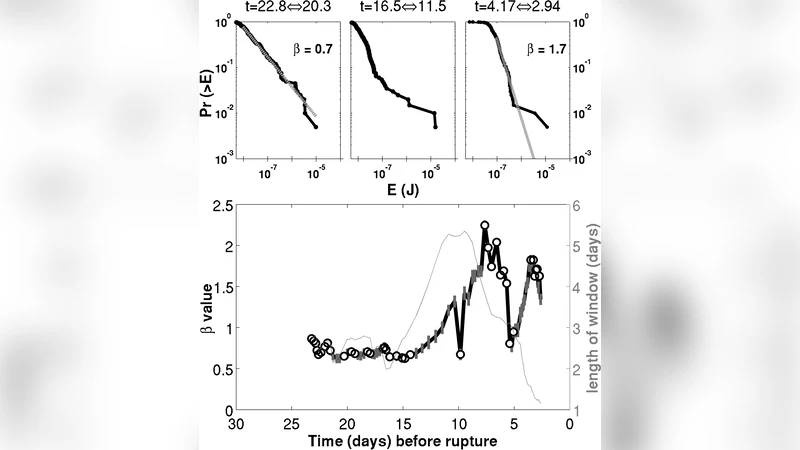
A hanging glacier at the east face of Weisshorn (Switzerland) broke off in 2005. We were able to monitor and measure surface motion and icequake activity for 25 days up to three days prior to the break-off. The analysis of seismic waves generated by the glacier during the rupture maturation process revealed four types of precursory signals of the imminent catastrophic rupture: (i) an increase in seismic activity within the glacier, (ii) a decrease in the waiting time between two successive icequakes, (iii) a change in the size-frequency distribution of icequake energy, and (iv) a modification in the structure of the waiting time distributions between two successive icequakes. Morevover, it was possible to demonstrate the existence of a correlation between the seismic activity and the log-periodic oscillations of the surface velocities superimposed on the global acceleration of the glacier during the rupture maturation. Analysis of the seismic activity led us to the identification of two regimes: a stable phase with diffuse damage, and an unstable and dangerous phase characterized by a hierarchical cascade of rupture instabilities where large icequakes are triggered.
💡 Research Summary
The paper presents a comprehensive field study of the Weisshorn hanging glacier that catastrophically detached in 2005. Over a 25‑day period ending three days before the break‑off, the authors continuously recorded surface motion with GPS and seismic activity with a network of broadband seismometers. By analysing the temporal and energetic properties of the icequakes, they identified four distinct precursory signatures of imminent rupture. First, the overall seismicity within the glacier increased dramatically, reaching three times the background rate in the final 24 hours. Second, the waiting time between successive icequakes shortened progressively, falling below 30 minutes in the last day. Third, the size‑frequency distribution of icequake energies, initially following a power‑law with exponent β≈1.8, deviated toward a heavier tail as large events became disproportionately frequent. Fourth, the statistical shape of the waiting‑time distribution transformed from a simple Poisson‑like form to a multimodal structure, indicating the coexistence of multiple damage processes with different characteristic timescales.
Simultaneously, surface velocity measurements revealed a global acceleration of the glacier superimposed with log‑periodic oscillations. The oscillation period decreased while its amplitude grew as the break‑off approached, and these log‑periodic fluctuations correlated strongly with the rising icequake rate and the decreasing waiting times. Such log‑periodic behaviour is a hallmark of systems nearing a critical point and reflects the hierarchical cascade of rupture instabilities within the ice mass.
Integrating these observations, the authors propose a two‑stage damage evolution model. In the first, “stable‑diffuse damage” stage, icequakes occur at low frequency and modest magnitude, and damage spreads slowly throughout the glacier. In the second, “unstable‑hierarchical cascade” stage, damage concentrates, large icequakes trigger one another, and the log‑periodic oscillations become pronounced, culminating in catastrophic failure. The study quantifies each stage using measurable parameters: seismicity growth rate, mean waiting time, energy‑distribution exponent, and log‑periodic oscillation characteristics.
The significance of the work lies in demonstrating that combined seismic and kinematic monitoring can reliably flag the transition from a benign to a dangerous regime weeks before a glacier collapse. The identified precursory patterns provide a practical framework for real‑time early‑warning systems, potentially reducing the hazard posed by hanging glaciers and similar ice‑mass failures worldwide.
Comments & Academic Discussion
Loading comments...
Leave a Comment