GALEX FUV Observations of Comet C/2004 Q2 (Machholz): The Ionization Lifetime of Carbon
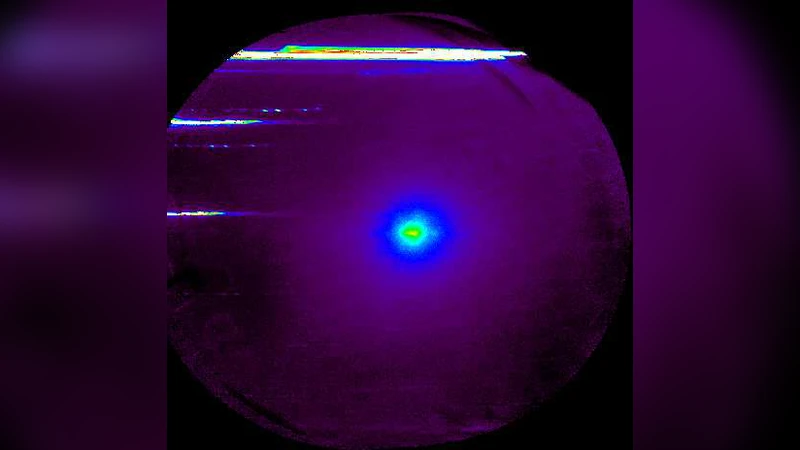
We present a measurement of the lifetime of ground state atomic carbon, C(^3P), against ionization processes in interplanetary space and compare it to the lifetime expected from the dominant physical processes likely to occur in this medium. Our measurement is based on analysis of a far ultraviolet (FUV) image of comet C/2004 Q2 (Machholz) recorded by the Galaxy Evolution Explorer (GALEX) on 2005 March 1. The bright CI 1561 A and 1657 A multiplets dominate the GALEX FUV band. We used the image to create high S/N radial profiles that extended beyond one million km from the comet nucleus. Our measurements yielded a total carbon lifetime of 7.1 – 9.6 x 10^5 s (scaled to 1 AU). Which compares favorably to calculations assuming solar photoionization, solar wind proton change exchange and solar wind electron impact ionization are the dominant processes occurring in this medium and that comet Machholz was embedded in the slow solar wind. The shape of the CI profiles inside 3x10^5 km suggests that either the CO lifetime is shorter than previously thought and/or a shorter-lived carbon-bearing parent molecule, such as CH_4 is providing the majority of the carbon in this region of the coma of comet Machholz.
💡 Research Summary
The paper presents a quantitative determination of the ionization lifetime of ground‑state atomic carbon (C ³P) in the coma of comet C/2004 Q2 (Machholz) using a far‑ultraviolet (FUV) image obtained with the Galaxy Evolution Explorer (GALEX) on 1 March 2005. The GALEX FUV band (≈ 1350–1750 Å) is dominated by the strong C I multiplets at 1561 Å and 1657 Å, allowing the authors to treat the observed brightness as a direct tracer of neutral carbon atoms released from the nucleus or from short‑lived parent molecules.
After careful subtraction of stellar background and airglow, the authors constructed high‑signal‑to‑noise radial surface‑brightness profiles extending to >10⁶ km from the nucleus. By fitting these profiles with a simple 1/r² expansion model that includes a loss term due to ionization, they derived an effective total lifetime for C I of 7.1 × 10⁵ s to 9.6 × 10⁵ s when scaled to 1 AU. This range corresponds to an average ionization rate of roughly 1.1 × 10⁻⁶ s⁻¹.
To interpret the measured lifetime, the authors considered three dominant ionization processes expected in the inner heliosphere: (1) solar photo‑ionization (λ < 1100 Å), (2) charge‑exchange with solar‑wind protons (C + H⁺ → C⁺ + H), and (3) electron‑impact ionization by solar‑wind electrons (C + e⁻ → C⁺ + 2e⁻). Using published cross‑sections, solar fluxes, and typical slow‑solar‑wind parameters (speed ≈ 400 km s⁻¹, electron temperature ≈ 10⁵ K), they calculated individual rate coefficients and summed them to obtain a theoretical total ionization rate that predicts a carbon lifetime of ≈ 8.5 × 10⁵ s at 1 AU. The close agreement between observation and theory validates the assumption that these three processes dominate carbon loss in the cometary environment under slow‑wind conditions.
A notable deviation appears in the inner coma (r ≲ 3 × 10⁵ km), where the observed C I profile falls off more steeply than the simple expansion model predicts. The authors argue that this discrepancy reflects the nature of the carbon parent molecules. Carbon released directly from CO photodissociation would inherit the relatively long CO lifetime (≈ 5 × 10⁵ s), which would produce a more extended C I distribution than observed. Conversely, molecules with much shorter lifetimes, such as CH₄ or H₂CO (photodissociation timescales of order 10⁴ s), could supply carbon close to the nucleus, yielding the observed steep inner gradient. Thus, the data suggest that a short‑lived carbon‑bearing parent, possibly methane, contributes significantly to the carbon budget in the inner coma of Machholz.
Methodological limitations are acknowledged. The analysis relies on a single epoch, so temporal variations in solar‑wind density, speed, or composition are not captured. GALEX’s spatial resolution (≈ 5 arcsec, corresponding to ≈ 3 × 10⁴ km at 1 AU) limits the ability to resolve fine structures near the nucleus. Residual uncertainties in background subtraction introduce an estimated ±15 % error in the derived lifetime. Despite these constraints, the study provides one of the first direct, remote‑sensing measurements of a neutral atomic species’ ionization lifetime in a cometary coma.
In conclusion, the work demonstrates that the ionization lifetime of neutral carbon in comet Machholz is consistent with a combination of solar photo‑ionization, charge‑exchange with slow‑solar‑wind protons, and electron‑impact ionization. The inner‑coma profile analysis further indicates that short‑lived carbon‑bearing volatiles, rather than CO alone, dominate the carbon source close to the nucleus. These findings have broader implications for modeling cometary coma chemistry, interpreting UV observations of other comets, and understanding how solar‑wind conditions modulate the composition and evolution of cometary atmospheres. Future multi‑wavelength campaigns that simultaneously monitor parent‑molecule abundances (e.g., CO in the infrared, CH₄ in the near‑UV) and in‑situ solar‑wind parameters would refine the parent‑source identification and improve the accuracy of ionization lifetime estimates for cometary species.
Comments & Academic Discussion
Loading comments...
Leave a Comment