The Three-Dimensional Structure of Cassiopeia A
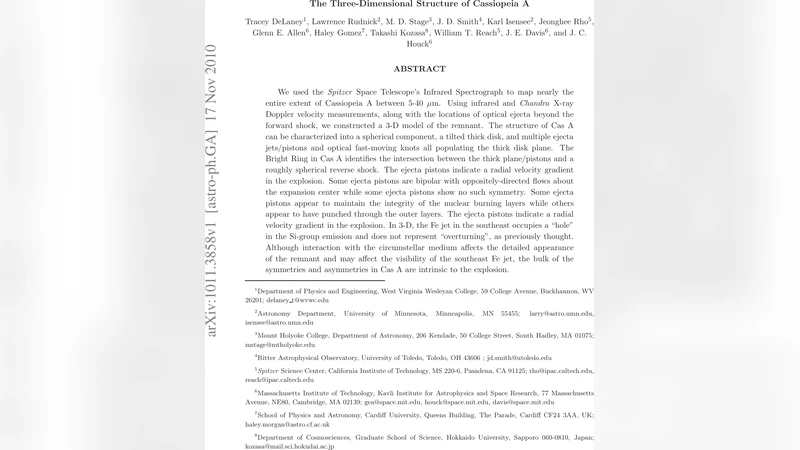
We used the Spitzer Space Telescope’s Infrared Spectrograph to map nearly the entire extent of Cassiopeia A between 5-40 micron. Using infrared and Chandra X-ray Doppler velocity measurements, along with the locations of optical ejecta beyond the forward shock, we constructed a 3-D model of the remnant. The structure of Cas A can be characterized into a spherical component, a tilted thick disk, and multiple ejecta jets/pistons and optical fast-moving knots all populating the thick disk plane. The Bright Ring in Cas A identifies the intersection between the thick plane/pistons and a roughly spherical reverse shock. The ejecta pistons indicate a radial velocity gradient in the explosion. Some ejecta pistons are bipolar with oppositely-directed flows about the expansion center while some ejecta pistons show no such symmetry. Some ejecta pistons appear to maintain the integrity of the nuclear burning layers while others appear to have punched through the outer layers. The ejecta pistons indicate a radial velocity gradient in the explosion. In 3-D, the Fe jet in the southeast occupies a “hole” in the Si-group emission and does not represent “overturning”, as previously thought. Although interaction with the circumstellar medium affects the detailed appearance of the remnant and may affect the visibility of the southeast Fe jet, the bulk of the symmetries and asymmetries in Cas A are intrinsic to the explosion.
💡 Research Summary
The authors present a comprehensive three‑dimensional reconstruction of the Cassiopeia A (Cas A) supernova remnant by combining infrared spectroscopy from the Spitzer Space Telescope’s Infrared Spectrograph (IRS) with Doppler velocity measurements from Chandra X‑ray observations and the spatial distribution of optical fast‑moving knots (FMKs) located beyond the forward shock. The IRS mapping covers nearly the entire remnant in the 5–40 µm band, providing line‑of‑sight velocity information for a wide range of ionic species (e.g., Si, S, Ar, Fe). By aligning these velocity data with the projected positions of the FMKs, the authors generate a volumetric model that reveals the overall geometry of the ejecta.
The reconstructed structure can be described as three distinct components: (1) a roughly spherical outer shell that corresponds to the reverse shock, (2) a thick, tilted disk‑like plane inclined by ~30° to the line of sight, and (3) a series of “pistons” or jets that lie primarily within the disk plane. The pistons exhibit a clear radial velocity gradient, indicating that material was expelled with different speeds depending on direction during the explosion. Some pistons form bipolar pairs with opposite‑directed flows about the expansion centre, while others are unpaired, suggesting a mixture of symmetric and asymmetric outflows.
A key result concerns the southeast Fe‑rich jet. In the 3‑D model this jet occupies a cavity in the Si‑group emission rather than being an over‑turned plume of Fe that has penetrated the outer layers, as previously proposed. The Fe jet therefore does not require large‑scale overturning of nucleosynthetic layers; instead it appears to be a localized, high‑velocity channel within the thick disk that happens to intersect a region of low Si‑group density. The authors argue that circumstellar medium (CSM) interaction modifies the detailed appearance of the jet—e.g., reducing its surface brightness in some sectors—but does not dominate the overall asymmetry.
The “Bright Ring” seen in X‑ray and infrared images is identified as the intersection of the thick disk/pistons with the roughly spherical reverse shock. This explains why the ring is bright: material from the pistons is suddenly decelerated and heated as it encounters the reverse shock, producing enhanced line emission. The distribution of FMKs along the same plane further supports the notion that the disk is a genuine structural feature rather than a projection effect.
From a theoretical perspective, the findings impose stringent constraints on core‑collapse supernova models. Any successful model must reproduce (a) a pronounced, tilted disk of ejecta, (b) a mixture of bipolar and unpaired high‑velocity pistons, (c) preservation of nucleosynthetic layering in some pistons while allowing others to punch through outer layers, and (d) the existence of a localized Fe jet that does not require wholesale overturning. These characteristics point toward intrinsic explosion asymmetries, possibly driven by large‑scale instabilities such as the standing accretion shock instability (SASI), rapid rotation, or strong magnetic fields.
In summary, the paper demonstrates the power of multi‑wavelength, velocity‑resolved mapping for reconstructing supernova remnants in three dimensions. The authors’ model of Cas A reveals that the bulk of its observed symmetries and asymmetries are imprinted by the explosion itself, with circumstellar interaction playing a secondary role in shaping the fine‑scale morphology. The work provides a valuable benchmark for future high‑resolution hydrodynamic simulations aimed at unraveling the physics of core‑collapse supernova explosions.
Comments & Academic Discussion
Loading comments...
Leave a Comment