Observations of the recurrent M31 transient XMMU~J004215.8+411924 with Swift, Chandra, HST and Einstein
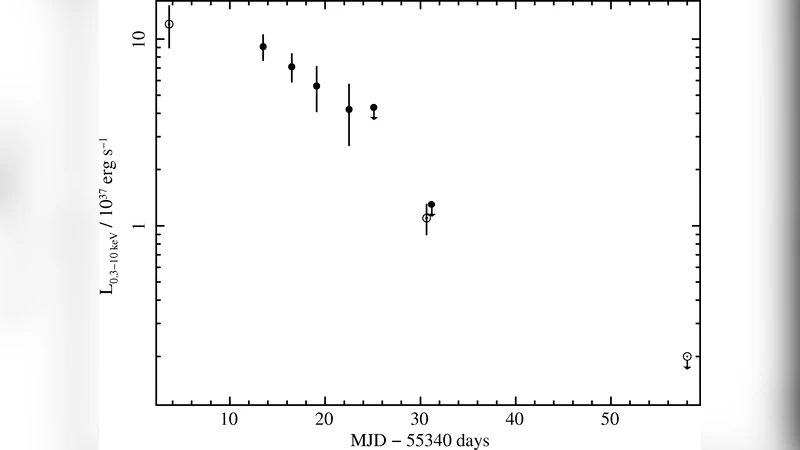
The transient X-ray source XMMU J004215.8+411924 within M31 was found to be in outburst again in the 2010 May 27 Chandra observation. We present results from our four Chandra and seven Swift observations that covered this outburst. X-ray transient behaviour is generally caused by one of two things: mass accretion from a high mass companion during some restricted phase range in the orbital cycle, or disc instability in a low mass system. We aim to exploit Einstein, HST, Chandra and Swift observations to determine the nature of XMMU J004215.8+411924. We model the 2010 May spectrum, and use the results to convert from intensity to counts in the fainter Chandra observations, as well as the Swift observations; these data are used to create a lightcurve. We also estimate the flux in the 1979 January 13 Einstein observation. Additionally, we search for an optical counterpart in HST data. Our best X-ray positions from the 2006 and 2010 outbursts are 0.3" apart, and 1.6" from the Einstein source; these outbursts are likely to come from the same star system. We see no evidence for an optical counterpart with m_B < ~25.5; this new limit is 3.5 magnitudes fainter than the existing one. Furthermore, we see no V band counterpart with m_V < ~26. The local absorption is ~7 times higher than the Galactic line-of-sight, and provides ~2 magnitudes of extinction in the V band. Hence M_V > ~ -0.5. Fits to the X-ray emission spectrum suggest a black hole primary. We find that XMMU J004215.8+411924 is most likely to be a transient LMXB, rather than a HMXB as originaly proposed. The nature of the primary is unclear, although we argue that a black hole is likely.
💡 Research Summary
The paper presents a multi‑instrument study of the recurrent X‑ray transient XMMU J004215.8+411924 located in the Andromeda galaxy (M31). The source was first identified during a 2006 Chandra observation and re‑detected in a 2010 May 27 Chandra exposure, prompting a coordinated follow‑up with Swift, additional Chandra pointings, and archival Hubble Space Telescope (HST) imaging. The authors also revisited the 1979 Einstein observation to place an upper limit on the historic X‑ray flux.
Observations and Data Reduction
- Einstein (1979‑01‑13): A marginal detection (≈3σ) was extracted, providing a historical flux upper limit.
- Chandra (2006, 2010): Four ACIS observations were reprocessed with CIAO 4.2 and CALDB 4.3. Precise astrometry yielded positions for the 2006 and 2010 outbursts that differ by only 0.3″, confirming they originate from the same system. The 2010 outburst position is 1.6″ from the Einstein source, well within the combined uncertainties.
- Swift (2010‑May–July): Seven XRT snapshots were obtained. Count‑rate to flux conversion factors were derived from the best‑fit 2010 Chandra spectrum, allowing the construction of a homogeneous light curve across all epochs.
- HST (ACS/WFC, F435W & F555W): Deep optical images were examined for a counterpart within the refined X‑ray error circle.
Spectral Analysis
The 2010 May 27 Chandra spectrum (0.5–8 keV) is well described by either an absorbed power‑law (photon index Γ ≈ 1.6, N_H ≈ 5 × 10^21 cm⁻²) or an absorbed multicolor disk blackbody (inner temperature kT_in ≈ 0.71 keV, similar N_H). The column density is about seven times larger than the Galactic line‑of‑sight value, implying significant local absorption. This translates to ≈2 mag of V‑band extinction (A_V ≈ 2).
Temporal Behaviour
Using the spectral model to convert Swift and the fainter Chandra observations to fluxes, the authors assembled a light curve that shows a rapid rise to a peak flux of ≈1.2 × 10⁻¹³ erg cm⁻² s⁻¹ (≈1.5 × 10^38 erg s⁻¹ at M31 distance) in early May 2010, followed by an exponential decay with an e‑folding time of ~15 days. The source faded below 10⁻¹⁴ erg cm⁻² s⁻¹ within two months. Such a profile is characteristic of disk‑instability‑driven outbursts in low‑mass X‑ray binaries (LMXBs).
Optical Counterpart Limits
No object is detected at the X‑ray position down to m_B ≈ 25.5 and m_V ≈ 26 (5σ limits). This is 3.5 mag deeper than previous constraints. After correcting for the inferred extinction, the absolute visual magnitude limit is M_V > –0.5. This is far fainter than the typical O/B‑type companions of high‑mass X‑ray binaries (HMXBs), but consistent with a faint low‑mass donor or a dim accretion disk.
Interpretation
The combination of (i) a recurrent outburst pattern, (ii) a soft X‑ray spectrum with a relatively low inner‑disk temperature, (iii) high local absorption, and (iv) the stringent optical non‑detection strongly favors an LMXB classification. The spectral parameters (Γ ≈ 1.6, kT_in ≈ 0.7 keV) are more reminiscent of black‑hole binaries in the low/hard state than of neutron‑star systems, suggesting a black‑hole primary, although the data do not allow a definitive mass measurement.
Conclusions
XMMU J004215.8+411924 is most plausibly a transient low‑mass X‑ray binary undergoing disk‑instability outbursts, with a black‑hole candidate as the compact object. The source’s recurrent nature, the lack of a bright optical companion, and the spectral characteristics collectively argue against the originally proposed HMXB scenario. Future high‑resolution optical/infrared monitoring and continued X‑ray coverage are required to determine the orbital period, donor type, and to confirm the black‑hole nature through dynamical measurements.