Swift follow-up of unidentified X-ray sources in the XMM-Newton Slew Survey
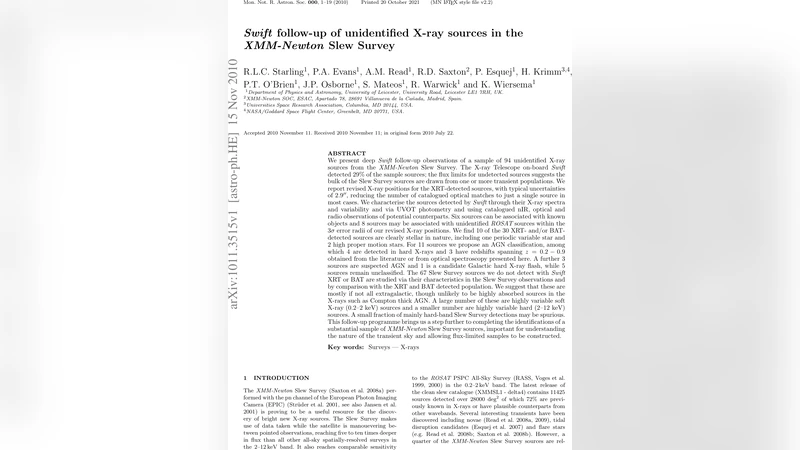
We present deep Swift follow-up observations of a sample of 94 unidentified X-ray sources from the XMM-Newton Slew Survey. The X-ray Telescope on-board Swift detected 29% of the sample sources; the flux limits for undetected sources suggests the bulk of the Slew Survey sources are drawn from one or more transient populations. We report revised X-ray positions for the XRT-detected sources, with typical uncertainties of 2.9", reducing the number of catalogued optical matches to just a single source in most cases. We characterise the sources detected by Swift through their X-ray spectra and variability and via UVOT photometry and catalogued nIR, optical and radio observations. Six sources can be associated with known objects and 8 may be associated with unidentified ROSAT sources within the 3-sigma error radii of our revised X-ray positions. We find 10 of the 30 XRT-detected sources are clearly stellar in nature, including one periodic variable star and 2 high proper motion stars. For 11 sources we propose an AGN classification, among which 4 are detected with BAT and 3 have redshifts spanning z = 0.2 - 0.9 obtained from the literature or from optical spectroscopy presented here. The 67 Slew Survey sources we do not detect with Swift are studied via their characteristics in the Slew Survey and by comparison with the XRT and BAT detected population. We suggest that these are mostly if not all extragalactic, though unlikely to be highly absorbed sources in the X-rays such as Compton thick AGN. A large number of these are highly variable soft X-ray sources. A small fraction of mainly hard-band detections may be spurious. This follow-up programme brings us a step further to completing the identifications of a substantial sample of XMM-Newton Slew Survey sources, important for understanding the nature of the transient sky and allowing flux-limited samples to be constructed.
💡 Research Summary
The paper reports on a systematic Swift follow‑up of 94 X‑ray sources that were detected in the XMM‑Newton Slew Survey but remained unidentified in existing catalogs. Using the Swift X‑ray Telescope (XRT), the Ultraviolet/Optical Telescope (UVOT), and the Burst Alert Telescope (BAT), the authors obtained deep (∼5 ks) observations of each target. XRT detected 30 of the 94 sources, corresponding to a detection fraction of 29 %. For the detected sources the authors refined the X‑ray positions to a typical 1‑σ uncertainty of 2.9 arcseconds, a substantial improvement over the original Slew Survey error circles that often spanned tens of arcseconds. This positional refinement dramatically reduced the number of possible optical/infrared counterparts, usually leaving a single plausible match.
Spectral analysis of the XRT detections was performed using absorbed power‑law models, with photon indices Γ ranging from roughly 1.5 to 2.2 and column densities N_H typically of order 10²² cm⁻². A subset of sources required an additional soft thermal component, indicative of stellar coronal emission or cataclysmic variables. Variability was assessed by comparing the Swift fluxes with those reported in the Slew Survey; many sources showed changes of an order of magnitude or more, especially in the soft (0.2–2 keV) band, suggesting that the Slew sample contains a substantial transient component.
Multi‑wavelength cross‑matching with cataloged optical, near‑infrared, and radio data, together with UVOT photometry, allowed the authors to classify the XRT‑detected sources. Ten objects are clearly stellar: they include a periodic variable star, two high‑proper‑motion stars, and several active late‑type dwarfs. Eleven sources are identified as active galactic nuclei (AGN). Four of these are also detected by BAT, confirming hard X‑ray emission, and three have published redshifts (z ≈ 0.2–0.9) obtained either from the literature or from new optical spectroscopy presented in the paper. Six sources could be associated with previously known objects, and eight lie within 3‑σ of unidentified ROSAT detections.
The remaining 64 Slew Survey sources that were not detected by Swift were examined using their Slew Survey properties. Most of these are soft‑band detections with large flux variability, implying that they are likely to be transient extragalactic objects such as low‑luminosity AGN, tidal disruption events, or highly variable quasars, rather than heavily absorbed (Compton‑thick) AGN. A small fraction of hard‑band‑only detections may be spurious, given the lack of corroborating BAT or XRT signals. The authors argue that the non‑detections are unlikely to be dominated by heavily obscured sources because such objects would be expected to appear in BAT or to retain a detectable soft component in deeper XRT exposures.
Overall, the study demonstrates that the unidentified X‑ray population in the XMM‑Newton Slew Survey is dominated by two classes: (1) variable stellar sources (including flaring stars and cataclysmic variables) and (2) variable extragalactic sources, primarily AGN with moderate absorption. The high‑precision Swift positions and the multi‑wavelength characterization provide a roadmap for completing the identification of the Slew Survey catalog, enabling the construction of flux‑limited samples and improving our understanding of the transient X‑ray sky. The work also highlights the importance of coordinated follow‑up observations to capture the fleeting nature of many X‑ray transients and to distinguish genuine astrophysical sources from statistical fluctuations.
Comments & Academic Discussion
Loading comments...
Leave a Comment